The Challenge of Complex AI Task Decomposition
Modern AI systems, particularly large language models (LLMs), are increasingly tasked with complex, multi-step problems. A common approach involves breaking down a large task into smaller, manageable sub-tasks. However, efficiently executing these sub-tasks, especially when they can be performed independently, presents a significant orchestration challenge. Traditional sequential processing can lead to bottlenecks, unnecessarily extending completion times. The need for parallel execution of independent sub-tasks by specialized AI agents is becoming paramount for scaling AI capabilities.
Consider a scenario where an AI needs to research a topic, draft an article, and then create social media posts about it. Each of these could be handled by a distinct agent. If the drafting and social media creation steps don't strictly depend on the *completion* of the research (but rather on its *output*), they could potentially run in parallel with other research sub-tasks or even commence as soon as initial research data is available.
Introducing Parallel Async Child Agents
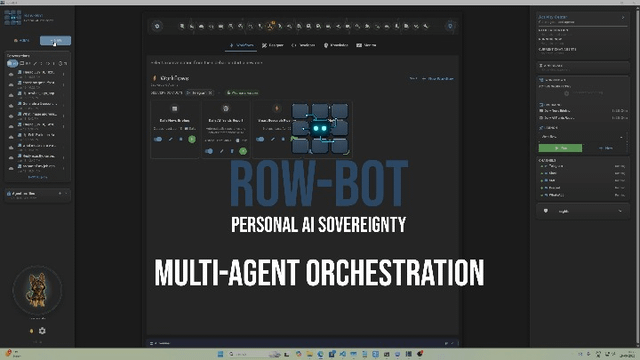
The open-source project, found at github.com/siddsachar/row-bot, tackles this by implementing a parent agent that delegates work to multiple asynchronous child agents. This architecture allows for significant performance gains by enabling concurrent processing. Instead of waiting for one agent to finish before the next begins, the parent agent can dispatch tasks to several child agents simultaneously, each operating independently and in parallel.
The core mechanism involves the parent agent managing a queue of tasks and assigning them to available child agents. These child agents, once assigned a task, execute it and return their results. The parent agent collects these results, potentially aggregating them or using them to inform subsequent delegation. The asynchronous nature is key here; it means that the parent agent doesn't block while waiting for a single child agent to respond. It can continue to manage other agents or tasks, creating a highly responsive and efficient system.
This pattern is particularly useful for scenarios involving data collection, processing, or analysis where different data streams or types can be handled by separate agents concurrently. For instance, an agent tasked with summarizing market trends could delegate the fetching of data from various financial news sources to multiple child agents. Each child agent would fetch data from a different source, and their results would be aggregated by the parent agent for the final summary.
Technical Implementation and Benefits
The implementation likely leverages modern concurrency patterns found in languages like Python, which are popular for AI development. Libraries for asynchronous programming (like asyncio) are crucial for managing the parallel execution of these child agents without blocking the main thread of the parent agent. This allows for a high degree of scalability; as the complexity of the task or the volume of data increases, more child agents can theoretically be spun up to handle the load.
The primary benefit of this multi-agent orchestration is increased throughput and reduced latency. By processing tasks in parallel, the overall time to complete a complex operation is significantly shortened. This is analogous to a project manager assigning different parts of a large project to different team members simultaneously, rather than having one person complete each part sequentially. The project finishes much faster.
Furthermore, this approach enhances modularity and fault tolerance. Each child agent can be designed and optimized for a specific sub-task. If one child agent encounters an error or fails, it doesn't necessarily bring down the entire system. The parent agent can be designed to detect the failure, potentially re-assign the task to another agent, or simply proceed with the results from the successful agents.
Implications for AI Development and Deployment
This pattern of multi-agent orchestration has broad implications for how AI systems are designed and deployed. It moves beyond monolithic AI models towards more distributed, composable systems. Developers can build specialized agents for specific functions and then orchestrate them to tackle problems that would be too complex or time-consuming for a single agent.
For users, this means faster response times and the ability for AI to handle more sophisticated workflows. Imagine an AI assistant that can simultaneously book flights, reserve hotels, and add events to your calendar, all without making you wait for each step to complete before the next one begins. Or consider scientific research where multiple agents can independently run simulations, analyze datasets, or review literature, accelerating the pace of discovery.
The open-source nature of projects like row-bot is also critical. It allows the community to build upon, refine, and adapt these orchestration patterns. As LLMs become more capable, the ability to effectively manage and coordinate multiple instances of these models, or specialized agents derived from them, will be a key differentiator in building powerful AI applications.
Future Directions and Unanswered Questions
While parallel execution is a significant step, several questions remain for advanced multi-agent systems. How do parent agents best learn to decompose tasks optimally? What are the most effective strategies for inter-agent communication and synchronization beyond simple result passing? And critically, how do we ensure robust error handling and recovery when dozens or hundreds of agents are operating concurrently? The current project provides a foundational pattern, but the sophisticated management of emergent behaviors and complex dependencies in large-scale multi-agent systems is an active area of research and development.