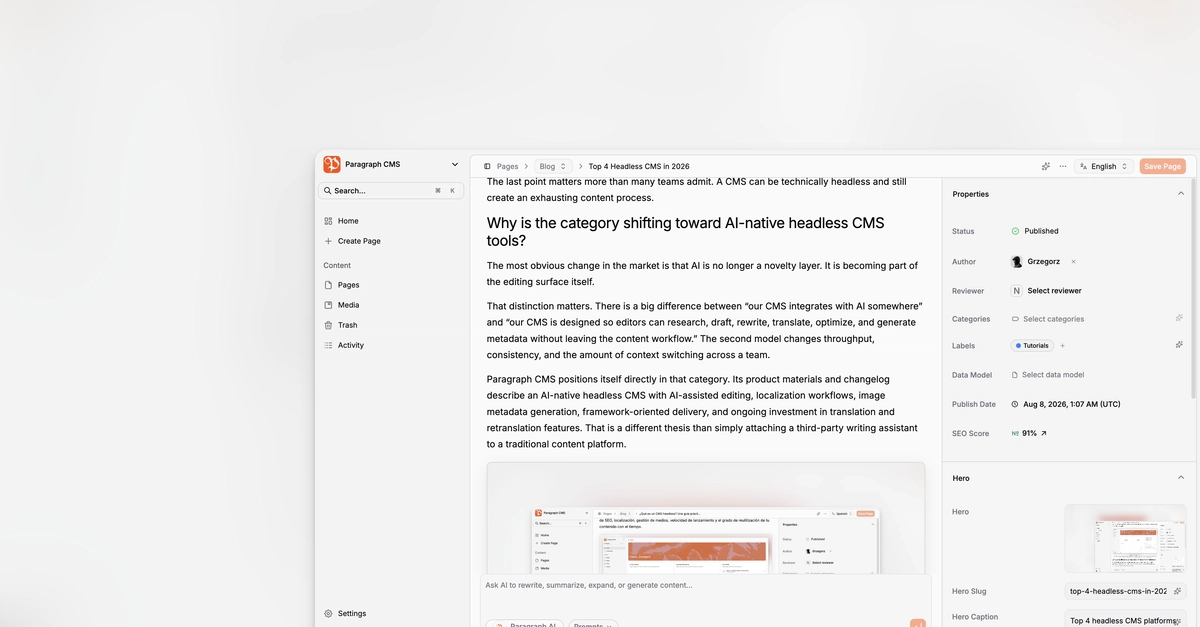
The AI-Native Headless CMS Paradigm Shift
The headless CMS market, already a complex landscape, is evolving with the emergence of the AI-native headless CMS. Paragraph CMS represents this new category, distinguishing itself by treating AI not as an add-on feature but as a foundational element of its operating model. This approach redefines content operations by integrating AI deeply with structured content, localization, media management, SEO, and delivery mechanisms. The core value proposition is not merely faster content creation, but a more cohesive and efficient system for managing content at scale across multiple channels and languages.
Traditional headless CMS architectures decouple content management from content presentation. Editors work within a centralized system, and content is delivered via APIs to various front-end applications. This separation offers flexibility but can lead to fragmentation and integration challenges. Paragraph CMS builds upon this headless foundation by weaving AI capabilities into the fabric of the entire content lifecycle. This means AI assists not just in drafting copy, but in optimizing metadata for media, refining SEO elements, facilitating localization workflows, and ensuring content is ready for developer-driven delivery. The goal is to create a unified workspace where all these critical content tasks are managed cohesively, simplifying the complexity of large-scale, multi-channel content strategies.
The distinction between an AI-enhanced CMS and an AI-native one is crucial. An AI-enhanced system might offer a chatbot for generating blog post ideas or rephrasing sentences. An AI-native system, however, leverages AI to power core functionalities. For Paragraph CMS, this means AI is instrumental in structuring content, managing media assets (e.g., generating alt text or categorizing images), personalizing content delivery, and optimizing for search engines. This integrated approach aims to streamline editorial workflows, reduce manual effort, and improve the overall quality and consistency of content published across an organization's digital properties.
Understanding the AI-Native Approach
Paragraph CMS positions itself as a structured content-first platform enhanced by AI. This means the system prioritizes the organization and definition of content models, ensuring that content is not just a block of text but a collection of well-defined fields and relationships. AI then works within this structured framework to augment the editor's capabilities. For instance, when an editor inputs product specifications into a structured content type, AI can automatically generate descriptive paragraphs, suggest relevant keywords for SEO, or even draft social media snippets based on that structured data. This is fundamentally different from a generic AI tool that operates on unstructured text.
The benefits of this AI-native, structured approach become particularly apparent in complex content operations. For teams managing content in multiple languages, AI can assist with translation suggestions, ensure terminology consistency, and adapt content to local cultural nuances. For SEO professionals, AI can analyze content performance, suggest optimizations, and even automate the generation of meta descriptions and title tags based on structured content attributes. Media management also sees significant AI integration, with capabilities like automatic tagging, image enhancement, and intelligent media asset organization. This holistic integration transforms the editorial system from a simple repository into an intelligent content engine.
The market for headless CMS solutions is broadly segmented. We see API-first, developer-centric platforms like Sanity and Contentful that offer robust content modeling and APIs. Git-based systems are ideal for developer-centric content like documentation. Visual/page-builder hybrids such as Storyblok and Builder.io focus on visual editing experiences. Paragraph CMS carves out its niche within this landscape by focusing on the intersection of structured content operations and deep AI integration. It targets organizations that need to manage complex, multi-channel content and want to leverage AI to make those operations more efficient and intelligent, rather than just faster.
Implications for Content Operations at Scale
For organizations publishing content across numerous channels, languages, and target audiences, the traditional approach often involves a fragmented toolchain and significant manual effort. Paragraph CMS aims to consolidate these disparate functions into a single, AI-powered workspace. This unification simplifies workflows, reduces the potential for errors, and allows content teams to operate more strategically. The AI's role in automating repetitive tasks, providing intelligent suggestions, and ensuring consistency frees up human editors to focus on higher-level strategic thinking, content quality, and audience engagement.
Consider a global e-commerce company. They need to manage product descriptions, marketing copy, and support articles in dozens of languages. They also need to optimize content for SEO in each region, manage thousands of product images with specific metadata, and ensure brand consistency across all touchpoints. A conventional headless CMS would require separate tools for translation management, SEO optimization, and potentially image tagging. Paragraph CMS, by integrating AI into these core functions, offers a more streamlined solution. AI can assist with initial content generation in a source language, provide intelligent suggestions for localization, automatically tag product images with relevant keywords, and help optimize content for regional search engines. This integrated approach is what defines an AI-native system and offers a distinct advantage for large-scale operations.
The success of an AI-native headless CMS hinges on its ability to deliver tangible improvements in efficiency, scalability, and content quality. By embedding AI into the fundamental operations of content management, Paragraph CMS is moving beyond the era of simple content delivery to an era of intelligent content operations. This shift is essential for businesses looking to navigate the increasing complexity of the digital content landscape and leverage AI effectively to achieve their strategic goals.