The Need for Quality: Beyond Bug-Free Execution
Building an AI agent is more than just ensuring it doesn't crash. In the previous installment, the agent successfully navigated an e-commerce workflow: searching for a product, adding it to the cart, requesting an address, and stopping at the confirmation page. While this demonstrated functional correctness and adherence to state machine logic, it didn't answer the critical question: "Is it actually good?" A bug-free agent can still deliver suboptimal customer experiences, such as providing inaccurate shipping timelines. This gap, where qualitative performance is unmeasured, is precisely what this part of the series addresses.
The core problem is that traditional testing methods, like the 31 passing unit tests from Part 6, prove the agent is free of defects but cannot evaluate the quality of its output. These tests verify that the agent performs actions correctly but do not assess the *effectiveness* or *appropriateness* of its responses in a real-world customer interaction. The promise from Part 7 was to build an evaluation harness, transforming subjective assessments like "is it good?" into objective scores. This installment delivers on that promise by introducing an LLM-as-a-judge framework.
Introducing the LLM Judge Harness
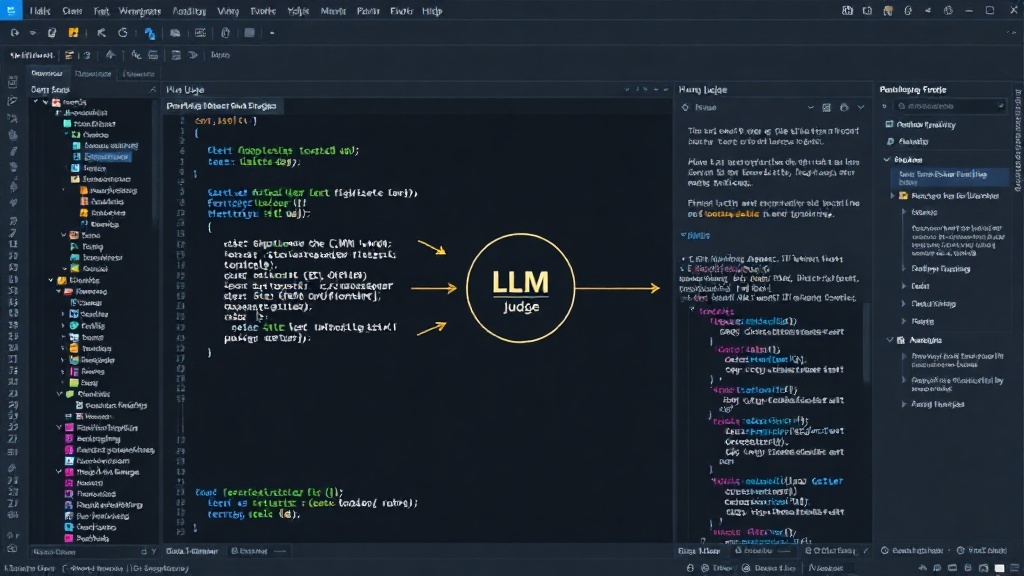
The solution involves leveraging a Large Language Model (LLM) itself to act as a judge. This harness is designed to evaluate the agent's performance by analyzing its interactions and assigning a score. The process begins by defining the criteria for a "good" agent interaction. This includes factors like clarity of communication, accuracy of information provided, adherence to business rules (e.g., correct shipping estimates), and overall helpfulness to the user.
The harness works by feeding the agent's interaction logs to the LLM judge. The LLM is prompted with specific instructions, including the context of the interaction, the agent's goal, and the desired quality metrics. It then analyzes the dialogue, comparing the agent's responses against these criteria. For instance, if the agent was supposed to provide a shipping estimate, the LLM judge would verify if the estimate given was accurate based on known business rules or external data, and if it was communicated clearly to the user.
Defining Evaluation Metrics and Prompts
Crafting effective prompts for the LLM judge is paramount. The prompts must be detailed enough to guide the LLM towards accurate and consistent evaluations. They typically include:
- Context: The scenario of the customer interaction.
- Agent's Goal: What the agent was trying to achieve.
- User Input: The customer's queries or statements.
- Agent's Output: The agent's responses.
- Evaluation Criteria: Specific aspects to score, such as accuracy, clarity, helpfulness, and efficiency.
- Scoring Scale: A defined scale (e.g., 1-5) for each criterion.
For example, a prompt might ask the LLM to score the agent's response to "What is the shipping time?" on a scale of 1 to 5 for accuracy and clarity, based on the provided business rule that shipping takes 3-5 business days. The LLM would then analyze the agent's reply and assign scores accordingly.
Integrating the Judge into the Spring Boot Application
The LLM judge harness is integrated into the existing Spring Boot application. This allows for automated evaluation as part of the development and deployment pipeline. The application orchestrates the agent's interaction, collects the logs, and then submits them to the LLM judge service. The results are aggregated, providing a performance score for each interaction or a series of interactions.
This integration means that "is it good?" can now be quantified. Instead of relying on manual review or subjective feedback, developers and product managers can get a data-driven assessment of the agent's performance. This score can be tracked over time, used to compare different agent versions, and trigger alerts if performance drops below a certain threshold. This moves the agent development process from a purely functional testing phase to a quality assurance phase that mirrors user experience.
The Future of Agent Evaluation
This LLM judge is a significant step towards building production-ready AI agents. It provides a mechanism to measure and improve the qualitative aspects of agent performance, which are often the most critical for user satisfaction and business outcomes. While this implementation uses an LLM as the judge, future iterations could explore more sophisticated evaluation techniques, potentially involving human-in-the-loop systems for complex edge cases or reinforcement learning to continuously optimize agent responses based on judge feedback.
The ability to score agent performance objectively transforms how we build and deploy these systems. It allows for a more rigorous approach to quality assurance, ensuring that agents are not just functional but truly effective and valuable to users. This moves the needle from simply having an agent to having a *great* agent.