
Introducing Panel: An Agent-Native Research Environment
A recent Hacker News 'Show HN' post unveiled Panel, an ambitious project aiming to redefine the research workspace for artificial intelligence. The core innovation lies in its design: Panel is built to be an environment where AI agents, not just humans, can construct and manage their own analytical tools, or "panes." This represents a significant shift from traditional research tools, which are typically designed and manipulated by human users.
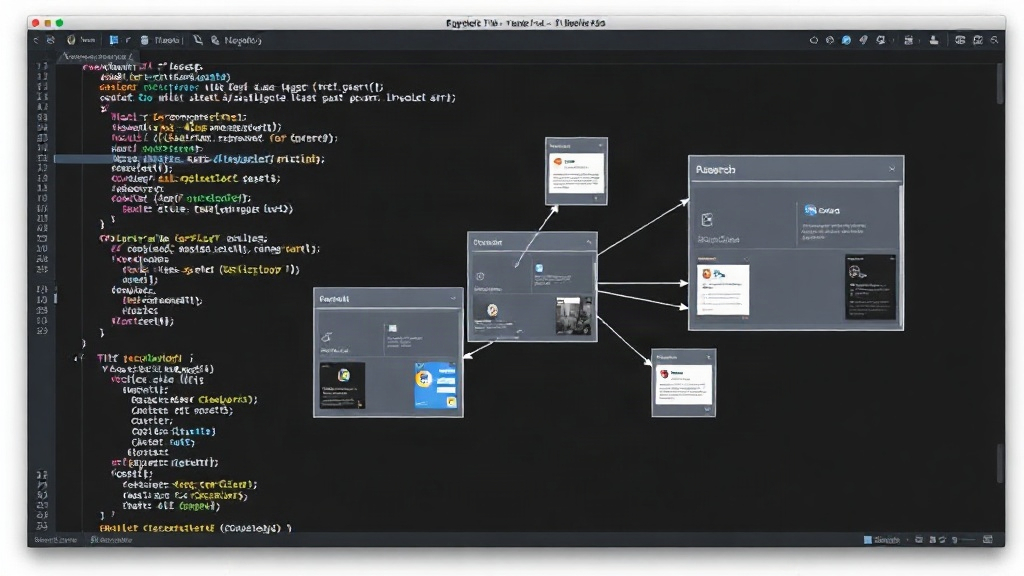
The project, shared by GitHub user greentfrapp, positions Panel as a dynamic workspace. Instead of a static interface with pre-defined widgets, Panel allows AI agents to dynamically create, arrange, and interact with custom panes tailored to their specific research tasks. Imagine an AI researcher needing to analyze a dataset. Instead of a human programmer writing code to create a visualization pane, Panel enables the AI agent itself to generate that pane, populate it with relevant data, and use it for its analysis. This self-directed creation of tools is the project's central thesis.
The implications for AI research are substantial. Current AI development often involves a human-in-the-loop for every step of analysis and experimentation. Panel suggests a future where AI agents can operate with greater autonomy, managing their own computational environments and analytical components. This could dramatically accelerate the pace of discovery, particularly in complex domains where rapid iteration and custom tooling are essential.
How Panel Empowers Autonomous Agents
At its heart, Panel functions as an interpreter and orchestrator for AI agents. The agent's objective is communicated to Panel, and the system then facilitates the agent's ability to define, instantiate, and manage various 'panes.' These panes are essentially modular components that can perform specific tasks, such as data visualization, statistical analysis, text summarization, or even interaction with external APIs. The agent decides which panes are needed, how they should be configured, and how they should interact with each other.
Consider a scenario where an AI agent is tasked with exploring a large corpus of scientific literature to identify emerging trends. The agent might first create a 'search pane' to query databases. Based on the initial results, it might then instantiate a 'keyword extraction pane' to identify key terms, followed by a 'visualization pane' to map the relationships between these terms over time. If the visualization reveals an unexpected cluster, the agent could then create a 'summarization pane' to generate abstracts for relevant papers within that cluster. This entire workflow is constructed and managed by the agent, with Panel providing the underlying framework.
The project's structure suggests a flexible architecture. While the specifics of the agent's internal reasoning engine are separate from Panel, Panel provides the interface through which the agent can express its intent and manipulate its workspace. This is akin to how a human researcher uses a graphical user interface (GUI) to arrange windows, run applications, and process information, but here, the 'user' is an AI.
The 'Show HN' Reaction and Future Potential
The Hacker News community's reaction to Panel highlights its novelty. Users expressed excitement about the potential for AI agents to become more self-sufficient in their research endeavors. The discussion touched upon the challenges of designing interfaces for non-human users and the philosophical implications of AI agents managing their own analytical environments. Questions arose about the agent's ability to self-correct, learn from its pane-building experiences, and handle complex, multi-step research problems.
One of the most intriguing aspects of Panel is its potential to democratize advanced AI research. By abstracting away the complexities of interface design and tool management, Panel could enable researchers to focus on higher-level problem-solving. It also opens up possibilities for creating specialized AI research assistants that can be tailored to specific scientific disciplines, from drug discovery to climate modeling.
The project is currently shared as a 'Show HN,' indicating it's an early-stage demonstration of a concept. The immediate utility for developers lies in understanding this new paradigm for human-AI collaboration in research. For founders, it signals a potential future direction for AI development platforms and research infrastructure. The ability for AI to self-organize its analytical tools could lead to entirely new classes of AI-powered discovery engines.
Unanswered Questions in Agent-Driven Research
What nobody has addressed yet is the scalability and robustness of such a system. If an agent can build its own panes, can it also debug them when they fail? How does Panel handle resource management when an agent might, in theory, create an unbounded number of complex panes? Furthermore, how do we ensure the integrity and reproducibility of research conducted by agents that are dynamically constructing their own experimental setups? These are critical questions for the future development and adoption of agent-native research environments.
Panel represents a bold step towards more autonomous AI systems. Its success will depend on how effectively it can bridge the gap between an agent's conceptual understanding of a research problem and its ability to translate that understanding into a functional, interactive workspace. The project invites a re-evaluation of what a 'research workspace' truly means in the age of advanced AI.