
The Problem with Pages
Operating systems manage memory in fixed-size blocks called pages, typically 4KB. While this offers benefits like inherent memory alignment, it creates new problems. Requesting a page from the OS is efficient if you need a large contiguous block, but what if you only need a small amount of data, like a single byte or a small struct? The OS still gives you a whole page, leading to significant wasted memory. This is the core challenge addressed by page-based memory allocation solutions.
Memory Alignment: A Necessary Evil
Modern 64-bit architectures read data from RAM in 8-byte chunks, or "words." If data isn't aligned to these word boundaries, the CPU must perform multiple memory reads to fetch a single variable. This is slow and inefficient. The OS's page-based allocation helps here by providing memory chunks already aligned to 4096-byte boundaries. However, if a small variable like a `char` is placed at the beginning of a page, the system might add "filler" bytes (padding) to ensure the next variable is aligned. This padding, while necessary for performance, contributes to memory waste when dealing with many small allocations.
Introducing the Free-List Allocator
To combat the inefficiency of requesting full pages for small data needs, a common solution is the free-list allocator. This approach manages memory within a single page, or a pre-allocated larger chunk, by dividing it into smaller, fixed-size blocks. When memory is requested, the allocator checks its list of available (free) blocks. If a suitable block is found, it's allocated and removed from the free list. When memory is no longer needed, it's returned to the allocator and added back to the free list, ready for reuse. This prevents constant requests to the OS for new pages and significantly reduces fragmentation and waste.
How the Free List Works
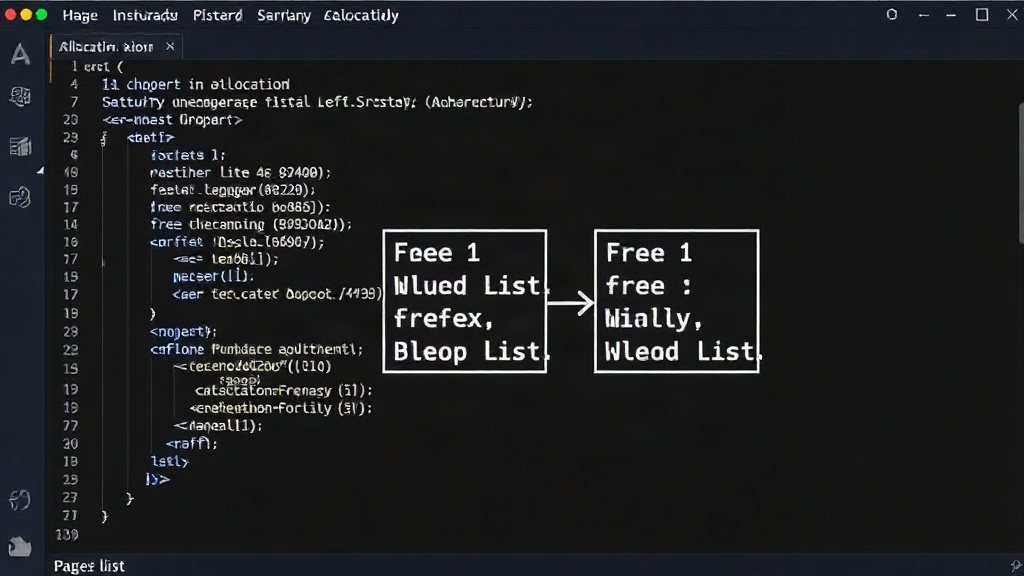
A free-list allocator typically maintains a linked list of available memory blocks. Each block on the free list contains a pointer to the next free block. When a request for memory of a specific size comes in, the allocator searches this list. It might select the first available block that is large enough (first-fit), the smallest block that is large enough (best-fit), or the largest block that is large enough (worst-fit). The choice impacts performance and fragmentation. Once a block is allocated, it's removed from the free list. When a block is freed, it's added back to the free list, often at the head for quick access.
Managing Varying Sizes
A challenge arises when applications need to allocate blocks of different sizes. A simple free-list might become inefficient if blocks are of vastly different sizes. To address this, sophisticated allocators often use multiple free lists, each dedicated to a specific block size. For example, one list might hold all available 8-byte blocks, another for 16-byte blocks, and so on. When a request comes in, the allocator consults the appropriate list. If an exact match isn't found, it might split a larger block to satisfy the request, adding the remainder back to the appropriate free list. This strategy is known as a segregated free list or binning.
The Trade-offs and Complexity
While free-list allocators are highly effective at reducing internal fragmentation (wasted space within an allocated block) and external fragmentation (wasted space between allocated blocks), they introduce their own complexities. The management of the free lists themselves requires overhead. Searching through lists, splitting blocks, and merging freed blocks can consume CPU cycles. Furthermore, choosing the right allocation strategy (first-fit, best-fit, etc.) and managing multiple free lists requires careful design and tuning to achieve optimal performance for a given workload. The