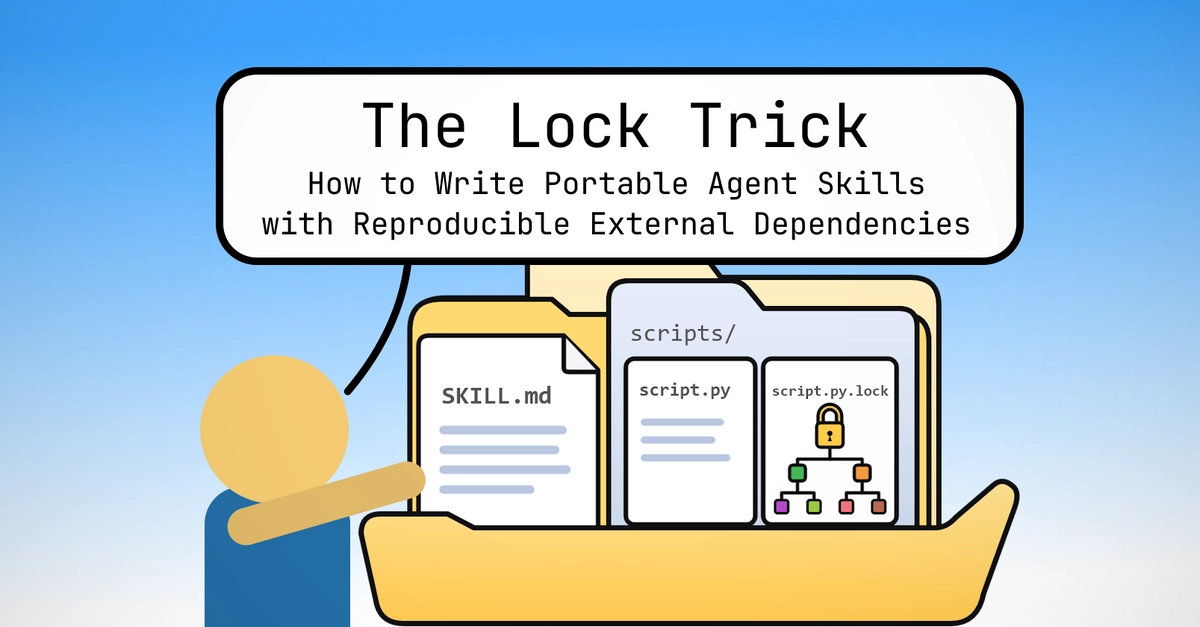
The Challenge of Agent Skill Dependencies
Developing AI agent skills, particularly in enterprise settings, often involves orchestrating complex workflows. While the entry point may be natural language, many underlying processes are deterministic, involving tasks like JSON transformations, HTML rendering, conditional logic, and basic classification. The core problem arises when these skills rely on external tools or libraries. Ensuring these dependencies are met consistently across different execution environments—development, staging, and production—is a significant hurdle. Without a robust dependency management strategy, skills can behave unpredictably, leading to errors and a loss of trust in the agent's capabilities.
Traditional package managers often fall short for agent skills. They might handle system-level dependencies but struggle with the specific versions or configurations required by a particular skill. This can lead to a "works on my machine" scenario, where a skill functions perfectly for the developer but fails when deployed. The lack of reproducible environments means that even if a skill works today, a future update to a shared dependency could break it without warning. This fragility is a critical issue for enterprises that depend on these skills for core business processes.
Introducing The Lock Trick
The "Lock Trick" proposes a novel approach to managing external dependencies for agent skills. At its heart, it’s about creating a snapshot of the exact dependencies a skill requires, along with their specific versions and configurations. This snapshot acts as a lock file, ensuring that when the skill is deployed, it pulls in precisely the same set of dependencies that were tested and verified.
Think of it less like a standard software package manager and more like a meticulously curated recipe card for your skill. This recipe doesn't just list the ingredients (dependencies); it specifies the exact brand, quantity, and even the preparation method (version and configuration) for each. This level of detail prevents substitutions or variations that could alter the final outcome of the skill.
The implementation involves creating a dedicated dependency file, often named something like dependencies.lock or skill.lock. This file is generated by a specific tool or script that analyzes the skill's requirements. When a developer writes or updates a skill, they run this tool, which then consults the skill's explicit dependencies (e.g., listed in a requirements.txt or package.json) and resolves them to their exact versions. This resolution process considers not only direct dependencies but also transitive dependencies, ensuring a complete and accurate lock file.
Reproducibility and Portability
The primary benefit of the Lock Trick is enhanced reproducibility. By locking down dependencies, developers can guarantee that a skill will behave identically across any environment where it's deployed, provided the environment can execute the locked dependencies. This eliminates the ambiguity and variability that plague traditional deployment pipelines.
Portability is a direct consequence of reproducibility. A skill that is guaranteed to work consistently is inherently portable. It can be moved between different machines, cloud environments, or even different agent platforms with a high degree of confidence. This is invaluable for organizations that operate in hybrid cloud setups or need to migrate their agent infrastructure over time. The lock file acts as a portable contract, defining the skill's operational environment.
Implementation Details and Considerations
The practical implementation of the Lock Trick can vary. One approach involves using a containerization technology like Docker. A Dockerfile can be constructed to install the exact versions of all required libraries and tools. The dependencies.lock file would then dictate the contents of this Docker image. When the agent skill needs to run, it executes within this pre-configured container, ensuring isolation and consistency.
Another method could involve a custom script that uses existing package managers (like pip for Python or npm for Node.js) but enforces strict version pinning based on the lock file. This script would be responsible for installing dependencies exactly as specified. The challenge here is ensuring that the script correctly handles all types of dependencies, including system libraries or specific binary versions that might not be easily managed by standard package managers.
The key is the generation process. A robust dependency resolution algorithm is crucial. This algorithm must be capable of traversing dependency trees, resolving version conflicts, and producing a deterministic output. The output format of the lock file should be machine-readable, easily parsable, and human-inspectable where possible. JSON or YAML are common choices for this purpose.
Broader Implications for Agent Development
The Lock Trick has significant implications for the broader ecosystem of agent development. It addresses a fundamental pain point that has hindered the reliable deployment of complex agent functionalities. For developers, it means less time spent debugging environment-specific issues and more time focusing on building core skill logic.
For enterprises, it translates to increased reliability and reduced operational overhead. When agent skills are dependable, they can be integrated more deeply into business-critical workflows. This fosters greater adoption of AI agents within organizations, moving them from experimental tools to essential components of the operational stack.
What remains to be seen is how widely this pattern will be adopted and whether standard platforms will begin to incorporate similar dependency locking mechanisms natively. Currently, it appears to be a developer-driven best practice, but its utility suggests it could become a foundational element of agent skill development frameworks.