The Problem: Freelance Deals Get Bogged Down
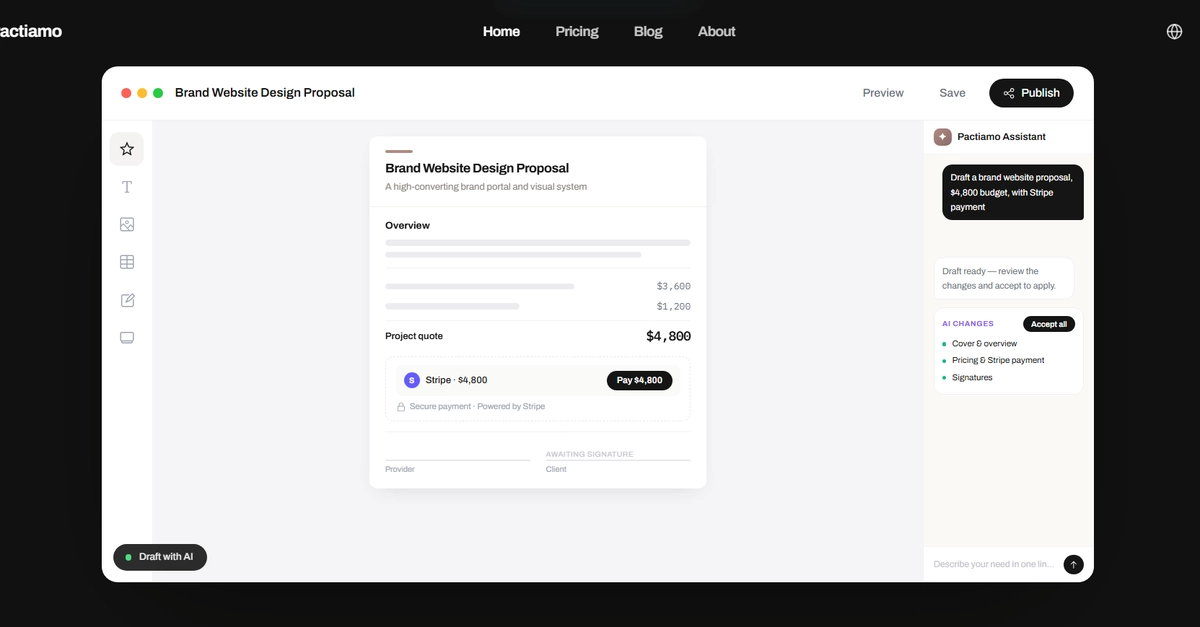
The freelance economy thrives on agility, but the administrative overhead can kill deals. Imagine this: a client agreement starts with a proposal document, moves to a PDF for the contract, requires an electronic signature, and finally, a separate payment link. Each step is a potential dropout point, a place where enthusiasm wanes and a deal can simply evaporate. This fragmentation, the painful gap between tools, is what Miguel Ángel (Migu) created Pactiamo to solve. His goal was simple: collapse the entire freelance deal lifecycle into a single, shareable link.
Building a product solo presents unique challenges. Every decision carries significant weight, and there’s no engineering team to delegate to. Migu recently shared his journey building Pactiamo, highlighting five critical decisions that shaped the product and its architecture. These aren't just technical choices; they are strategic moves born from a deep understanding of the freelance pain points.
Decision 1: Zero Client Accounts, Maximum Friction Reduction
Perhaps the most counterintuitive decision Migu made was to eliminate client accounts entirely. The rationale is stark: every signup screen, every login prompt is a hurdle. It’s another opportunity for a potential client to decide the process is too complex and walk away. For Pactiamo, the user experience for the client signing a contract or making a payment had to be frictionless. This principle drove the architecture more than any specific technology choice.
The public share page for contracts is server-rendered. This ensures it loads quickly and functions reliably, even on slow internet connections, without requiring heavy JavaScript to hydrate. This was a deliberate choice to accommodate users in regions with less robust infrastructure or those on mobile devices with limited bandwidth. The system captures signatures without requiring authentication, instead directly recording the signer’s identity—name, email, and a timestamp—alongside the signature itself. This focus on a seamless client experience, prioritizing conversion over account creation, is a powerful differentiator in a crowded SaaS landscape.
Decision 2: No Touching the Money, No Percentage Taken
Migu’s second key decision was to never touch the money. Pactiamo doesn’t process payments directly, nor does it take a percentage of transactions. Instead, it integrates with payment processors like Stripe. This architectural choice has significant implications. Firstly, it bypasses the complexities and regulatory burdens associated with handling financial transactions directly. This includes PCI compliance, managing chargebacks, and dealing with various tax regulations across different jurisdictions. By acting as an intermediary that facilitates the connection between client and payment processor, Pactiamo significantly reduces its own operational complexity and liability.
Secondly, this approach aligns with a trust-based model. Clients are reassured that their payment is going directly to the freelancer, not being held or processed by a third-party platform that takes a cut. This builds confidence and can contribute to higher conversion rates for freelancers using the tool. For a solo founder, minimizing operational complexity and regulatory risk is paramount. This decision allows Migu to focus on product development and core features, rather than on the intricate and often costly world of payment processing and financial compliance.
Decision 3: Leveraging Server-Side Rendering for Performance and Accessibility
The commitment to server-side rendering (SSR) for public-facing pages, particularly contract signing pages, is a testament to Migu’s user-centric approach. In an era dominated by Single Page Applications (SPAs) that rely heavily on client-side JavaScript, choosing SSR is a deliberate move to prioritize performance and accessibility. SPAs can suffer from slow initial load times, especially on less powerful devices or slower networks, as they need to download, parse, and execute JavaScript before rendering content. Server-rendered pages, in contrast, send fully formed HTML to the browser, allowing users to see content almost immediately.
This strategy is particularly effective for documents that need to be signed quickly and efficiently. A contract signing page isn't typically a highly interactive application; it’s a static document that requires a signature. Optimizing for rapid display and minimal user interaction, without relying on JavaScript for core content rendering, ensures that the process is as smooth as possible for the end-user. It also improves SEO for any publicly accessible contract pages, though that is a secondary benefit to the primary goal of conversion optimization.
Decision 4: A Minimalist Tech Stack Built for Speed
Migu opted for a deliberately minimalist tech stack. For the backend, he chose Node.js with Express.js, a common and robust combination for building web applications. For the frontend, he utilized EJS (Embedded JavaScript templating), which is a simple templating engine that works well with server-side rendering. The database is PostgreSQL, a powerful and reliable relational database. This stack is not cutting-edge, but it is battle-tested, performant, and allows for rapid development, especially for a solo founder.
The choice of EJS is particularly telling. It’s a straightforward templating language that integrates seamlessly with Node.js and facilitates the server-side rendering approach. It avoids the complexity of modern JavaScript frameworks like React, Vue, or Angular for the client-side, which would typically necessitate a more complex build process and potentially heavier client-side JavaScript bundles. This minimalist approach allows Migu to move quickly, deploy efficiently, and maintain the codebase with less overhead. It’s a pragmatic choice that prioritizes shipping a functional, performant product over adopting the latest trends.
Decision 5: Focus on Core Value: The Single Link
The overarching decision that ties all others together is the relentless focus on Pactiamo’s core value proposition: the single link. Migu didn't get sidetracked by feature creep or trying to build a full-blown CRM or project management tool. The product is designed to do one thing exceptionally well: streamline the process of sending, signing, and getting paid for freelance deals. This singular focus simplifies development, marketing, and the user experience. It ensures that every feature, every architectural decision, directly serves this primary goal.
This clarity of purpose is often missing in product development. Teams can get lost in adding adjacent features, diluting the core value and increasing complexity. For a solo founder, this laser focus is not just beneficial; it's essential for survival. It means that the product is opinionated and solves a specific problem deeply, rather than broadly and shallowly. This makes it easier to identify the target audience and communicate the value proposition effectively.
The Unanswered Question: Scalability of Frictionless Onboarding
While Migu’s decision to eliminate client accounts is a clear win for conversion, the long-term implications for user management and retention are worth observing. As Pactiamo grows, how will it handle the management of potentially thousands of active contracts and freelancers without a traditional account structure for the service providers themselves? The current model prioritizes the client’s ease of use, but scaling might eventually require a different approach for the professional user. This is not a criticism, but a natural evolution for any platform that prioritizes frictionless onboarding at its core.
The success of Pactiamo, as detailed by Migu’s deliberate choices, offers a compelling case study for other solo founders. It demonstrates that a deep understanding of user pain points, coupled with pragmatic technical decisions, can lead to a product that effectively addresses a real-world problem. By prioritizing core value and minimizing friction, Migu has built a tool that streamlines the freelance deal process, allowing creators and freelancers to focus on what they do best.