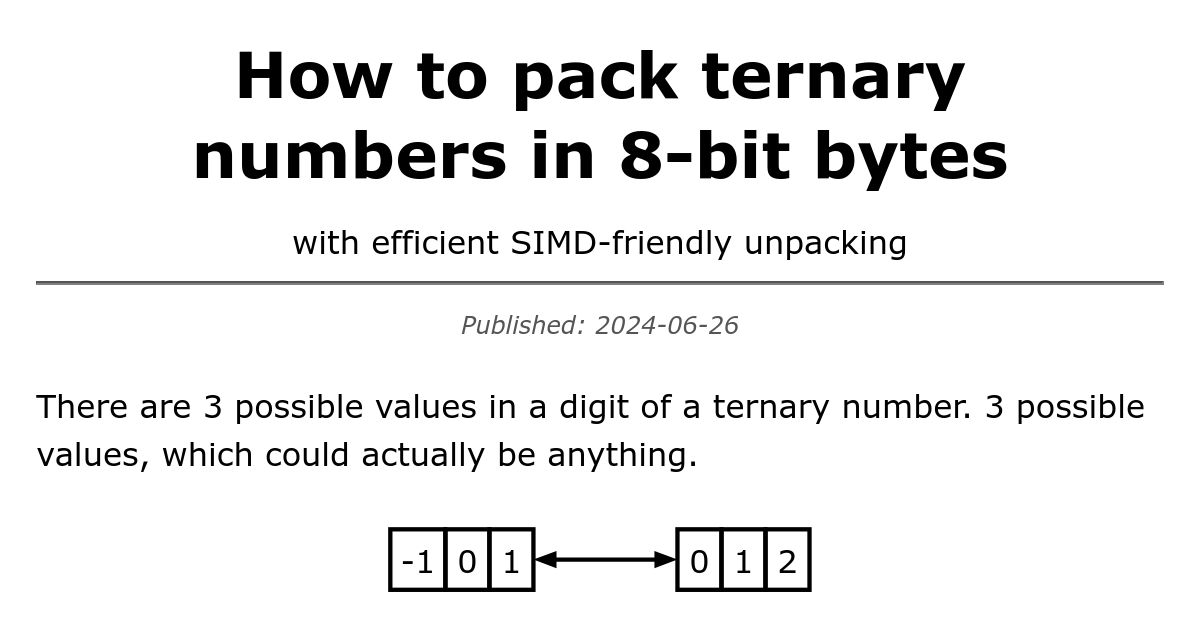
The Challenge of Ternary Representation
Representing numbers in base-3 (ternary) offers potential advantages in certain computational contexts, such as reduced energy consumption or specialized arithmetic operations. However, the ubiquitous nature of byte-addressable memory, which operates on base-2 (binary) 8-bit bytes, presents a significant challenge for efficient ternary storage. A single ternary digit, or "trit," requires log2(3) ≈ 1.58 bits of information. This means we cannot perfectly map trits to bits; there will always be some wasted space or the need for complex packing and unpacking algorithms. The goal is to minimize this overhead.
Consider the standard binary system. Each bit can represent two states (0 or 1). An 8-bit byte can therefore represent 28 = 256 distinct values. In ternary, each trit can represent three states (0, 1, or 2). If we were to use bits directly, we might allocate 2 bits per trit, which would waste one state (00, 01, 10, 11), or 3 bits, which would waste 23 - 3 = 5 states. Neither is efficient. The problem boils down to finding the greatest common divisor between the number of trits and the number of bits in a byte, or more practically, finding efficient packing schemes that amortize the bit waste over multiple trits.
Direct Packing Strategies and Their Limitations
One straightforward approach is to group trits together and then encode them into bytes. Since each trit needs approximately 1.58 bits, packing 5 trits would require roughly 5 * 1.58 = 7.9 bits. This suggests that 5 trits can fit into a single byte, with minimal overhead. Let's examine this more closely. Five trits, in base-3, can represent 35 = 243 distinct values. An 8-bit byte can represent 256 distinct values. This means that 5 trits fit comfortably within a byte, leaving 256 - 243 = 13 unused states. This is an overhead of 13/256 ≈ 5.1% per byte, which is quite efficient.
The challenge lies in the conversion. To pack 5 trits (t4t3t2t1t0) into a byte, we can think of this as a number in base-3: N = t4*34 + t3*33 + t2*32 + t1*31 + t0*30. This sum will range from 0 (when all trits are 0) to 242 (when all trits are 2). This value N can then be directly stored in an 8-bit byte. The unpacking process involves converting the byte value N back into its base-3 representation. This typically involves repeated division and modulo operations by 3. For example, t0 = N mod 3, N = N / 3 (integer division), then t1 = N mod 3, and so on.
While packing 5 trits into 8 bits is efficient, it's not perfect. The 13 unused states within each byte are a form of dead space. For applications that require extremely high data density, this small overhead might still be significant. Furthermore, the arithmetic required for packing and unpacking can add computational cost.
Alternative Packing Schemes and Trade-offs
To overcome the limitations of the 5-trit packing, researchers and developers have explored other schemes. One common strategy involves using larger blocks of bits and trits. For instance, consider packing 8 trits. This would require approximately 8 * 1.58 = 12.64 bits. We could use two bytes (16 bits) to store these 8 trits. The number of possible values for 8 trits is 38 = 6561. Stored in 16 bits, we can represent 216 = 65536 values. This results in a much larger overhead (65536 - 6561) / 6561 ≈ 8.9 times more space than needed, which is clearly inefficient.
A more effective approach often involves finding the least common multiple (LCM) of the number of states. The LCM of 2 (bits) and 3 (trits) is 6. This suggests that a block of 6 bits could potentially be used to represent a whole number of trits without any remainder. Six bits can represent 26 = 64 states. How many trits can we fit? We need ceil(6 / log2(3)) = ceil(6 / 1.58) = ceil(3.79) = 4 trits. Four trits represent 34 = 81 states. This doesn't seem to work because 81 > 64. Let's try the other way around: how many bits do we need for a whole number of trits? For k trits, we need k * log2(3) bits. We want this to be an integer. If k=2, we need 2 * 1.58 = 3.16 bits. If k=3, we need 3 * 1.58 = 4.74 bits. If k=4, we need 4 * 1.58 = 6.32 bits. If k=5, we need 5 * 1.58 = 7.9 bits, which we've seen fits into 8 bits.
The key insight is that while individual trits don't map cleanly to bits, groups of trits can be packed into groups of bits more efficiently. The 5-trit-in-8-bit scheme is optimal for small numbers of trits. For larger numbers, one might consider block-based compression where a block of, say, 15 trits (315 = 14,348,907 values) could be packed into 24 bits (3 bytes), requiring 24 bits. This gives 315 values in 3 bytes, which is a perfect mapping (24 bits = 224 possible states, but we only need 315 states). The overhead is zero for this specific block size.
Implementation Considerations
Implementing these packing schemes requires careful attention to detail. For the 5-trit pack:
- Packing: Given five trits [t4, t3, t2, t1, t0], calculate the value N = t4*81 + t3*27 + t2*9 + t1*3 + t0. Store N in a byte.
- Unpacking: Given a byte with value N, calculate t0 = N % 3, N = N / 3. Repeat for t1, t2, t3, t4.
These operations can be performed using standard integer arithmetic. Bitwise operations are generally not directly applicable because the base-3 representation doesn't align with bit boundaries. However, for the 15-trit pack (or other perfect-fit block sizes), the conversion becomes a base conversion problem between base-3 and base-2, which can be implemented using multiplication and division, or more optimized algorithms for specific block sizes.
The choice of packing strategy depends heavily on the specific application. If memory is extremely constrained and the number of ternary values to store is small, the 5-trit scheme offers a good balance of density and implementation simplicity. For applications dealing with larger volumes of ternary data, finding a block size that allows for perfect packing (like 15 trits into 24 bits) will eliminate overhead entirely, at the cost of potentially more complex conversion routines and larger, fixed-size data blocks.
The surprising detail here is not that ternary numbers are difficult to pack, but how close 5 trits come to filling an 8-bit byte. The required bits (log23) are irrational, but their ratio to integers often leads to near-perfect packing schemes like the 5-trit-to-8-bit conversion. This suggests that while perfect packing might be rare, highly efficient packing is achievable with careful mathematical consideration.
The Unanswered Question: Performance Benchmarks
While the theoretical efficiency of these packing schemes is clear, what remains largely unaddressed in general discussions is the real-world performance impact. How do the computational costs of packing and unpacking ternary numbers affect the overall speed of an application compared to using native binary representations or less dense ternary storage? Benchmarking these algorithms across different hardware architectures and common programming languages would provide invaluable data for developers deciding whether the memory savings justify the potential CPU overhead. Without such benchmarks, the choice often relies on theoretical density alone.