The Problem: Manual Server Setup Is a Recipe for Chaos
Every new server spun up manually is a potential deviation from the ideal. This was the reality for EC2 instances where each new machine required painstaking, step-by-step installation of packages and configuration adjustments. The process was prone to human error, difficult to document consistently, and nearly impossible to audit. This led to environments where supposedly identical servers were anything but, making troubleshooting a nightmare. The core question became: how do we make server provisioning repeatable, versioned, and auditable?
The Solution: Golden Images with Packer and Ansible
The solution lies in creating standardized, pre-configured server images, often called "golden images." These images serve as a pristine starting point for any new instance. The key to achieving this lies in the powerful combination of HashiCorp Packer and Ansible.
Packer: The Image Builder
Packer is an open-source tool for creating identical machine images for multiple platforms from a single source configuration. It automates the process of building images for cloud providers (like AWS AMI, Azure Image, GCP Image), virtualisation platforms (like VirtualBox, VMware), and containers.
Packer works by defining a builder, which specifies the target platform and environment (e.g., an AWS region, an EC2 instance type). It also defines provisioners, which are scripts or tools that run on the instance after it's launched but before the image is finalized. This is where Ansible comes into play.
The Packer configuration file (typically JSON or HCL) describes:
- Builders: Where and how the image will be created (e.g., AWS, Azure, GCP, VirtualBox).
- Provisioners: The tools or scripts to run for configuration (e.g., shell scripts, Ansible playbooks).
- Post-processors: Actions to take after the image is built (e.g., tagging the image, uploading it to a repository).
By defining the image build process in code, Packer ensures that the image is created consistently every single time. This eliminates the "snowflake server" problem, where each server is unique and undocumented.
Ansible: The Configuration Management Engine
Ansible is an open-source automation tool that simplifies configuration management, application deployment, and task automation. It uses a declarative language (YAML) to describe the desired state of systems.
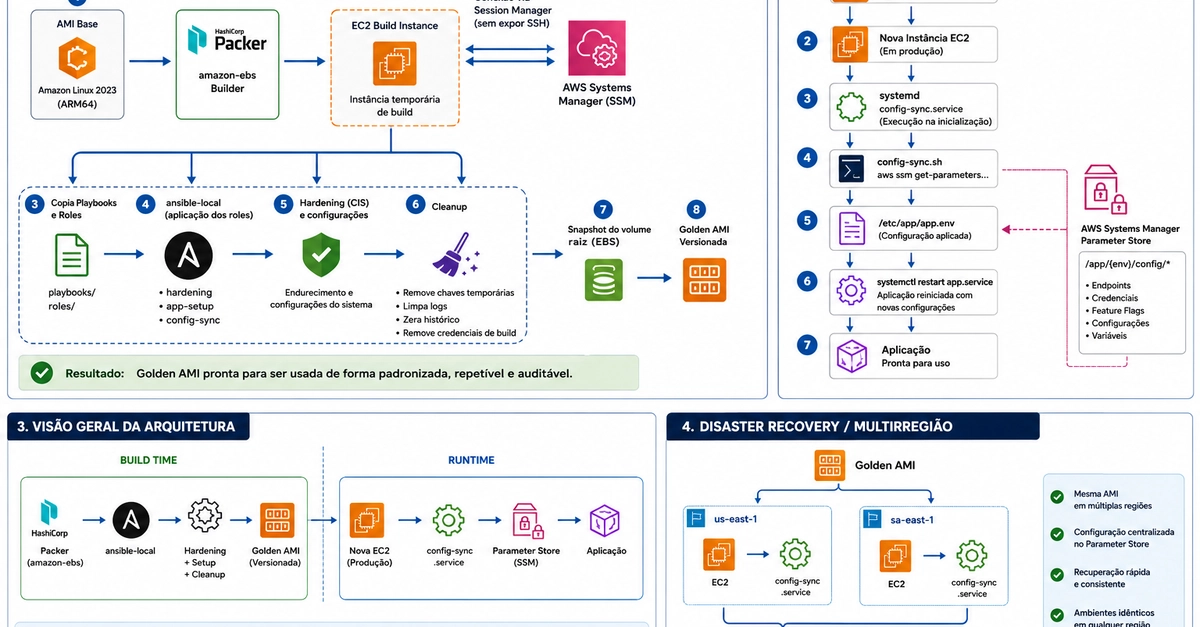
When used with Packer, Ansible acts as the primary provisioner. Packer launches a temporary instance, boots it up, and then uses Ansible to connect to it (typically via SSH) and execute a playbook. This playbook contains the instructions for installing software, configuring services, setting up users, and applying security hardening measures.
An Ansible playbook used with Packer might include tasks like:
- Updating all installed packages (`apt update && apt upgrade`).
- Installing essential software (e.g., Nginx, Docker, Python libraries).
- Configuring application settings via configuration files.
- Setting up firewall rules.
- Ensuring specific services are running and enabled.
The beauty of using Ansible here is its idempotency. Running the same playbook multiple times will result in the same final state without unintended side effects, which is crucial for reliable image building.
The Workflow: From Code to Golden Image
The process typically flows like this:
- Define the Image: Create a Packer template file specifying the base image (e.g., Ubuntu 22.04 LTS), the builder (e.g., AWS `us-east-1` region), and the provisioner (an Ansible playbook).
- Create the Playbook: Develop the Ansible playbook that defines all the necessary software installations, configurations, and security settings for the desired server environment.
- Build the Image: Run the `packer build` command. Packer will provision a temporary instance, execute the Ansible playbook against it, and then capture a new machine image (e.g., an AMI) from the configured instance.
- Deploy: Once the golden image is created, new instances can be launched directly from this image, guaranteeing they start with the correct software and configuration already in place.
This workflow transforms server setup from a manual, error-prone task into an automated, code-driven process.
Benefits of This Approach
The advantages of using Packer and Ansible for golden image creation are substantial:
- Consistency: Every instance launched from a golden image is identical, eliminating configuration drift and reducing the "it works on my machine" problem.
- Speed: Pre-configured images mean instances launch much faster, as all software and setup are done beforehand, not after boot.
- Auditability: The Packer template and Ansible playbook serve as version-controlled documentation of the server's state. You can see exactly what went into the image and when.
- Reliability: Automation reduces human error. The build process is repeatable and predictable.
- Security: Golden images can be hardened according to security best practices before deployment, ensuring a secure baseline for all instances. Vulnerabilities can be patched in the image and redeployed.
- Cost Savings: Faster deployments and reduced troubleshooting time translate directly into operational cost savings.
The Unanswered Question: Image Lifecycle Management
While Packer and Ansible provide a robust method for creating golden images, a critical aspect often overlooked is the lifecycle management of these images. How often should they be rebuilt? What is the strategy for patching vulnerabilities discovered in base images or installed software? How do you deprecate and remove old, unpatched images from your infrastructure?
Establishing clear policies and automated pipelines for image rebuilding, testing, and rotation is essential to maintain the security and relevance of your golden images over time. Without this, even a well-built golden image can become a security liability as the underlying components age.