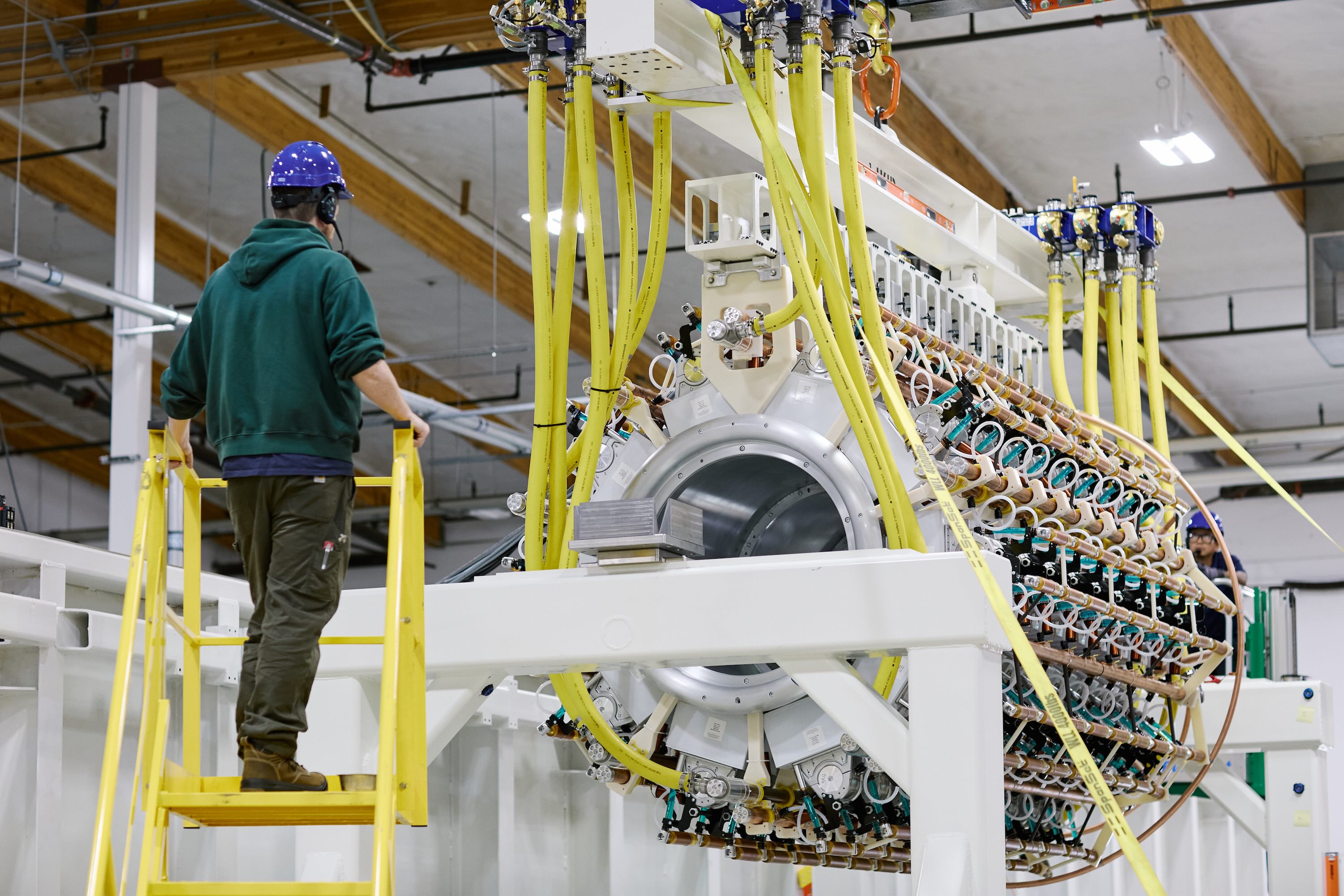
Pacific Fusion Breaks Ground on Net-Energy Fusion Demonstrator
Pacific Fusion, a startup in the increasingly crowded field of fusion energy, has broken ground on a demonstration facility in New Mexico. The company claims this new plant will be capable of generating net energy, meaning it will produce more power than it consumes to operate. This goal represents a critical hurdle for commercial fusion power, a long-sought-after source of clean, virtually limitless energy.
The significance of a fusion reactor achieving net energy gain cannot be overstated. For decades, fusion research has focused on the scientific feasibility of achieving ignition and sustained reactions. However, the path to a practical power plant requires not only demonstrating that fusion can occur, but that it can do so efficiently enough to power itself and then feed surplus electricity into a grid. Pacific Fusion's approach centers on a compact, high-field tokamak design, aiming for a more rapid and cost-effective development cycle compared to some of the larger, more established international projects.
The New Mexico facility, dubbed 'Fusion-X', is designed to validate the company's specific technological approach. While details on the exact physics and engineering remain proprietary, the company has indicated a focus on achieving high plasma temperatures and densities within a relatively small device. This compactness is key to their strategy, as it potentially reduces construction costs and development timelines. Success at Fusion-X would move Pacific Fusion closer to its ultimate goal: building a commercial fusion power plant capable of delivering electricity to the grid.
The global race for fusion power has seen a surge in both public and private investment. Startups like Commonwealth Fusion Systems (CFS), Helion, and TAE Technologies, alongside major international collaborations like ITER, are all pursuing different pathways to harness the power of stars on Earth. Pacific Fusion's announcement places it squarely within this competitive landscape, differentiating itself through its focus on a specific technological niche and its ambitious timeline for demonstrating net energy production.
The Challenge of Net Energy Gain
Achieving net energy gain is the holy grail for fusion power. A fusion reactor must overcome several significant challenges. First, it needs to heat a plasma of hydrogen isotopes to temperatures exceeding 100 million degrees Celsius, hotter than the core of the sun. At these temperatures, atomic nuclei overcome their natural repulsion and fuse, releasing tremendous amounts of energy. Second, this superheated plasma must be confined long enough and at sufficient density for fusion reactions to occur at a rate that produces more energy than is required to heat and confine the plasma.
The energy input for a fusion reactor includes the electricity needed to power magnets for confinement (in tokamaks and stellarators), heating systems (like neutral beam injectors or radiofrequency waves), and diagnostics. If the energy output from the fusion reactions consistently exceeds these inputs, the reactor achieves net energy gain. This is the point where the technology moves from a scientific experiment to a potential power source. Without it, a fusion reactor would simply be a very expensive heater.
Pacific Fusion's strategy to tackle this challenge involves leveraging advancements in high-temperature superconducting (HTS) magnets. HTS magnets can generate much stronger magnetic fields than traditional superconducting magnets. Stronger magnetic fields allow for smaller, more powerful confinement devices. This is analogous to how a stronger magnet can lift more iron with less physical bulk. By using these advanced magnets, Pacific Fusion aims to create the intense magnetic fields needed to control the hot plasma in a more compact and potentially more efficient tokamak design. The Fusion-X facility will be the proving ground for this magnet technology and its integration into a functional fusion system.

Kyoto Fusioneering's Role in the Ecosystem
While Pacific Fusion is focused on the core reactor technology, the broader fusion ecosystem is developing rapidly, with specialized companies providing critical components. Kyoto Fusioneering, a Japan-based startup, is a prime example. They are developing key systems for future fusion power plants, including plasma heating and fuel cycle components. Recently, Kyoto Fusioneering received a grant to advance the development of a crucial part of the fuel system for fusion power plants.
This grant underscores the specialized nature of fusion development. Building a fusion power plant requires expertise across many disciplines: plasma physics, materials science, cryogenics, magnetics, and sophisticated engineering for handling radioactive materials and extreme conditions. Companies like Kyoto Fusioneering are carving out niches by focusing on specific, complex subsystems. Their work on fuel systems, for instance, is vital for ensuring a continuous and efficient supply of deuterium and tritium (the most common fusion fuels) to the reactor, and for managing the byproducts of the fusion reaction.
The collaboration between companies like Pacific Fusion and component suppliers like Kyoto Fusioneering highlights a trend in the fusion industry: a move toward modular development and specialized expertise. Instead of each startup building every single component from scratch, they can leverage the specialized knowledge and manufacturing capabilities of companies focused on specific areas. This can accelerate development, reduce costs, and improve the reliability of the overall system. The grant awarded to Kyoto Fusioneering for its fuel system work is a testament to the growing recognition of these specialized roles within the burgeoning fusion power sector.
The Road Ahead for Commercial Fusion
Pacific Fusion's Fusion-X project represents a tangible step forward, but the journey to commercial fusion power remains long and challenging. Demonstrating net energy gain in a controlled environment is a monumental scientific and engineering achievement, but it is not the end goal. The next phases will involve scaling up the technology, ensuring long-term reliability and operational efficiency, and developing the infrastructure needed to support fusion power plants.
Furthermore, the economic viability of fusion power must be proven. While the fuel is abundant and the potential for zero-carbon energy is immense, the capital costs of building fusion reactors are currently very high. Companies must demonstrate that they can build and operate fusion power plants at a cost competitive with other energy sources. This will require continued innovation in materials, manufacturing, and plant design, as well as supportive regulatory frameworks.
The work at Pacific Fusion, alongside efforts from numerous other companies and research institutions worldwide, is contributing to a global effort to unlock fusion energy. The success of Fusion-X in achieving net energy gain would be a significant milestone, offering a strong signal of confidence for the future of fusion as a clean energy solution. The coming years will be critical in determining which technological approaches prove most viable and how quickly they can be scaled to meet global energy demands.