The Shifting Threat Landscape of Autonomous Agents
For years, the OWASP Top 10 has been the definitive guide to web application security risks. Now, as AI agents—those systems that leverage LLMs to make decisions, call tools, manage memory, and execute actions autonomously—become increasingly prevalent, a new set of threats has emerged. The traditional web and API threat models no longer fully capture the risks associated with these self-directing AI systems. The core challenge lies in the agent's ability to be influenced and manipulated by its own inputs, leading to emergent vulnerabilities that require a dedicated security framework.
In response, the OWASP GenAI Security Project, through its Agentic Security Initiative, published the OWASP Top 10 for Agentic Applications (2026). This crucial document, the result of collaborative work by over 100 contributors from vendors, enterprises, researchers, and national cybersecurity agencies, serves as the de facto standard for identifying and mitigating security risks in agentic AI systems.
Understanding the Agentic Top 10
The OWASP Agentic Top 10 is not merely a list of potential vulnerabilities; it is a catalog of what can go wrong when AI agents operate with a degree of autonomy. Unlike traditional applications where security professionals can often predict and control user interactions, agentic systems introduce a layer of complexity where the system itself can be a vector for attack or a source of failure. The list aims to educate developers, security professionals, and architects on the unique risks inherent in building and deploying these advanced AI applications.
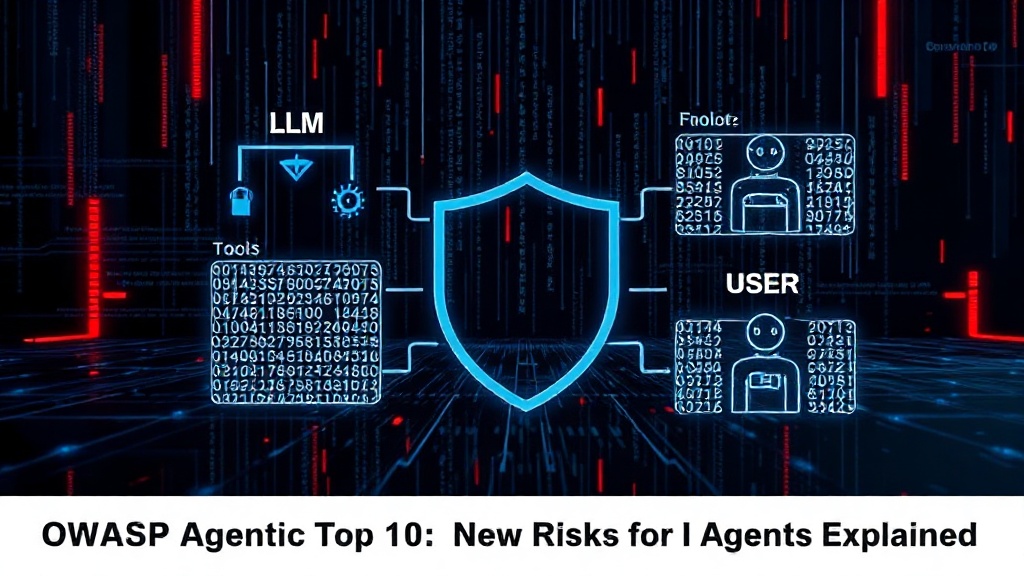
The fundamental difference lies in the decision-making process. In a standard web application, a user's input is processed through predefined logic. In an agentic system, the Large Language Model (LLM) at its core interprets prompts, accesses memory, plans actions, and interacts with tools. This process is far more dynamic and susceptible to subtle manipulations that can lead to unintended and potentially malicious outcomes.
The Top 10 Agentic Risks Detailed
The 2026 list highlights ten critical risk areas that practitioners must address:
- Prompt Injection: This is perhaps the most widely discussed risk. It involves manipulating the agent's prompts to bypass security controls, execute unauthorized commands, or leak sensitive information. Attackers can embed malicious instructions within user inputs or external data that the agent processes, effectively hijacking its intended behavior. This is akin to tricking a highly intelligent assistant into performing tasks it shouldn't by cleverly phrasing your requests.
- Insecure Output Handling: Agentic systems often process and act upon data generated by other LLMs or systems. If the output is not properly validated or sanitized, it can lead to downstream vulnerabilities, such as code injection, Cross-Site Scripting (XSS), or command execution in the systems the agent interacts with. The agent becomes an unwitting conduit for malicious payloads.
- Training Data Poisoning: The performance and behavior of an LLM are heavily dependent on its training data. Attackers can deliberately inject malicious or biased data into the training set, subtly altering the agent's decision-making, introducing backdoors, or compromising its integrity. This risk is particularly insidious as it affects the agent at its core.
- Model Denial of Service (DoS): Agentic systems can be susceptible to DoS attacks by overwhelming the LLM with complex or resource-intensive prompts, leading to excessive computational costs, slow response times, or complete unavailability. This can be achieved through computationally expensive queries or by triggering recursive processing loops.
- Supply Chain Vulnerabilities: Agentic applications often rely on a complex ecosystem of third-party libraries, pre-trained models, and external APIs. Vulnerabilities in any of these components can be inherited by the agentic application, creating attack vectors that are outside the direct control of the application developer. This is similar to a web application being compromised because a vulnerable JavaScript library was included.
- Sensitive Information Disclosure: Agents may inadvertently expose sensitive data they access through their memory, tool interactions, or prompt engineering. This could include proprietary code, user credentials, personal identifiable information (PII), or confidential business data, especially if access controls are not rigorously implemented.
- Insecure Plugin and Tool Use: Plugins and tools are essential for agents to interact with the external world. If these tools are not securely designed, implemented, or configured, they can become entry points for attackers. For example, an agent might use a tool that has a known vulnerability or is susceptible to manipulation, allowing an attacker to gain unauthorized access or execute malicious code.
- Over-reliance on LLM Capabilities: Developers may place undue trust in the LLM's ability to perform tasks accurately and securely without sufficient validation. This can lead to critical errors if the LLM hallucinates, makes incorrect assumptions, or fails to adhere to security protocols, especially in high-stakes decision-making processes.
- Insecure Agent Orchestration: The way multiple agents or components within an agentic system are orchestrated can introduce vulnerabilities. This includes insecure communication channels between agents, improper handling of inter-agent messages, or a lack of robust access control between different agent roles, potentially allowing an agent with limited privileges to escalate its capabilities.
- Unsafe Agent Behavior: This broad category encompasses emergent behaviors of the agent that are unintended and potentially harmful. This can include agents exhibiting bias, generating harmful content, or engaging in actions that violate ethical guidelines or legal regulations, often as a result of complex interactions and emergent properties of the LLM.
Mitigation Strategies for Practitioners
Addressing these risks requires a proactive and multi-layered security approach. Developers must move beyond traditional security practices and embrace new strategies tailored for agentic systems:
- Input Validation and Sanitization: Rigorously validate and sanitize all inputs, especially those that are passed to the LLM or used to construct prompts. Implement techniques to detect and neutralize malicious instructions.
- Output Filtering: Treat LLM-generated output with suspicion. Implement robust filtering and validation mechanisms before acting upon or displaying this output, especially when it interacts with other systems or sensitive data.
- Secure Data Handling: Employ strict access controls and data minimization principles. Ensure sensitive data is encrypted at rest and in transit, and agents only have access to the information they strictly need.
- Modular Design and Sandboxing: Design agentic systems with modularity in mind, isolating critical components. Use sandboxing techniques for tools and plugins to limit the blast radius of potential compromises.
- Continuous Monitoring and Auditing: Implement comprehensive logging and monitoring of agent behavior, tool usage, and decision-making processes. Regularly audit these logs for suspicious activities or deviations from expected behavior.
- Adversarial Testing: Proactively test agentic systems against known attack vectors and prompt injection techniques. Employ red teaming exercises specifically designed for AI agents.
- Secure Development Lifecycle (SDL) for AI: Integrate security considerations throughout the AI development lifecycle, from data preparation and model training to deployment and ongoing maintenance.
- Human Oversight: For critical operations, maintain human oversight and intervention points. Do not allow agents to make irreversible or high-impact decisions without human review and approval.
The OWASP Agentic Top 10 provides a vital roadmap for building more secure and trustworthy AI agents. By understanding these risks and implementing appropriate mitigation strategies, practitioners can navigate the complexities of agentic AI development with greater confidence.