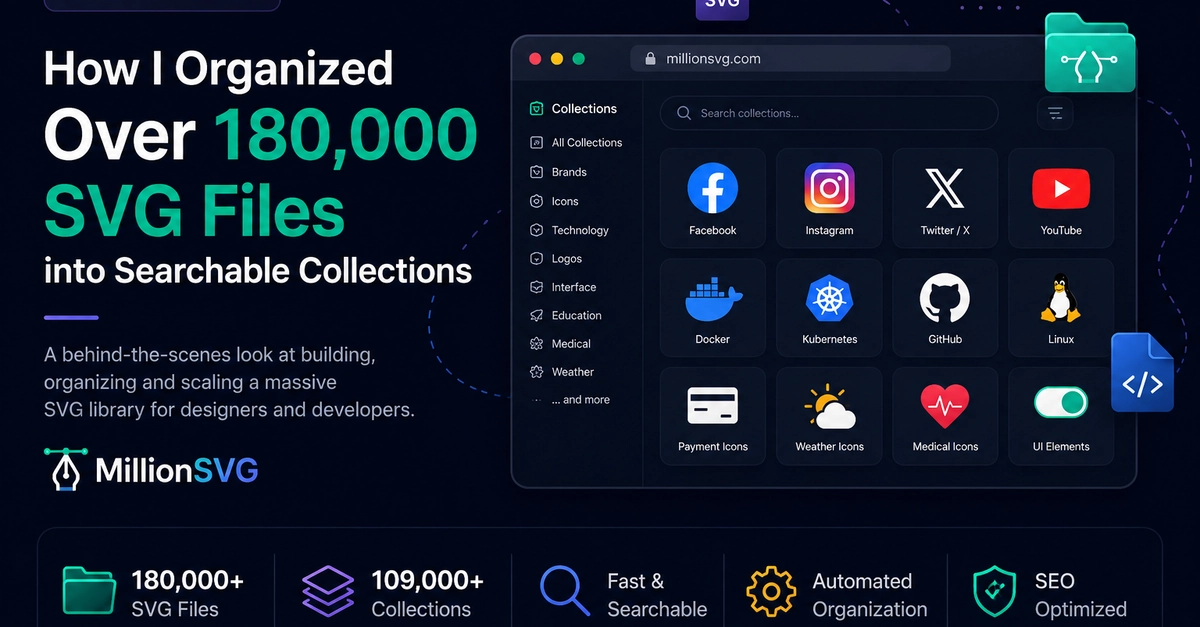
The Unseen Challenge: Taming a Digital Deluge
Developers often focus on the act of creation, the elegant lines of code, the functional architecture. But what happens when the assets supporting that code become a sprawling, unmanageable mess? For one developer, building a large SVG library, the initial excitement of amassing over 180,000 vector files quickly turned into a daunting organizational challenge. Collecting the files was the easy part; making them discoverable and usable was the true test.
The core problem, as the developer quickly discovered, was the sheer volume and the inevitable duplication. With hundreds of thousands of files, identifying and eliminating redundant assets becomes a critical first step before any meaningful organization can occur. Imagine a digital attic crammed with identical tools – you need a way to know you already have five hammers before you bother dusting off another one.

De-duplication: The Foundation of Order
Before any advanced tagging or collection strategy could be implemented, the developer tackled the pervasive issue of duplicate files. This wasn't a simple matter of comparing filenames. True de-duplication requires a more robust approach, typically involving hashing file contents. By generating a unique digital fingerprint (a hash) for each SVG file, identical files would produce identical hashes, regardless of their names or locations. This allows for programmatic identification and removal of redundant assets, reclaiming significant storage space and, more importantly, reducing confusion.
The process likely involved scripting, where a program iterates through the entire directory, calculates the hash for each file, and stores these hashes along with their corresponding file paths. A subsequent pass identifies duplicate hashes, flagging the associated files for deletion or consolidation. This systematic approach is essential when dealing with such vast quantities of data, as manual inspection would be prohibitively time-consuming and error-prone.
Building Searchable Collections: Beyond Folders
Once the library was de-duplicated, the next hurdle was making the remaining files easily retrievable. Traditional folder structures, while familiar, quickly become insufficient for libraries of this magnitude. Searching for a specific icon might involve navigating through dozens of nested directories, a process that is both slow and frustrating. The solution lay in creating a more intelligent, metadata-driven system.
The developer's strategy focused on creating distinct, searchable collections. This implies a system where files are not just stored but are also categorized and tagged with relevant metadata. This metadata could include:
- Keywords: Descriptive terms associated with the icon's function or appearance (e.g., "user", "settings", "arrow", "left", "outline").
- Categories: Broader classifications to group similar icons (e.g., "UI Elements", "Social Media", "Logos", "Illustrations").
- Tags: Specific attributes that might be useful for filtering (e.g., "filled", "stroke", "color", "monochrome").
Implementing this requires a robust metadata management system. This could be a custom-built application, a database, or a sophisticated file management tool that supports advanced tagging and searching capabilities. The goal is to move from a file-system-based hierarchy to a semantic, query-based retrieval system.
The Tooling Stack: From Scripting to Databases
To achieve this level of organization, a carefully selected toolchain is indispensable. The initial de-duplication phase would likely rely on scripting languages like Python or Node.js, leveraging libraries for file system operations and hashing algorithms. These scripts automate repetitive tasks, ensuring consistency and speed.
For the metadata management and searching, a more powerful solution is needed. A relational database (like PostgreSQL or MySQL) or a NoSQL database (like MongoDB) could store the metadata, allowing for complex queries. Alternatively, dedicated asset management systems or even specialized search engines like Elasticsearch could be employed to index the metadata and provide fast, full-text search capabilities. The choice of tool would depend on the developer's existing expertise, the desired scalability, and the specific features required for searching and filtering.
Consider this not just as organizing files, but as building a miniature, specialized search engine for visual assets. If you're a developer managing a large library of any kind of digital asset – be it code snippets, images, or documentation – the principles of de-duplication and rich metadata tagging are universally applicable.
The Payoff: Efficiency and Reusability
The ultimate benefit of such an undertaking is a dramatic increase in efficiency. When designers and developers can quickly find the exact SVG they need, project timelines shorten, and creative blocks are minimized. Instead of wasting time searching or recreating existing assets, they can focus on their core tasks. This organized library becomes a valuable, reusable resource that accelerates the entire development and design workflow. It transforms a chaotic collection into a strategic asset, empowering faster iteration and more consistent visual branding across projects.
What Comes Next?
The immediate challenge has been met, but the long-term implications are significant. What happens when this meticulously organized library needs to be shared across teams? How are new assets integrated while maintaining the integrity of the system? And what are the best practices for version control of these tagged SVGs? These are the questions that arise once a foundational system is in place, highlighting the ongoing nature of effective asset management.