The Silent Cost of Conflicting Instructions
Developers building with large language models (LLMs) often encounter a frustrating phenomenon: instructions that appear clear and unambiguous in documentation yield unexpected or contradictory results in practice. The root cause, as detailed in the Opus 5 analysis, lies in instruction conflicts. When an AI model receives multiple, opposing directives, it resolves these collisions internally without explicit warning, consuming valuable time and computational tokens in the process. The primary indicator of such a conflict is the diverging output itself, leaving developers to reverse-engineer the model's decision-making to understand the failure.
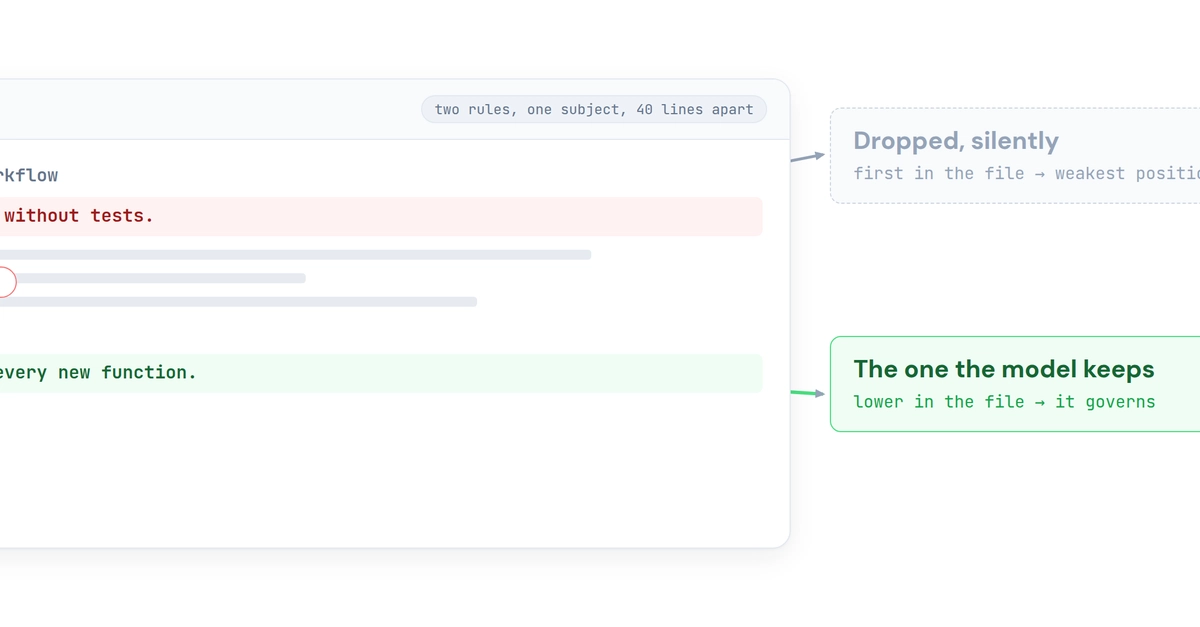
Consider a scenario where a developer defines a set of instructions for an AI agent. In one part of the instruction set, perhaps in a file named CLAUDE.md, the directive might be to use a scratchpad for code development and to ship code without tests. Further down in the same instruction set, a conflicting rule could state: write a test for every function. When the AI agent, following its programmed workflow, first writes a script in the scratchpad, the two instructions clash. One mandates that such throwaway scripts need no tests, while the other insists on comprehensive test coverage for all code.
The critical aspect here is how the model handles this contradiction. It doesn't flag the conflict to the user. Instead, it silently processes both instructions, selects one as dominant, and discards the other. The determining factor in this silent resolution is positional: the instruction that appears lower in the file takes precedence. Consequently, in the example above, the AI agent would likely write a test for the throwaway scratchpad script, precisely the behavior the developer intended to prevent with the earlier, higher-placed instruction.

Understanding the Mechanism of Resolution
This positional dominance is not an intentional design choice for obfuscation but rather a consequence of how sequential processing and attention mechanisms function within LLMs. When an AI model processes a set of instructions, it effectively reads them in order. Upon encountering a contradiction, its internal state is updated based on the latter instruction, overriding the former. This is analogous to updating a variable in programming: the last assignment dictates the variable's final value. The model doesn't maintain a complex logical arbitration system to weigh the importance or intent of conflicting rules. It simply follows the path of least computational resistance, which often means adhering to the most recently encountered directive.
The cost of this silent conflict resolution is multifaceted. Firstly, it leads to wasted computational resources. The model expends tokens and processing cycles to interpret, resolve, and act upon these conflicting instructions, even if the outcome is incorrect. For users operating under strict token limits or seeking efficient inference, this is a direct financial and performance penalty. Secondly, it creates a significant debugging challenge. Developers must meticulously review the AI's output, compare it against their intended logic, and then trace back through their instruction set to pinpoint the exact conflict. This process is time-consuming and requires a deep understanding of the AI's internal workings, which are often opaque.
The Broader Implications for AI Development
The Opus 5 findings underscore a critical gap in current LLM development: the need for more robust conflict detection and user feedback mechanisms. As AI agents become more autonomous and are tasked with increasingly complex operations, the potential for subtle instruction conflicts to derail workflows grows exponentially. This is not merely an academic concern; for businesses integrating AI into critical processes, such as code generation, data analysis, or content creation, these silent failures can lead to significant errors, security vulnerabilities, or missed opportunities.
The current paradigm forces developers to act as AI mind-readers, constantly anticipating potential ambiguities and structuring their instructions with an almost superstitious adherence to ordering. This is unsustainable. Imagine a complex software project where every developer had to guess which of their colleagues' comments the compiler would silently ignore. The result would be chaos. Similarly, the reliance on positional precedence for instruction resolution in AI models introduces an element of unpredictability that undermines trust and efficiency.
What remains unaddressed is the development of standardized best practices for crafting instruction sets that minimize the potential for such conflicts. While techniques like prompt engineering aim to improve AI output, they often focus on clarity and specificity rather than the inherent logic of instruction sets themselves. Future advancements may involve AI models that can proactively identify potential conflicts, query the user for clarification, or provide a ranked list of potential resolutions based on inferred user intent. Until then, developers must remain vigilant, treating their instruction sets not as simple commands but as intricate logical structures where every line matters and its position can determine the fate of the entire operation.
The cost isn't just in tokens or time; it's in the erosion of confidence and the added burden on human oversight. As AI systems become more integrated into our tools and workflows, resolving these silent instruction conflicts is paramount to unlocking their true potential without introducing a new class of unpredictable errors.