
The median fixed-connection download speed globally is 104.43 Mbps. In places like Cuba, it plummets to 3.48 Mbps. But the real challenge for many developers is not just slow, but *unreliable* connectivity, often hovering around 120 kbps and prone to dropping at any moment. This isn't a problem of making your app *faster*; it's about fundamentally rethinking how much work your app *needs* to do.
Optimization begins with an aggressive stance on elimination. Don't download what isn't needed. Don't compute what can be avoided. Don't request what you already have. Don't render what the user can't see. Don't send what the server doesn't require. The core question isn't how to speed up transfers, but how to drastically reduce the need for them in the first place.
Eliminate Before Compressing
The most effective optimization is achieving zero data transfer. Data that is never sent inherently beats data that is compressed. This principle applies to every aspect of an application's lifecycle, from initial asset loading to background data synchronization. Consider the user's actual needs in their current context. Do they need that high-resolution image right now, or would a lower-fidelity version suffice? Can that complex calculation be deferred until a more stable connection is available, or even offloaded to a device with better resources?
This means scrutinizing every byte. For web applications, this translates to aggressively pruning unnecessary JavaScript, CSS, and media files. For mobile applications, it means carefully managing on-device storage and downloading only essential components. The goal is to create an application that is as lightweight as possible, minimizing its footprint and its demand on the network.
APIs as Resources: Return Only What's Used
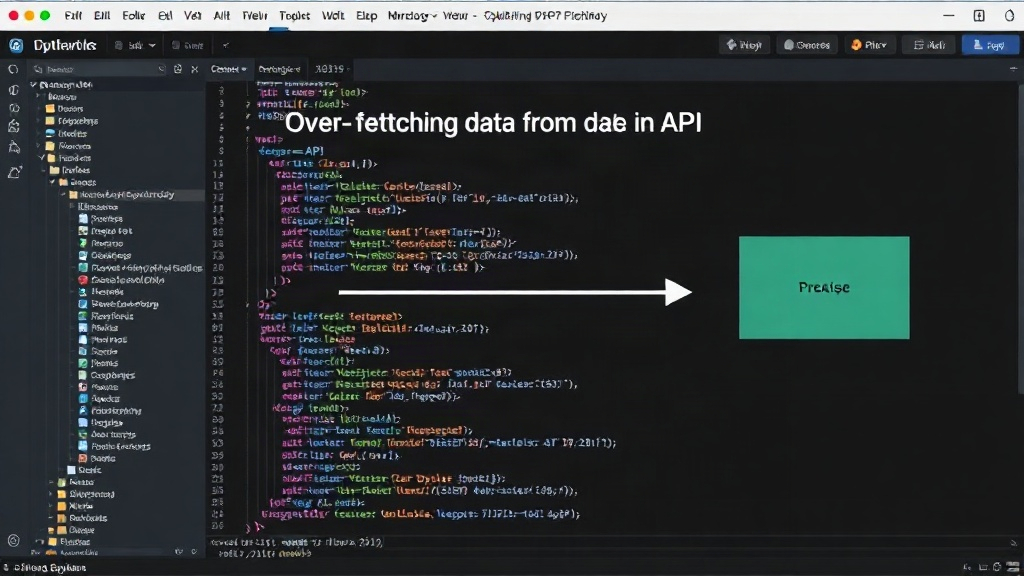
Every API request carries a cost beyond just bandwidth. There are overheads for DNS lookups, establishing secure connections, encryption and decryption, server-side processing, data serialization and parsing, and on the client side, battery drain and user waiting time. An API is a resource, and like any resource, it should be used efficiently. This means designing APIs to return only the specific fields that a consuming component actually requires. Avoid monolithic API responses that deliver a wealth of data, only for the client to discard most of it.
For example, if a user profile component only needs a user's name and avatar URL, the API call should not return their full address, purchase history, and social media connections. This requires a shift in API design philosophy, moving towards granular, queryable endpoints or implementing techniques like GraphQL to allow clients to specify exactly what data they need. This not only saves bandwidth but also reduces processing load on both the client and server, leading to faster response times and a more efficient application.
Cache with Boundaries
Caching is a critical strategy for offline-first and low-bandwidth applications, but it must be implemented with clear boundaries. Not all data is suitable for aggressive caching, and not all cached data should be considered authoritative indefinitely. Define strict cache invalidation strategies. What is the lifespan of a piece of data? What events trigger a cache refresh? Consider techniques like time-based expiration, conditional requests (using ETags or Last-Modified headers), or even server-sent events to push updates when data changes.
This boundary-aware caching ensures that users don't operate on stale data for too long, while still benefiting from offline access and reduced network requests. For critical data that changes frequently, caching might be minimal or non-existent, relying instead on robust offline fallback mechanisms. For static assets or infrequently changing configuration data, longer cache durations are appropriate. The key is to tailor the caching strategy to the specific data's volatility and importance.
Survive Offline: State Management and Progressive Enhancement
The ultimate goal is an application that doesn't just tolerate offline states but actively survives and functions within them. This requires meticulous state management. Ensure that user actions taken while offline can be queued and synchronized reliably once connectivity is restored. This involves storing user input locally, often in a database or key-value store, and implementing a robust synchronization mechanism.
Progressive enhancement is also vital. Design the application so that its core functionality is available even with no network connection. Features that rely heavily on remote data or real-time updates can be progressively enabled as connectivity improves. This might mean displaying a cached version of a product catalog with a clear indicator that it's offline data, or allowing users to draft emails that will be sent later. The user experience should degrade gracefully, not collapse entirely, when the network fails. This approach ensures that the application remains useful and functional, even under the most challenging network conditions.
The Right Question: How Much Work Does My App Actually Need?
The shift in perspective is profound. Instead of asking how to optimize for speed and efficiency on good networks, developers must ask how to minimize the *necessity* of network interaction and computation altogether. This involves a deep understanding of user workflows, data dependencies, and the inherent costs of network communication. By prioritizing elimination, designing efficient APIs, implementing intelligent caching, and building for offline resilience, applications can become truly usable in environments where connectivity is a luxury, not a given.