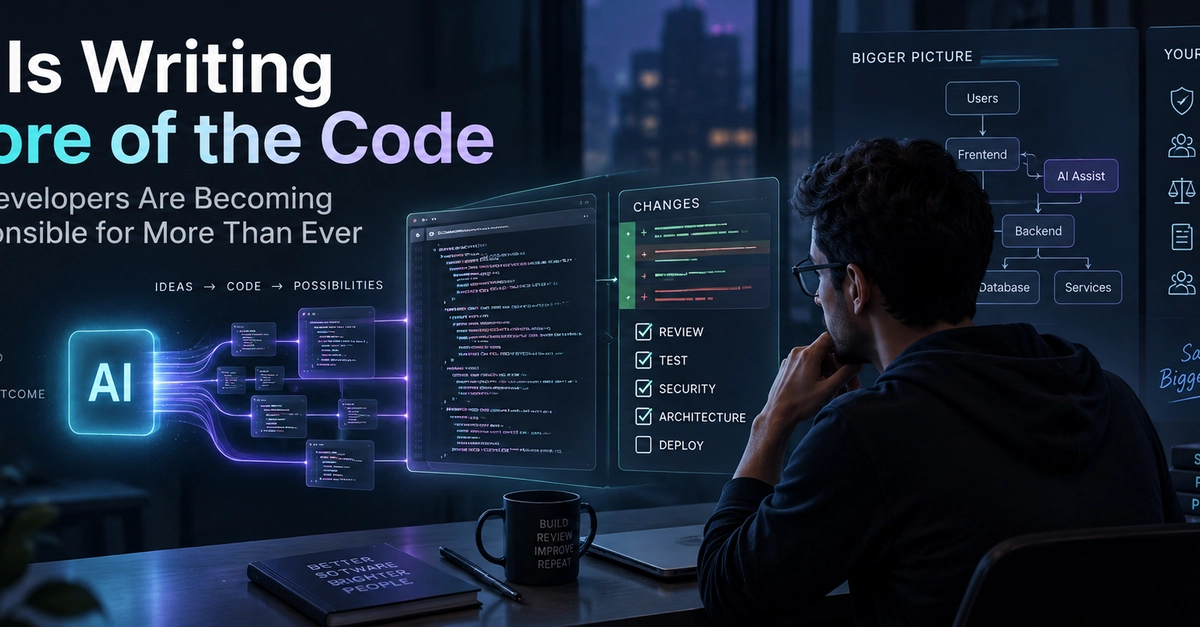
AI's Code Generation Surge
Artificial intelligence is undeniably accelerating the pace of software development. Tools powered by large language models can now generate code snippets, write entire features, create unit tests, refactor complex modules, and even update documentation. Developers can prompt AI agents to perform tasks ranging from generating SQL queries to reviewing pull requests, and in many cases, the output is surprisingly effective. This shift promises to free up developer time, allowing them to focus on higher-level design and problem-solving.
The ability of AI to automate repetitive coding tasks is a significant advancement. Imagine asking an AI to generate boilerplate code for a new API endpoint, complete with basic error handling and logging. Or consider the time saved when AI can draft comprehensive test suites that cover edge cases you might have overlooked. This isn't just about speed; it's about augmenting developer capabilities, making the coding process more efficient and potentially more enjoyable by reducing the drudgery.
The Shifting Burden of Responsibility
However, this increased reliance on AI-generated code introduces a critical, often underestimated, shift in responsibility. While AI can write the code, it doesn't own the system's performance or reliability in production. When a critical system fails at 2 AM, the question won't be about which AI model generated the faulty function. Instead, the inevitable question will be: "Who owns this system?" The answer, as it has always been, remains the human developers and their teams.
This creates a fundamental disconnect. Developers are increasingly writing less of the actual code lines, but they are becoming responsible for a larger, more complex system composed of AI-generated components. This means their role is evolving from pure code creation to one of orchestration, validation, and ultimately, accountability. They must understand how these AI-generated pieces fit together, ensure they meet performance and security requirements, and be prepared to diagnose and fix issues that arise from their integration, regardless of who or what initially wrote them.
The Old Workflow vs. The New Reality
The traditional software development workflow was more straightforward. Developers wrote code, tested it, and deployed it. The chain of command and responsibility was clear. If a bug occurred, the developer who wrote the code was typically the one to fix it. This model, while sometimes slow, was predictable and easy to reason about. Debugging involved tracing logic that a human mind had constructed.
The new reality is far more nuanced. Developers are now responsible for validating AI-generated code, integrating it into existing systems, and ensuring its security and performance. This requires a different skill set. Instead of deep dives into algorithmic logic, developers need to become experts in prompt engineering, AI output validation, and systems-level integration. They are essentially becoming the architects and quality assurance managers for code they may not have personally authored, but for which they are ultimately accountable. This is akin to a chef no longer growing all their ingredients but still being responsible for the final dish's quality and safety – they must trust and verify their suppliers.
Consider a scenario where an AI generates a database query that, under specific load conditions, becomes a performance bottleneck. The AI might have generated a syntactically correct query, but it lacks the contextual understanding of the application's overall architecture and usage patterns. The developer is then tasked with identifying this AI-generated bottleneck, understanding why it occurred, and refactoring it or the surrounding system to prevent future issues. This requires a holistic view of the system, not just an understanding of individual code blocks.
Implications for Developer Skillsets and Team Structures
This evolution necessitates a re-evaluation of developer skillsets. Proficiency in specific programming languages remains important, but it's no longer sufficient. Developers need to develop strong capabilities in:
- Prompt Engineering: Crafting effective prompts to elicit the desired code from AI models.
- Code Validation: Rigorously testing and verifying AI-generated code for correctness, security, and performance.
- Systems Thinking: Understanding how different components, including AI-generated ones, interact within a larger system.
- Debugging Complex Integrations: Diagnosing issues that may arise from the interaction of human-written and AI-generated code.
- Security Auditing: Ensuring that AI-generated code does not introduce new vulnerabilities.
Team structures may also need to adapt. Specialised roles focused on AI integration and validation could emerge. More importantly, the culture within development teams must embrace this new paradigm. Trust in AI tools should be balanced with a healthy skepticism and a robust process for human oversight and intervention. The ultimate goal is to leverage AI to enhance, not replace, the critical judgment and accountability that developers provide.
The future of software development is a partnership between human ingenuity and artificial intelligence. AI can handle the heavy lifting of code generation, but developers remain the critical guardians of production systems. Their responsibility is not diminished; it has simply transformed, demanding new skills and a deeper understanding of the systems they steward.