The Unprecedented Rise of OpenClaw
In a landscape saturated with AI projects, OpenClaw has achieved a velocity rarely seen. Amassing 210,000 GitHub stars in just four months, it surpassed the growth rates of foundational technologies like React and Vue, and every preceding AI project. This isn't a result of a fleeting viral trend; it signals a deeper resonance with developer needs. The rapid adoption suggests that OpenClaw is addressing a critical pain point that has been overlooked by many cloud-centric AI solutions. The question isn't just *if* it's significant, but *why* it has captured the attention of so many developers so quickly.
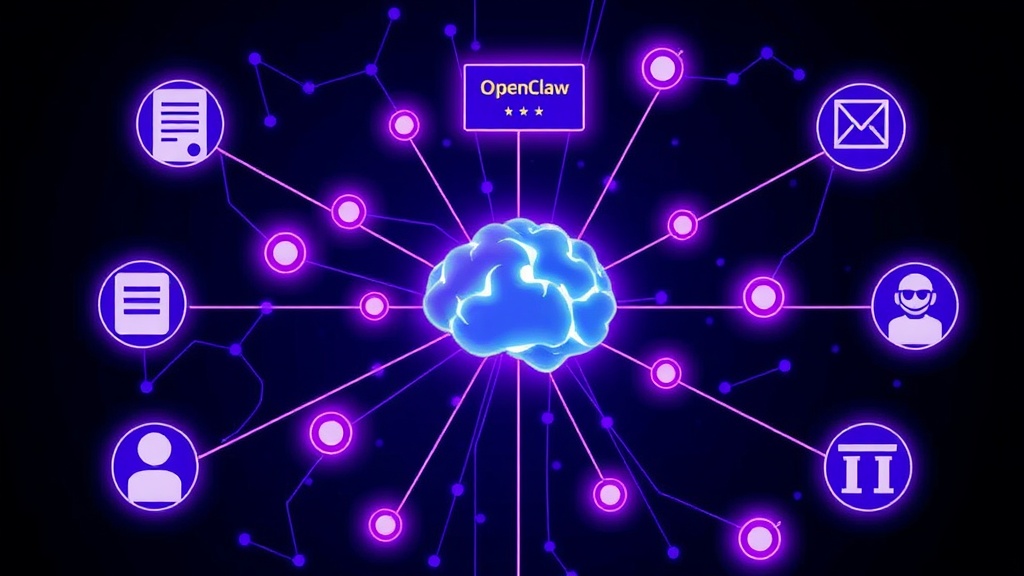
To understand this phenomenon, a deep dive into its architecture and functionality is necessary. While the README describes OpenClaw as a "local-first AI agent framework," this label only scratches the surface. A closer examination reveals it to be far more: a sophisticated local messaging hub powered by an AI brain. It resides on a user's machine, acting as a central orchestrator for communication across a multitude of platforms, including WhatsApp, Telegram, Slack, Discord, Signal, and iMessage, among others. This local-first approach is a key differentiator, offering a level of privacy and control often absent in cloud-based AI services.
The core of OpenClaw's intelligence is derived from NousResearch's Hermes Agent stack. This foundation allows OpenClaw to process and respond to messages intelligently, making it more than just a simple aggregator. It can understand context, learn from interactions, and execute tasks based on natural language commands. This blend of local control and advanced AI capabilities creates a powerful personal operating system for communication and task management.
Architecture: Local-First Messaging Meets AI Brain
OpenClaw's architecture is designed around the principle of local execution. This means that data processing, AI inference, and message handling occur directly on the user's machine, rather than being sent to remote servers. This design choice has several critical implications:
- Privacy: Sensitive conversations and personal data remain on the user's device, significantly reducing the risk of data breaches or unauthorized access common with cloud services.
- Control: Users have direct control over their data and how the AI agent operates. They can inspect the codebase, modify its behavior, and ensure it aligns with their privacy preferences.
- Cost: Eliminating reliance on cloud APIs for every interaction can lead to significant cost savings, especially for users with high message volumes.
- Offline Functionality: While some AI features may require an internet connection for model updates or specific queries, the core messaging hub and agent logic can function even when offline.
The integration with multiple messaging platforms is handled through a robust plugin system. This modular design allows OpenClaw to be extended to support new platforms as they emerge or as user demand dictates. The "AI brain" aspect is powered by the Hermes Agent stack, which provides the natural language understanding (NLU) and generation (NLG) capabilities. This allows OpenClaw to not only relay messages but also to interpret their intent, formulate intelligent responses, and even initiate actions on behalf of the user. For instance, an AI agent could monitor a Slack channel for specific keywords, summarize discussions, and draft a response directly within the channel, all processed locally.
Think of OpenClaw less like a cloud-based chatbot that needs to send your data to a remote server for processing, and more like a hyper-intelligent personal assistant living on your computer, meticulously organizing and managing your digital conversations with unparalleled privacy.
Why the Explosive Growth?
The rapid adoption of OpenClaw can be attributed to several converging factors that tap into current developer and user sentiments:
- Rejection of Cloud AI Monopolies: Many developers are growing wary of the opaque data policies and vendor lock-in associated with major cloud AI providers. OpenClaw offers a compelling alternative that prioritizes user sovereignty.
- Demand for Personal AI: The concept of a "personal AI" that understands and manages an individual's digital life is highly appealing. OpenClaw provides a tangible framework for building such a system.
- Developer-Friendly Framework: By building on the Hermes Agent stack and providing a clear, modular architecture, OpenClaw lowers the barrier to entry for developers wanting to create custom AI agents. The open-source nature encourages community contributions and rapid iteration.
- Multi-Platform Utility: The ability to unify and manage communications across disparate platforms is a significant convenience. Users are constantly juggling multiple apps, and an agent that can bridge these divides offers immediate value.
- The "Local-First" Advantage: In an era of increasing data privacy concerns, the promise of keeping personal data on one's own machine is a powerful draw. This resonates deeply with individuals and organizations concerned about security and control.
The project's clear focus on these pain points, combined with a robust and extensible architecture, has created a potent mix that has resonated deeply within the open-source community. It aligns with a broader trend towards decentralized and user-controlled technologies, offering a practical solution for managing the complexities of modern digital communication.
The Surprising Simplicity of its Core Value Proposition
What's truly surprising about OpenClaw's success is not the complexity of its underlying technology, but the elegant simplicity of its core value proposition. It distills the promise of AI agents into a single, actionable concept: bringing intelligent automation to the places you already are, without compromising your privacy. Many AI agent frameworks aim for broad, abstract capabilities, often requiring significant technical expertise to deploy and manage. OpenClaw, however, targets a very specific and universally understood problem: the fragmentation and volume of digital communication. By providing a local-first solution that integrates with popular messaging apps, it offers immediate, tangible benefits that are easy to grasp and demonstrate. This focus on a relatable problem and a clear, local solution is a masterclass in product-market fit for the AI era.
Future Implications and Unanswered Questions
OpenClaw's rapid ascent poses intriguing questions about the future of AI agents. Will other projects adopt a similar local-first, privacy-centric model? How will major cloud AI providers respond to this challenge to their centralized approach? Furthermore, as more users adopt OpenClaw, what new forms of decentralized AI applications and workflows will emerge? The success of OpenClaw suggests a strong market appetite for AI tools that empower individuals with control over their data and digital interactions. The coming months will reveal whether this momentum can be sustained and how it will influence the broader AI ecosystem.