The Shifting Sands of Open Source Monetization
For years, the dominant strategy for commercializing open-source software involved building a managed cloud offering on top of a community-driven project. The idea was simple: let the community build the core product and its surrounding ecosystem, creating a powerful network effect and a significant technical moat. Then, wrap this open-source foundation with a convenient, scalable, and supported cloud service, selling operational ease to enterprises. Companies like MongoDB, Elastic, and HashiCorp built substantial businesses on this model.
This approach, championed by leaders like the CEO of Aiven, offered a clear path to revenue. It leveraged the collaborative power of open source while capturing value through the specialized expertise required to run complex software reliably at scale. The managed service provided a predictable revenue stream, abstracted away operational burdens, and often offered enhanced features or performance optimizations unavailable in the self-hosted version. It was, for a long time, the de facto standard for turning open-source projects into sustainable businesses.
However, this paradigm is already showing its age. The rapid advancement of AI and the evolving landscape of cloud infrastructure are fundamentally changing the economics and competitive dynamics of open-source software. What worked yesterday might not work tomorrow, and the “moat” built by community contributions is proving increasingly fragile.
The Collapsing Moat: Why the Old Model Is Failing
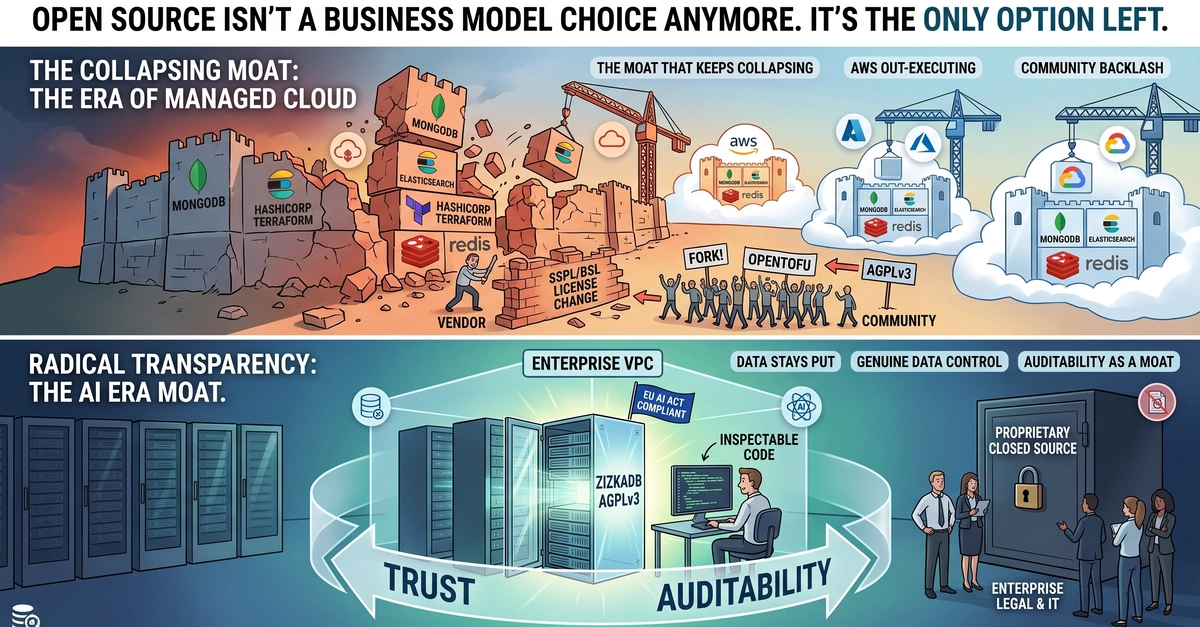
The trigger for this shift is often the emergence of cloud providers offering compatible managed services. AWS DocumentDB’s introduction, which prompted MongoDB to relicense its server-side code under the Server Side Public License (SSPL) in 2018, is a prime example. This move aimed to prevent cloud giants from offering MongoDB-compatible services without contributing back to the project. However, it led to controversial decisions like Debian, Red Hat, and Fedora dropping the package, fragmenting the open-source community and creating friction.
This tension between open-source projects and hyperscale cloud providers is a recurring theme. Cloud providers, with their immense scale and engineering resources, can often replicate the functionality of open-source projects and offer them as managed services with aggressive pricing. For users, the decision becomes less about the intrinsic value of the open-source code and more about the total cost of ownership, convenience, and integration with their existing cloud environment. If AWS, Google Cloud, or Azure can offer a “good enough” version of a popular database or data processing tool as a managed service, the appeal of paying a premium for the original vendor’s managed offering diminishes.
The core problem is that the “moat” built by community contributions is no longer as defensible. Cloud providers are adept at both contributing to and competing with open source. They can participate in upstream development, gain insights into roadmaps, and then leverage their scale to offer competing managed services. This creates a difficult situation for original vendors: either they restrict their license to try and maintain control, alienating their community and potentially hindering adoption, or they accept that their core innovation will be commoditized by larger players.
The AI Era's New Equation
The rise of AI is introducing a new layer of complexity. AI models themselves are increasingly becoming open source, but their true value lies in the data they are trained on and the specialized hardware required to run them. This shifts the value proposition from the software logic itself to the data and the infrastructure.
Consider the implications for data infrastructure, a common area for open-source innovation. Projects like Apache Spark, Kafka, and PostgreSQL have massive communities. Traditionally, companies like Databricks, Confluent, and Aiven have offered managed versions. However, the AI revolution means that the most valuable intellectual property might reside in curated datasets, proprietary model architectures, or the specialized fine-tuning processes. These elements are not easily replicated by community contributions alone.
The managed cloud model, which focused on operational convenience, may soon be insufficient. If the core innovation shifts to data and AI models, then the ability to offer a managed service around a database or a streaming platform becomes less of a differentiator. The real value will be in providing access to high-quality, proprietary data, or offering optimized AI inference and training services. This suggests a future where open-source software is a foundational component, but the primary business models will revolve around data access, AI model deployment, and specialized compute resources.
What Comes Next?
The current trajectory suggests that the era of simply layering a managed service on open source is drawing to a close. The competition from hyperscale cloud providers, coupled with the disruptive potential of AI, necessitates a re-evaluation of business strategies. Companies that rely on open source will need to look beyond operational convenience as their primary monetization lever.
This doesn't mean open source is dead. Far from it. It remains a powerful engine for innovation, collaboration, and adoption. However, its role as the *sole* basis for a business model is being challenged. The future likely involves a more nuanced approach, where open source serves as a critical component, but the true business value is derived from proprietary data, specialized AI capabilities, or unique ecosystem integrations that cannot be easily replicated or commoditized.
For developers, this means understanding where the real value is being created – in the code, the data, or the AI models. For founders, it requires a strategic rethink of their go-to-market and monetization plans, anticipating the moves of cloud giants and the demands of the AI economy. The decision is no longer about whether to embrace open source, but how to build a sustainable business in an AI-driven world where open source is just one piece of a much larger, more complex puzzle.