The Data Void in Nigerian Higher Education
Finding reliable, structured data on Nigerian tertiary institutions has been a persistent challenge. Previously, anyone seeking this information encountered a fragmented landscape of outdated blog posts and static PDFs. These sources often contradicted each other and required laborious manual re-typing, making programmatic access or data analysis nearly impossible. This lack of accessible, machine-readable data hindered research, policy-making, and the development of educational technology tools.
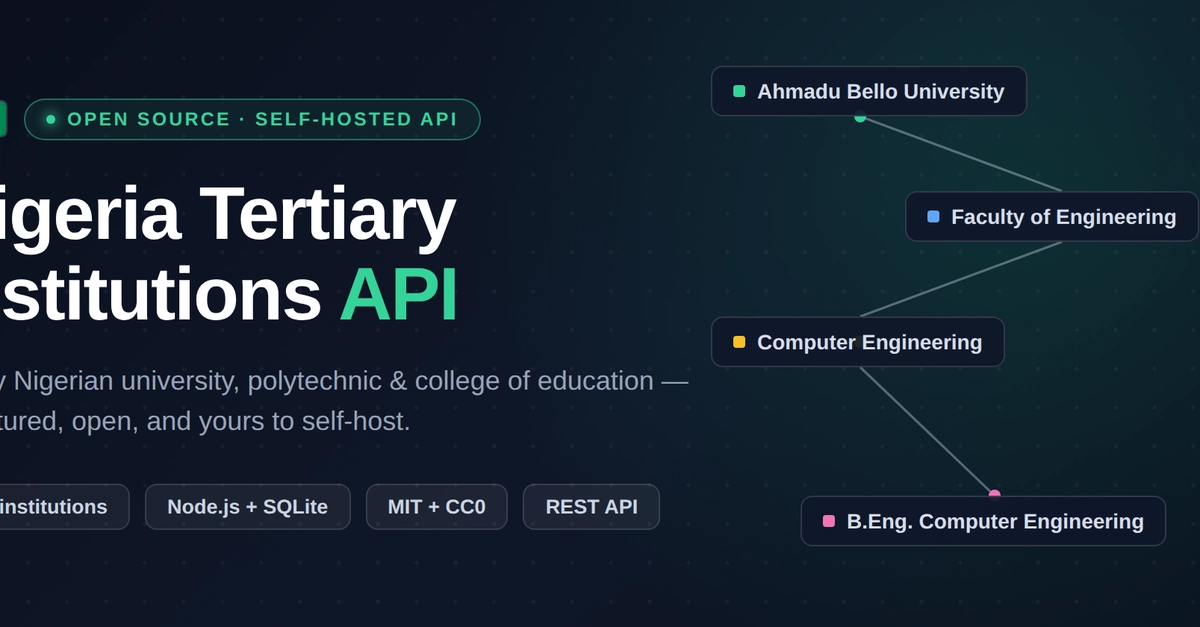
Recognizing this significant gap, developer Farouq Abdulrahman set out to build a solution. His initiative resulted in the creation of the nigeria-tertiary-institutions-api, a comprehensive, free, and open-source REST API and dataset that aggregates information on all 752 universities, polytechnics, and colleges of education across Nigeria.
Comprehensive Data Aggregation
The API provides a structured repository for critical information about each institution. It covers universities, polytechnics, and colleges of education, totaling 752 distinct entities. The data is categorized by ownership type: federal, state, and private. For universities alone, the dataset includes 312 institutions, broken down into 77 federal, 67 state, and 168 private ones. This detailed breakdown aims to provide a clear overview of the higher education landscape in Nigeria.
The API is designed for ease of use, offering standard RESTful endpoints for querying institutions. Developers can access data points such as the institution's name, type, location (state and city), and ownership status. The project is hosted on GitHub, emphasizing its open-source nature and encouraging community contributions. The underlying dataset is also made available, allowing for offline analysis and use in applications where direct API calls might not be feasible.
Technical Implementation and Accessibility
The nigeria-tertiary-institutions-api is built with accessibility and developer experience in mind. It leverages common web technologies to ensure broad compatibility. The project's open-source licensing means it can be freely used, modified, and distributed, fostering innovation within the Nigerian tech and education sectors. By providing a clean, standardized dataset, the API eliminates the need for manual data scraping or the creation of ad-hoc data collection methods for each project.
The developer's motivation stems from a direct encounter with the data scarcity problem. The frustration of encountering inconsistent and unusable data sources for Nigerian educational institutions led to the decision to build a centralized, programmatic solution. This approach not only benefits individual developers but also provides a foundational dataset for educational policymakers, researchers, and ed-tech startups looking to build services for the Nigerian market.
Beyond Basic Data: Potential Applications
The availability of such a comprehensive API unlocks numerous possibilities. For developers, it means faster prototyping and deployment of applications related to education in Nigeria. This could include tools for prospective students to research institutions, platforms for educational administrators to manage data, or services that help track educational trends and outcomes. The structured nature of the data allows for sophisticated analysis, such as mapping the distribution of institutions by state, comparing the growth of private versus public institutions, or identifying regional disparities in higher education access.
The open-source nature of the project is crucial. It invites collaboration, allowing other developers to contribute by identifying errors, suggesting improvements, or adding new data points. This community-driven approach ensures the API remains up-to-date and relevant. The project also serves as a model for addressing data deficits in other critical sectors within Nigeria and across the African continent. By tackling this specific data challenge, Abdulrahman has provided a valuable resource that can spur further development and insight into Nigeria's educational ecosystem.
Addressing a Critical Information Gap
The creation of the nigeria-tertiary-institutions-api directly addresses a critical information gap. The sheer volume of institutions—752 in total—underscores the importance of a centralized, accessible data source. Before this API, any developer or researcher would have to undertake a significant data collection and cleaning effort, a task that is often prohibitive for smaller projects or individual initiatives. This API effectively lowers the barrier to entry for anyone interested in working with data related to Nigerian higher education.
The project's success hinges on its commitment to open standards and community engagement. By making the API and its underlying dataset freely available, Abdulrahman has empowered a wide range of users. This resource is not just a technical achievement; it is a significant step towards improving data accessibility and enabling data-driven decision-making within Nigeria's educational sector. The hope is that this initiative will inspire similar projects in other domains, fostering a more data-rich environment across the nation.