On-Device AI: Bringing Intelligence to the Edge
The concept of bringing Artificial Intelligence directly onto user devices, often termed "on-device AI," represents a significant shift in how applications can leverage intelligent capabilities. This approach contrasts with traditional cloud-based AI, where models are hosted remotely and data is sent for processing. On-device AI offers several compelling advantages, including enhanced privacy, reduced latency, and offline functionality. For developers, this means building applications that can perform complex tasks like image recognition, natural language processing, or predictive analysis without constant network connectivity.
One prominent framework enabling this is Codename One. Codename One is an open-source platform designed for cross-platform mobile development, allowing developers to write code once in Java or Kotlin and deploy native applications across iOS, Android, desktop, and web environments. By integrating AI models directly into the application's runtime, Codename One facilitates scenarios where an AI agent can inspect or interact with a mobile application, all while maintaining a guarded local connection. This local processing is crucial for sensitive data or when real-time responsiveness is paramount.
Consider an AI-powered accessibility feature within a mobile app. Instead of sending screenshots or user interactions to a cloud server for analysis, an on-device AI model could interpret the screen layout and provide real-time audio descriptions or alternative input methods. This not only speeds up the response but also ensures that personal user data never leaves the device. The architecture for such an implementation would involve embedding pre-trained AI models within the application package, often optimized for mobile hardware through techniques like model quantization and pruning to reduce size and computational overhead.
The implications for user experience are substantial. Applications can become more personalized, proactive, and efficient. For developers, it requires a different mindset, focusing on model optimization, efficient resource management on the device, and understanding the trade-offs between on-device and cloud-based AI. This could involve using libraries like TensorFlow Lite or PyTorch Mobile to deploy models effectively. The ability to perform OCR, for instance, directly on a smartphone without relying on a server API opens up a new class of applications for field service, data entry, and enhanced user interfaces.
MCP: AI-Powered Management for Kubernetes
Shifting focus to the infrastructure layer, "MCP" emerges in the context of AI-powered management for Kubernetes, particularly within cloud environments like Amazon Elastic Kubernetes Service (EKS). This represents a different facet of AI integration, aimed at optimizing and automating the complex operations of container orchestration platforms.
Amazon EKS is a managed service that simplifies running Kubernetes on AWS. Managing EKS clusters involves a multitude of components, from the control plane and node groups to networking (VPC CNI, CoreDNS, kube-proxy), storage (EBS CSI Driver), and security (IAM, RBAC). Traditionally, optimizing and troubleshooting these components has been a labor-intensive task for DevOps and SRE teams.
The integration of AI, or MCP (which in this context appears to refer to Management and Control Plane capabilities enhanced by AI), aims to bring intelligence to this management layer. This could manifest in several ways: predictive scaling of cluster resources based on workload patterns, automated anomaly detection and root cause analysis for performance issues, intelligent security policy enforcement, or even AI-assisted capacity planning. The goal is to move beyond reactive management to a more proactive and self-optimizing infrastructure.
For instance, an AI-powered Kubernetes management system could analyze historical performance metrics, deployment patterns, and application logs to predict potential resource contention or bottlenecks before they impact users. It could then automatically adjust resource allocations, scale node groups, or even suggest configuration changes to mitigate these risks. This is akin to having an expert SRE constantly monitoring the cluster, but at a scale and speed that human operators cannot match.
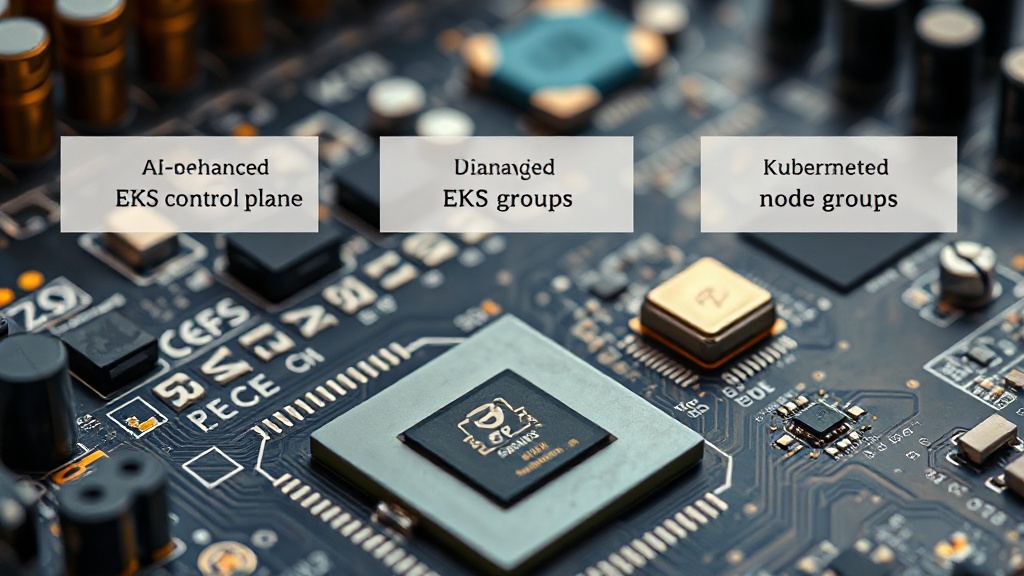
The use of tools like Terraform for infrastructure-as-code is fundamental to deploying and managing EKS clusters reliably. An AI management layer would ideally integrate with these IaC practices, ensuring that automated optimizations align with the defined infrastructure state. This means that while Terraform defines the desired architecture (e.g., EKS control plane, VPC, subnets, load balancers), the MCP layer works within that defined framework to optimize its runtime behavior.
The benefits are clear: reduced operational overhead, improved application reliability, enhanced security posture, and potentially significant cost savings through more efficient resource utilization. This approach democratizes advanced operational capabilities, making sophisticated Kubernetes management more accessible even to smaller teams who may not have dedicated SRE expertise.
Bridging the Divide: On-Device AI and MCP
While seemingly disparate, the advancements in on-device AI and AI-powered Kubernetes management highlight a broader trend: the pervasive integration of intelligence across all layers of the technology stack. On one end, we are embedding AI into the user-facing applications, making them smarter and more responsive. On the other, we are using AI to manage the complex infrastructure that powers these applications, making it more efficient and resilient.
What remains to be seen is how these two worlds will intersect more directly. Could on-device AI models be dynamically deployed or updated via an AI-managed Kubernetes cluster? Could insights from edge devices inform infrastructure scaling decisions in real-time? The future likely involves a more cohesive ecosystem where intelligence flows seamlessly from the end-user device to the deepest layers of cloud infrastructure, with AI acting as the connective tissue.
For developers and operations teams, this dual evolution demands continuous learning. Developers must adapt to optimizing AI models for edge devices, while operations professionals need to embrace AI-driven tools for managing cloud-native environments. The "MCP on every port" could eventually mean not just optimized Kubernetes, but also intelligent, context-aware applications running on every device connected to that infrastructure.