Introduction: The Quest for Local AI on Edge Devices
The dream of running sophisticated AI models locally, directly on edge devices, is a powerful one. It promises enhanced privacy, reduced latency, and offline functionality for intelligent applications. However, the computational demands of modern large language models (LLMs) often clash with the limited resources of hardware like NVIDIA's Jetson Nano. This review dives into the practical performance of Ollama, a popular tool for running LLMs locally, on the Jetson Nano, aiming to answer critical questions about its feasibility for real-world use cases.
The journey began with a simple goal: build a local AI application to generate flashcards and quizzes from personal text notes. This required exploring how to benchmark AI performance and what metrics truly matter. The reality, as often is the case in technology, is that the 'best' approach and 'good' numbers are highly dependent on the specific application and its priorities. For this particular project, the focus was on ease of use, local execution, and cost-effectiveness. This exploration led down several interesting technical paths, revealing the nuances of running LLMs on constrained hardware.
Setting the Stage: Hardware and Software Configuration
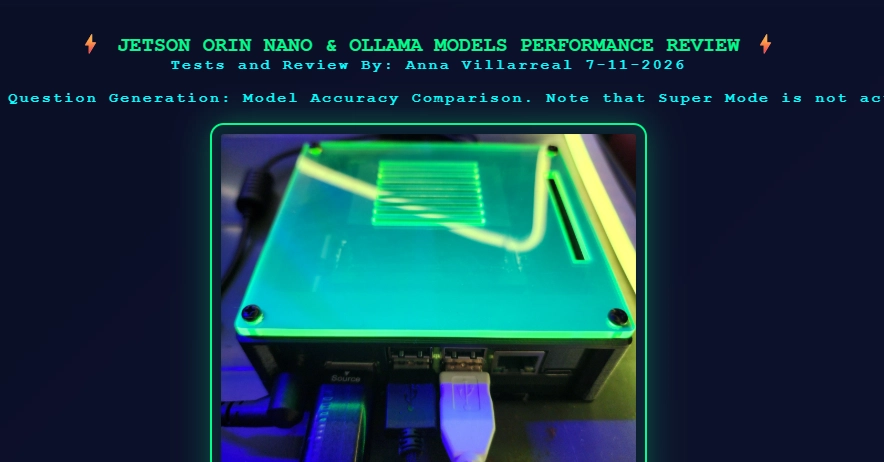
To conduct this benchmark, the hardware configuration was a standard NVIDIA Jetson Nano Developer Kit. This board features a 64-bit quad-core ARM A57 CPU and an NVIDIA Maxwell GPU with 128 CUDA cores, paired with 4GB of LPDDR4 RAM. While capable for its intended purpose of AI at the edge, it represents a significant constraint compared to desktop or server-grade hardware. The operating system was Ubuntu 18.04 LTS, a common choice for Jetson deployments.
Ollama was installed following its official documentation, which provides straightforward installation scripts for Linux systems. The primary challenge lies not in the installation itself, but in selecting and running appropriate LLM models. Ollama supports a wide range of models, but their size and computational requirements vary drastically. For the Jetson Nano, the key to successful operation is quantization – reducing the precision of model weights to decrease memory footprint and computational load. Models are typically available in various quantization levels (e.g., Q4_0, Q4_K_M, Q5_K_M), with lower numbers indicating more aggressive compression and potentially lower accuracy but higher performance.
Benchmarking Methodology: Token Generation Speed
The core of the benchmark focused on measuring token generation speed, a critical performance metric for LLMs. This metric indicates how quickly a model can produce output, directly impacting user experience in interactive applications. The methodology involved:
- Model Selection: Several popular open-source LLMs were tested, including variations of Llama 2, Mistral, and Phi. Crucially, only quantized versions suitable for the Jetson Nano's memory constraints were considered. Models like `llama2:7b-chat-q4_K_M` and `mistral:7b-instruct-q4_K_M` were primary candidates.
- Prompting Strategy: A consistent set of prompts was used across all models. These prompts were designed to be representative of typical use cases, such as conversational queries, text summarization, and code generation. The prompts were kept relatively short to avoid being bottlenecked by prompt processing time, focusing instead on the autoregressive generation phase.
- Measurement: Ollama's built-in benchmarking capabilities, or simple custom scripts leveraging its API, were used to measure the time taken to generate a fixed number of tokens (e.g., 100-200 tokens). The metric reported was tokens per second (t/s).
- Environment Control: To ensure consistent results, the Jetson Nano was operated at its default power settings, and no other significant background processes were running during the tests. The system was allowed to cool down between tests to prevent thermal throttling from artificially affecting performance.
Performance Results: What the Numbers Reveal
The benchmark results painted a clear picture: running LLMs on the Jetson Nano via Ollama is possible, but performance is highly dependent on model size and quantization level.
For a 7B parameter model, such as a quantized version of Mistral 7B or Llama 2 7B, using a Q4_K_M quantization, the token generation speeds typically hovered between 0.5 t/s and 2 t/s. This is a far cry from the tens or even hundreds of tokens per second achievable on high-end GPUs. However, for specific tasks, this speed might be acceptable. For instance, generating a short response or a few flashcards might take several seconds, which could be a tolerable delay for an offline, local application.
The surprising detail here is not the low absolute performance, but the relative performance differences between models even at similar sizes and quantization. Mistral-based models, particularly the instruct-tuned variants, often showed a slight edge in generation speed and coherence compared to Llama 2 of the same parameter count and quantization. This suggests that architectural choices and training methodologies play a significant role even when hardware constraints are the primary bottleneck.
The RAM Conundrum: Memory as the Primary Bottleneck
The most significant limitation encountered was not raw processing power, but the 4GB of RAM on the Jetson Nano. LLMs, even heavily quantized, require substantial memory to load their weights and manage the inference state. Loading a 7B parameter model quantized to 4-bit precision typically consumes around 4-5GB of RAM. This means that running these models often pushes the Jetson Nano to its absolute memory limit, leading to:
- Swapping: When RAM is exhausted, the system resorts to using the microSD card as virtual memory (swapping). This is orders of magnitude slower than RAM and drastically cripples performance, often making the system unresponsive.
- Model Loading Failures: In many cases, models simply fail to load due to insufficient available RAM.
This memory constraint dictates that only the smallest, most aggressively quantized models are viable. Attempting to run larger models (e.g., 13B parameters) or less quantized versions of 7B models is generally not feasible without significant system modifications or performance degradation to the point of unusability.
Practical Implications and Use Cases
So, what does this mean for developers and users looking to leverage AI on the Jetson Nano with Ollama? The performance numbers and memory limitations suggest that the Jetson Nano is best suited for:
- Specific, Lightweight Tasks: Applications that require generating short text snippets, performing simple classification, or acting as a local command interpreter might be feasible. Think of generating a single sentence summary or answering a simple factual question.
- Offline Assistants: For basic offline assistants where response time is not critical, the Jetson Nano could serve as a dedicated local processing unit.
- Educational Purposes: Demonstrating LLM concepts and local inference on edge hardware is a strong use case.
It is crucial to manage expectations. The Jetson Nano is not a replacement for cloud-based AI services or even more powerful edge devices like the Jetson Orin series. The experience will involve long waits for responses, and careful model selection is paramount. The ability to run models locally offers significant advantages in privacy and offline capability, but these benefits come at the cost of speed and model complexity.
The Unanswered Question: Beyond Token Speed
While token generation speed is a primary benchmark, what nobody has fully addressed yet is the impact of these performance constraints on downstream tasks. For example, if the goal is to generate flashcards, how many tokens constitute a 'flashcard'? Does a few seconds per flashcard become minutes for an entire set? Furthermore, how does the quantization, which is essential for fitting models into memory, affect the *quality* and *accuracy* of the generated output for specific tasks like summarization or creative writing? Understanding the trade-off between performance and output quality on resource-constrained devices remains a critical area for further investigation.
Conclusion: Ollama on Jetson Nano - A Niche Viability
Ollama provides a user-friendly interface for running LLMs locally, and it does function on the Jetson Nano. However, the hardware's limitations, particularly its 4GB of RAM, severely restrict the choice of models to small, heavily quantized variants. Performance, measured in tokens per second, is modest, ranging from 0.5 to 2 t/s for typical 7B parameter models. This makes it suitable for niche applications where latency is not a primary concern and privacy or offline operation is paramount. For more demanding AI tasks, users would need to consider more powerful hardware within the Jetson family or alternative cloud-based solutions.