NVMe 2.0: A Paradigm Shift for Storage
The Non-Volatile Memory Express (NVMe) protocol has long been the gold standard for high-performance storage, primarily serving traditional block-based SSDs. However, the latest iteration, NVMe 2.0, represents a significant evolution. It's not just an incremental update; it's a fundamental expansion designed to accommodate a wider array of storage media and access patterns, moving beyond the confines of block storage to embrace new command sets and transport organizations. This shift is crucial for unlocking the full potential of next-generation storage devices and applications.
At its core, NVMe 2.0 addresses the growing diversity in storage technologies. While NVMe has excelled with NAND flash, the storage landscape is rapidly evolving with technologies like persistent memory, computational storage, and even emerging non-volatile memory types. The NVMe 2.0 specification is built to be a universal fabric for these diverse devices. This means that instead of needing separate, specialized protocols for each new type of storage, NVMe aims to become the single, high-performance interface.
Key Innovations in NVMe 2.0
New Command Sets: Beyond Blocks
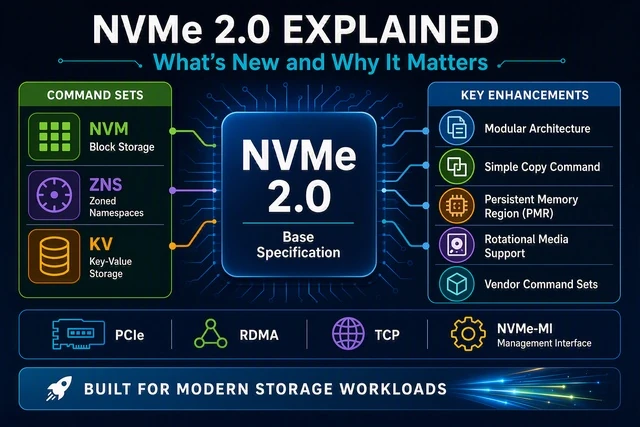
Perhaps the most impactful change in NVMe 2.0 is the introduction of new command sets that decouple the protocol from its block-based origins. This is a critical departure. Historically, NVMe was designed to optimize access for SSDs that presented themselves as traditional hard drives or SSDs – devices that operate on fixed-size blocks of data. This model, while highly effective, inherently limits the protocol's applicability to storage devices that don't fit this paradigm.
NVMe 2.0 introduces three primary command sets:
- NVMe Base Specification: This forms the foundation, defining core features and functionalities that are common across all NVMe devices.
- NVMe-oF (NVMe over Fabrics) Specification: This continues to build upon the previous NVMe-oF, enabling NVMe commands to be transmitted over network fabrics like Ethernet, Fibre Channel, and InfiniBand. This is crucial for disaggregated storage architectures and high-performance computing environments.
- NVMe Protocol Specification: This is the most significant addition, designed to support new storage media and access methods beyond traditional block storage. It includes features for Zoned Namespaces (ZNS) and Key-Value (KV) storage.
ZNS allows storage devices to manage data placement more intelligently. Instead of the host sending data to any arbitrary location, ZNS divides the storage device into zones. Data must be written sequentially within each zone. This simplifies garbage collection on the SSD, reducing write amplification and improving endurance and performance. Think of it less like a free-for-all write operation and more like writing to a pre-defined notebook where each page (zone) has a specific purpose and order of entry.
The Key-Value (KV) storage command set is equally transformative. It allows applications to interact with storage directly using key-value pairs, bypassing the need for a traditional file system or block layer. This is ideal for NoSQL databases, caching layers, and other applications that already operate on a key-value model. Instead of translating a key into a block address, the NVMe device can directly access the data associated with that key, drastically reducing latency and overhead.
Broader Media Support
The new command sets directly enable NVMe 2.0 to support a wider range of storage media. While NAND flash remains a primary target, the protocol is now architected to accommodate persistent memory (like Intel's Optane, though its future is uncertain), emerging non-volatile memory technologies, and even computational storage devices. Computational storage, in particular, is a growing area where processing logic is integrated directly into the storage device itself, allowing for data processing to occur closer to where the data resides. NVMe 2.0 provides the framework for these devices to be managed and accessed efficiently.
Improved Transport Organization
NVMe 2.0 also introduces enhancements to the transport layer. This includes optimizations for how commands and data are organized and transmitted across different interfaces (like PCIe, fabrics, etc.). While the specifics can be highly technical, the goal is to improve efficiency, reduce protocol overhead, and enhance scalability. This means more data can be moved faster and with less CPU intervention, which is critical for high-throughput workloads.
Why NVMe 2.0 Matters
For Developers and Applications
The introduction of ZNS and KV command sets directly impacts application development. Developers can now leverage storage devices that are optimized for their specific data access patterns. For applications that benefit from sequential writes and simplified data management, ZNS offers a path to improved performance and endurance. For those dealing with massive key-value stores, the KV command set provides a direct, low-latency interface, potentially eliminating the need for complex storage abstractions and reducing the software stack's complexity.
This also signals a move towards more specialized storage hardware. Instead of a one-size-fits-all block device, developers might soon choose NVMe drives optimized for KV operations or ZNS, leading to better performance and cost-effectiveness for specific use cases. The implications for databases, caching systems, and big data analytics platforms are substantial.
For System Architects and IT Professionals
NVMe 2.0 promises greater flexibility and consolidation. By supporting a wider range of storage types under a single, high-performance protocol, IT professionals can potentially simplify their infrastructure. The NVMe-oF enhancements continue to drive the trend of disaggregated storage, where storage resources can be pooled and accessed over a network, offering better utilization and scalability. This is particularly relevant for cloud environments and large-scale data centers.
For the Storage Industry
The NVMe 2.0 specification is a clear signal that the industry is moving beyond the limitations of traditional storage interfaces. It positions NVMe as a universal storage fabric capable of evolving with new memory and processing technologies. This standardization is vital for driving innovation, as it provides a common target for hardware vendors and software developers. The broader media support ensures that NVMe can remain relevant as storage technology continues its rapid advance.
The Road Ahead
While NVMe 2.0 defines the future, its widespread adoption will depend on hardware support and software ecosystem development. We are likely to see a gradual rollout, with initial implementations focusing on specific command sets like ZNS and KV. Developers will need to adapt their applications to take advantage of these new capabilities. The transition from a block-centric world to a more diverse storage landscape will take time, but NVMe 2.0 provides the foundational specification to make that transition seamless and high-performance. The expectation is that this will lead to more efficient, faster, and more versatile storage solutions across the board.