Inside Nvidia's Undisclosed Engineering SuperLab
Nvidia has pulled back the curtain on its previously secret Engineering SuperLab, located just miles from its Santa Clara headquarters. This facility is not just another data center; it's a dedicated proving ground for the company's most advanced AI hardware and infrastructure concepts. Tom's Hardware received an exclusive tour, witnessing firsthand the sheer scale of compute power and the innovative engineering driving Nvidia's next generation of AI solutions. The lab serves as a critical testbed, allowing Nvidia engineers to push the boundaries of performance, efficiency, and reliability before these technologies are deployed in customer environments.
At the heart of the SuperLab is the Vera Rubin NVL72, Nvidia's latest high-density GPU platform. This isn't merely an incremental upgrade; it represents a significant leap in how AI workloads can be consolidated and accelerated. The NVL72 is designed to house 72 Hopper H100 Tensor Core GPUs in a compact 8U chassis, a density that is staggering. This allows for an unprecedented amount of AI compute to be packed into a smaller physical footprint, a crucial factor for hyperscalers and large enterprises grappling with the ever-increasing demands of AI model training and inference.
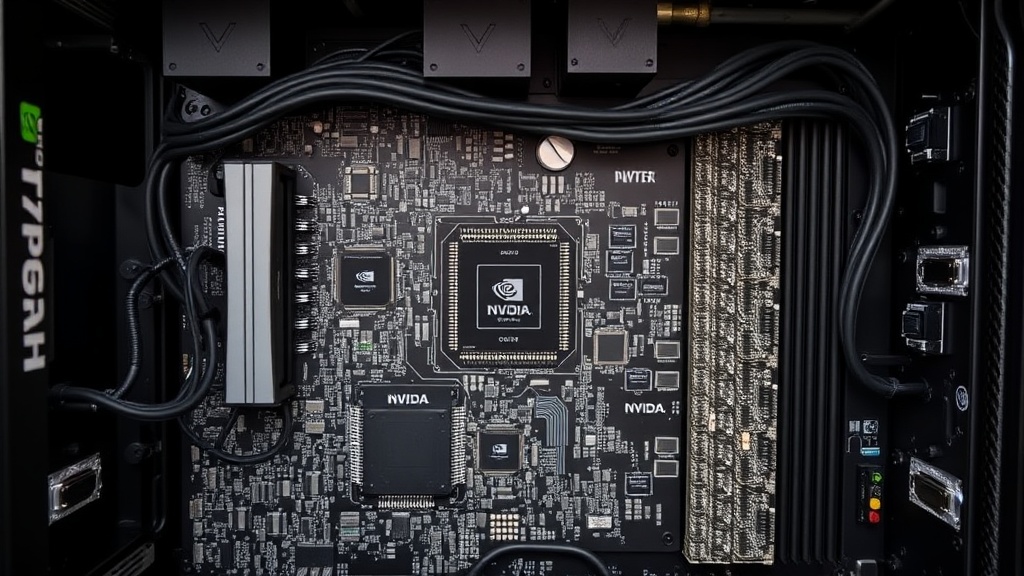
Vera Rubin NVL72: A New Paradigm for AI Compute Density
The Vera Rubin NVL72 system is a testament to Nvidia's relentless pursuit of density and performance. Each NVL72 unit is a powerhouse, capable of delivering petascale AI performance. The engineering challenge lies not just in fitting 72 H100 GPUs into a single rack unit, but in ensuring they can all operate at peak efficiency. This involves sophisticated thermal management, high-bandwidth interconnects, and robust power delivery systems. The lab environment allows Nvidia to stress-test these systems under extreme conditions, identifying and resolving potential bottlenecks before they become issues in real-world deployments.
During the tour, Nvidia demonstrated the NVL72 running demanding OpenAI workloads. This is significant because OpenAI's models are among the most complex and resource-intensive being developed today. Seeing the NVL72 handle these workloads with apparent ease highlights its capability to support the cutting edge of AI research and development. The ability to run such massive models on a consolidated platform translates directly into faster iteration cycles for AI researchers and developers, accelerating the pace of innovation. This level of integrated compute is becoming essential as AI models grow larger and more complex.
800VDC Power Delivery: The Future of Data Center Efficiency
Beyond raw compute, the SuperLab is also a showcase for advanced data center infrastructure. One of the most striking demonstrations was Nvidia's work with 800VDC power delivery. Traditional data centers typically operate at lower DC voltages (like 48V) or rely on AC power distribution. Stepping up to 800VDC offers substantial efficiency gains. Higher voltage means lower current for the same amount of power, which in turn reduces resistive losses (I²R losses) in cabling. This translates to less energy wasted as heat, lower operational costs, and a reduced carbon footprint. For AI workloads, which are notoriously power-hungry, these efficiency improvements are critical.
Nvidia's engineers explained that implementing 800VDC requires specialized power supplies, cabling, and safety protocols. However, the benefits are compelling. The SuperLab is used to validate these systems, proving their reliability and performance under load. This is not just theoretical; Nvidia is actively designing systems that can leverage this higher voltage power infrastructure. This forward-thinking approach to power delivery is essential for building sustainable and cost-effective AI data centers of the future. The transition to 800VDC is akin to upgrading from a narrow country road to a multi-lane superhighway for electricity, allowing far more data to flow with less friction.
Beyond the Hardware: A Holistic Approach to AI Infrastructure
The Engineering SuperLab isn't just about showcasing individual pieces of hardware; it's about validating entire AI infrastructure solutions. This includes the integration of compute, networking, storage, and power management. Nvidia's strategy extends beyond selling GPUs; they are increasingly focused on providing complete platforms and reference architectures for building AI data centers. The SuperLab allows them to test these integrated solutions rigorously, ensuring that everything from the server chassis to the power distribution and cooling systems works in harmony.
This holistic approach is vital for customers who are building massive AI deployments. They need assurance that the components will work together seamlessly and reliably. By simulating real-world conditions and extreme operational scenarios within the SuperLab, Nvidia can identify potential interoperability issues and optimize performance across the entire stack. This deep engineering insight is what differentiates Nvidia's approach and helps its customers accelerate their AI journeys without getting bogged down in infrastructure complexities.
The implications of the Vera Rubin NVL72 and the exploration of 800VDC power are clear: Nvidia is not only building the most powerful AI accelerators but also the most efficient and dense infrastructure to support them. The Engineering SuperLab is the hidden engine driving these innovations, a place where the future of AI data centers is being forged. As AI workloads continue to scale, the kind of integrated, high-density, and efficient solutions being developed and tested here will become indispensable.