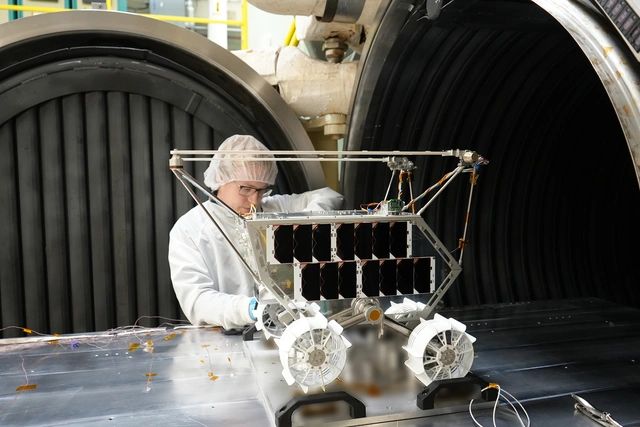
Nvidia's Lunar AI Initiative
Nvidia is extending its reach beyond Earth, partnering with Intuitive Machines to equip lunar missions with advanced AI processing capabilities. This collaboration marks a significant step in enabling sophisticated artificial intelligence operations in extraterrestrial environments. The initiative aims to leverage Nvidia's powerful GPUs to process vast amounts of data collected on the Moon, accelerating scientific discovery and paving the way for future space exploration endeavors.
The core of this mission involves deploying Nvidia's Jetson AGX Orin system, a compact yet potent AI computer, onto Intuitive Machines' lunar lander. This system is designed to handle the demanding computational tasks required for real-time data analysis, navigation, and potentially autonomous operations on the lunar surface. The Jetson AGX Orin is capable of running complex AI models, enabling tasks such as identifying geological features, analyzing soil samples, and supporting scientific experiments with unprecedented speed and efficiency.
This deployment is more than just a technological demonstration; it's a critical enabler for the future of space science. By bringing AI processing directly to the Moon, scientists can receive analyzed data much faster, reducing reliance on slow and bandwidth-limited communication with Earth. This immediacy is crucial for scientific breakthroughs, allowing researchers to make decisions and adjust experiments on the fly, much like they would in a terrestrial lab. The potential applications range from in-situ resource utilization (ISRU) research to advanced astronomical observations from a unique vantage point.
The Technical Challenge of Lunar AI
Operating complex computing hardware in the harsh lunar environment presents unique engineering challenges. The Jetson AGX Orin, while robust, must be further hardened to withstand extreme temperature fluctuations, radiation, and the vacuum of space. Nvidia and Intuitive Machines are working to ensure the system's reliability through specialized thermal management, radiation shielding, and rigorous testing protocols. The system's power consumption is also a critical factor, requiring efficient energy management, likely drawing power from the lander's solar arrays and batteries.
The choice of the Jetson AGX Orin is strategic. It represents a balance between computational power and form factor, making it suitable for space-constrained lander payloads. Its ability to perform complex AI inference at the edge means that raw sensor data can be processed locally, reducing the amount of data that needs to be transmitted back to Earth. This is akin to having a powerful mini-supercomputer on the Moon, capable of making sense of the environment without constant human oversight or a direct tether to ground control. This capability is essential for long-duration missions and for enabling greater autonomy for future lunar bases or even interplanetary missions.
The data processed by the GPUs could include high-resolution imagery from lunar cameras, spectral analysis data from scientific instruments, and sensor readings related to the lunar regolith. For instance, AI algorithms running on the Jetson AGX Orin could be trained to identify water ice deposits, crucial for future human habitation and resource extraction, or to map out areas of scientific interest with greater precision than previously possible. The system's flexibility allows for different AI models to be deployed and updated, adapting to new scientific objectives as the mission progresses.
Broader Implications for Space Exploration
This collaboration signifies a growing trend of integrating advanced AI and high-performance computing into space missions. As humanity looks towards establishing a sustained presence on the Moon and venturing further into the solar system, the need for intelligent, autonomous systems will only increase. Nvidia's involvement suggests that commercial off-the-shelf (COTS) AI hardware, with appropriate ruggedization, can play a vital role in these ambitious undertakings.
The success of this mission could serve as a blueprint for future lunar and Martian exploration. Imagine rovers that can autonomously identify scientifically valuable rock samples or orbital satellites that can process Earth observation data in real-time, flagging areas of interest for further investigation. The computational power brought to bear by systems like the Jetson AGX Orin, combined with the ingenuity of space exploration companies like Intuitive Machines, is set to redefine what is possible beyond our atmosphere.
What remains to be seen is how the data processed by these lunar GPUs will translate into tangible scientific discoveries and how this technology will evolve for even more demanding deep-space missions. The journey of Nvidia's GPUs to the Moon is not just about hardware; it's about unlocking a new era of AI-driven space exploration, bringing the power of intelligent computation to the final frontier.