Extreme Power Demands Emerge for Next-Gen Gaming
The advent of advanced AI-driven technologies like Nvidia's Deep Learning Super Sampling (DLSS) promises significant leaps in gaming performance, enabling higher frame rates and more visually stunning experiences. However, this technological prowess comes at a steep cost: unprecedented power consumption. Recent tests on what is understood to be Nvidia's upcoming GeForce RTX 5090 GPU, likely leveraging DLSS 5 capabilities, reveal alarming thermal and power draw figures. QuasarZone's testing, as reported by Tom's Hardware, shows the GPU peaking at nearly 650W, with a staggering 647W recorded during intensive workloads. This surge in power demand is pushing the limits of the current generation of power delivery hardware, particularly the 16-pin (12VHPWR) power connector.
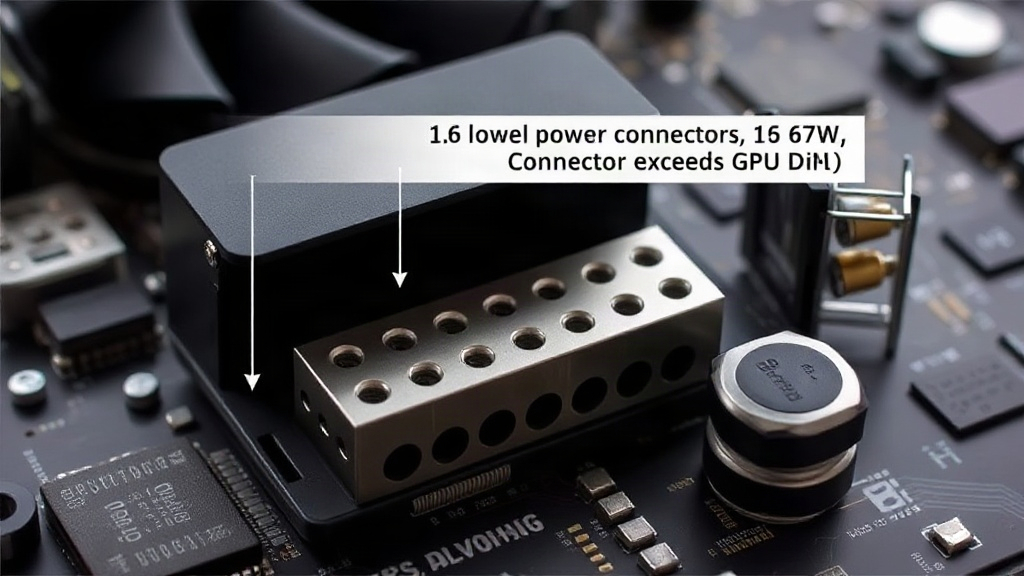
The core issue lies not just in the total wattage consumed, but in how that power is delivered and managed. The 16-pin connector, designed to consolidate power delivery for high-end graphics cards, is reportedly reaching temperatures exceeding 90 degrees Celsius under peak load. This is a critical concern because these temperatures are higher than the GPU die itself, which is designed to operate within specific thermal envelopes. The implications are significant for system stability, component longevity, and user safety. While the GPU die is engineered to dissipate heat effectively, the power connector and its associated cabling are not typically subjected to such extreme thermal stress. This scenario suggests that the current infrastructure supporting these high-performance components may be inadequate for the demands of future AI-accelerated gaming technologies.
Thermal Challenges of the 16-Pin Connector
The 16-pin 12VHPWR connector was introduced to simplify power delivery for the most power-hungry GPUs, consolidating multiple 8-pin PCIe power connectors into a single, more robust interface. Its design allows for up to 600W of power delivery per cable, with the potential for higher outputs through specific implementations. However, the reported temperatures of over 90 degrees Celsius on the connector itself, while the GPU die operates at a cooler temperature, indicate a bottleneck in thermal management at the point of power ingress. This is analogous to a high-performance engine being starved of fuel due to a narrow fuel line, leading to excessive heat buildup in the line itself rather than efficient combustion. The connector and its immediate surroundings are becoming the thermal weak point.
Several factors could contribute to this overheating. Inefficient power conversion within the GPU, poor contact resistance at the connector, or inadequate airflow around the connector and its cables can all exacerbate thermal issues. Furthermore, the physical design of the connector and the gauge of the wires within the cable play a crucial role. If these are not precisely engineered to handle such sustained high-wattage, high-temperature operation, they can become a fire hazard. The fact that the connector is hotter than the GPU die is particularly concerning, as GPU cooling solutions are highly advanced, whereas the thermal management of the power connector is often an afterthought for system builders and component manufacturers alike. This raises questions about the testing and validation processes for these new power delivery standards under real-world, extreme AI-driven gaming loads.
The Power Draw Phenomenon: What 647W Means
A power draw of 647W for a single graphics card is an extraordinary figure. For context, many high-end gaming PCs from just a few years ago had total system power supply unit (PSU) recommendations in this range. This means that a single GPU is now demanding as much power as an entire, albeit less powerful, system once did. This level of consumption has direct implications for the entire PC ecosystem. Users will require substantially more powerful PSUs, likely exceeding 1000W, to reliably power these GPUs and the rest of their system components. The increased power draw also translates directly into higher electricity bills, a factor that is becoming increasingly relevant for consumers as hardware capabilities advance.
Beyond the immediate hardware requirements, this power draw signifies a fundamental shift in the demands placed upon PC hardware by AI-enhanced applications. DLSS 5, by leveraging more sophisticated AI models and potentially higher resolution upscaling or more complex AI-driven features, is pushing the computational and thus the power requirements to new heights. This is not merely an incremental increase; it represents a significant jump that challenges the existing paradigms of power delivery and thermal management in consumer-grade hardware. The industry must now grapple with how to provide this immense power safely and efficiently, ensuring that the pursuit of graphical fidelity does not compromise the stability or longevity of the hardware.
Broader Implications for the Gaming and AI Hardware Landscape
The findings from the QuasarZone tests highlight a critical juncture for the PC hardware industry. As AI continues to permeate gaming and other computationally intensive applications, the demands on GPUs will only escalate. This situation is not unique to Nvidia; all manufacturers pushing the boundaries of AI acceleration will face similar challenges. The industry needs a coordinated effort to address these power and thermal issues. This could involve developing new connector standards, improving the thermal design of existing connectors and cables, and educating consumers on the importance of robust power delivery systems and proper cable management. The surprising detail here is not the raw power draw, but the thermal performance of the power connector itself, an often-overlooked component that is now proving to be a critical vulnerability.
For system builders and enthusiasts, this is a clear signal that future builds will require meticulous attention to power supply selection, cable quality, and case airflow. Ignoring these factors could lead to system instability, reduced component lifespan, or even safety hazards. The pursuit of higher frame rates and enhanced visual realism through AI is a powerful driver, but it necessitates a commensurate evolution in the supporting hardware infrastructure. The industry must innovate not only in processing power but also in the fundamental aspects of power delivery and thermal dissipation to ensure that these advancements are sustainable and safe for end-users.