%22%20%2F%3E%0A%20%20%3C%2Fsvg%3E)
Combating AI-Generated Misinformation in Broadcasts
The proliferation of AI-generated content, particularly synthetic videos, presents a significant challenge to information integrity, especially within broadcast media. Nvidia has developed a new Synthetic Video Detector, a microservice designed to identify manipulated or entirely fabricated video footage. This tool operates with remarkable speed and accuracy, aiming to equip broadcasters with a critical defense against the spread of misinformation. The detector can process uncompressed 1080p footage with an accuracy rate of up to 92%, and crucially, it achieves this in just 22 milliseconds per frame. This rapid processing time is essential for real-time broadcast environments where immediate verification is paramount.
The underlying technology leverages cutting-edge research in AI and computer vision. While the specifics of the algorithms are proprietary, it's understood that the detector analyzes subtle artifacts and inconsistencies within video frames that are often imperceptible to the human eye but indicative of AI manipulation. This could include analyzing pixel-level anomalies, temporal inconsistencies between frames, or unnatural motion patterns that AI generation models might introduce. The development signifies a crucial step towards creating a more trustworthy media landscape, especially as AI video generation tools become more sophisticated and accessible.
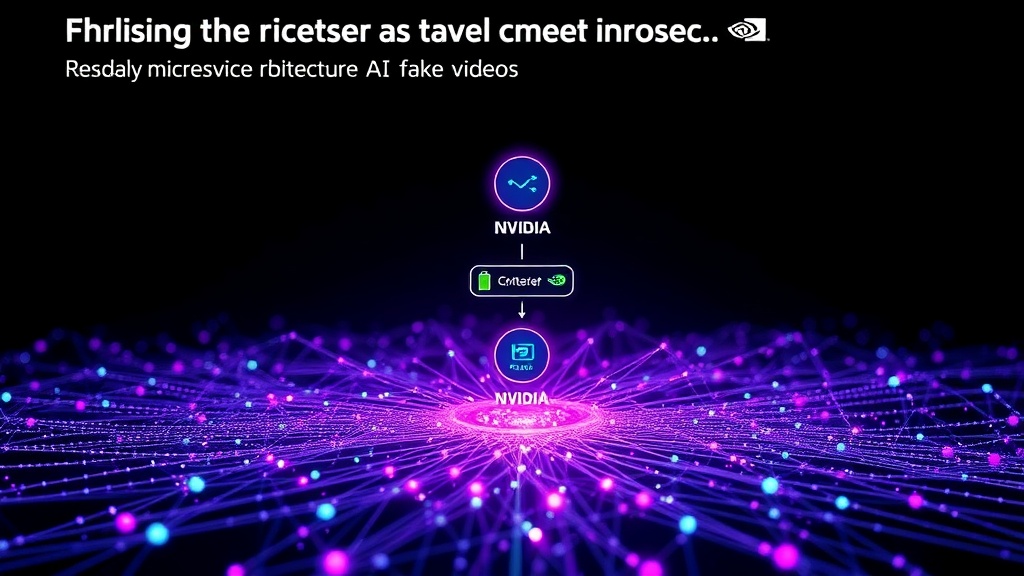
Nvidia's focus on a microservice architecture suggests an intent for easy integration into existing broadcast workflows. This approach allows broadcasters to deploy the detector as a modular component within their larger systems, rather than requiring a complete overhaul of their infrastructure. The ability to handle 1080p footage at scale means it can be applied to a wide range of broadcast content, from live news segments to pre-recorded programming. The 22ms processing speed is particularly noteworthy; it means that a significant amount of video can be analyzed in near real-time, allowing for rapid flagging of suspicious content before it goes to air or as it is being processed.
Technical Capabilities and Performance
The accuracy of up to 92% is a significant achievement, placing Nvidia's detector among the leading solutions for synthetic media detection. It is important to note that this accuracy rate is reported for uncompressed videos. Compressed videos, commonly used in broadcast transmission and online streaming, often introduce their own artifacts that could potentially affect detection accuracy. However, the 22ms processing time per frame is a critical metric for broadcast applications. For a 30 frames-per-second video stream, this translates to analyzing each frame almost instantaneously, enabling a near real-time detection pipeline. This speed is comparable to the latency experienced in many live production environments, making it feasible for immediate decision-making.
The detector's ability to process 1080p footage means it is capable of handling standard high-definition broadcast quality. Future iterations may extend this capability to higher resolutions such as 4K or 8K. The system's design as a microservice also implies that it can be scaled horizontally to meet the demands of large broadcasters with extensive content pipelines. This modularity allows for flexibility in deployment, whether integrated directly into ingest systems, playout servers, or content moderation platforms.
While Nvidia has not disclosed the exact training data or methodology, it is highly probable that the model was trained on a diverse dataset of both real and synthetic videos. This dataset would likely include various types of AI-generated content, such as deepfakes created using different generative adversarial networks (GANs) and other synthesis techniques. The effectiveness of the detector against novel or emerging AI generation methods will be a key factor in its long-term utility. The rapid evolution of AI synthesis means that detection models must continuously adapt to remain effective.
Implications for Broadcasting and Media Integrity
The introduction of Nvidia's Synthetic Video Detector has profound implications for the broadcast industry. Broadcasters are increasingly concerned about the potential for malicious actors to insert AI-generated disinformation into news feeds or live programming. Such content could be used to manipulate public opinion, damage reputations, or sow societal discord. A reliable, fast, and accurate detection tool can serve as a crucial line of defense, helping to maintain the credibility of news organizations and the information they provide to the public.
This technology could fundamentally alter content verification workflows. Instead of relying solely on human review, which is time-consuming and prone to error, broadcasters can augment their processes with automated AI detection. This allows human editors and fact-checkers to focus on more complex cases or to review content flagged by the AI. The speed of the detector means that potentially harmful synthetic content could be identified and removed before it ever reaches viewers, mitigating the risk of widespread dissemination. The platform neutrality of the detector, being a separate microservice, means it could theoretically be adopted by any broadcaster, regardless of their existing video infrastructure, provided they can integrate the service.
However, a critical question remains: what happens when the detector is not 100% accurate? Even at 92%, there is a 8% chance of either a false positive (flagging real video as fake) or a false negative (missing a fake video). For broadcasters, the consequences of either error can be severe. A false positive could lead to the unnecessary censorship or delay of legitimate content, while a false negative allows misinformation to slip through. The industry will need robust protocols to handle these edge cases, likely involving layered verification processes that combine AI detection with human expertise. The ongoing arms race between AI generation and AI detection means that this tool, while powerful today, will require continuous updates and retraining to keep pace with evolving synthetic media techniques.
The Broader Fight Against AI Misinformation
Nvidia's Synthetic Video Detector is part of a larger, industry-wide effort to combat the growing threat of AI-driven misinformation. As AI models become more capable of generating realistic text, images, and videos, the potential for misuse escalates. This tool from Nvidia offers a specific solution for the video domain, complementing other efforts in text and image detection. The development underscores the dual nature of AI: it can be used to create sophisticated misinformation, but it also provides the tools necessary to detect and counter it.
The research and development behind this detector highlight the increasing importance of specialized AI tools for maintaining digital trust. For content creators, media organizations, and even social media platforms, having access to reliable detection mechanisms is becoming non-negotiable. The speed and accuracy of Nvidia's offering suggest a future where AI verification is an integrated, seamless part of content creation and distribution pipelines. The challenge for Nvidia and others in this space will be to stay ahead of the curve, ensuring their detection capabilities evolve as rapidly as the AI generation techniques they aim to counter. The race is on, and tools like this are essential participants.