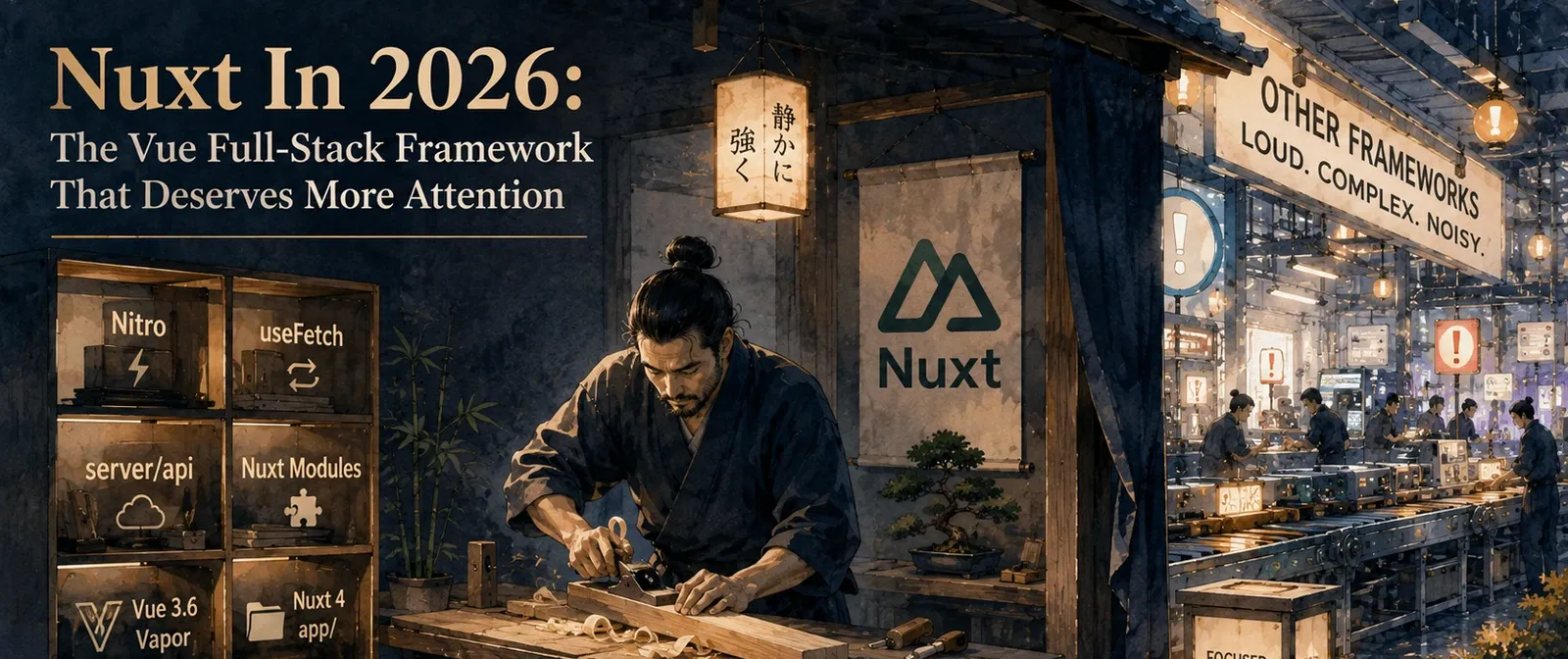
Nuxt's Quiet Ascendancy
In 2026, the JavaScript ecosystem largely points to Next.js as the de facto full-stack framework. Job postings, AI development tools, and conference discussions frequently center on React Server Components and related paradigms. Even developers unfamiliar with Vue.js have strong opinions on Next.js's data fetching methods. This widespread consensus, however, overlooks a significant shift happening elsewhere.
Nuxt, the Vue-based counterpart, has spent the past two years undergoing a profound transformation. With the release of Nuxt 4 in July 2025 and its subsequent iteration to v4.4.x, the framework is more robust and thoughtfully designed than ever. The upcoming Nuxt 5, powered by the new Nitro v3 engine, signals continued innovation. For those who last encountered Nuxt during the turbulent v2-to-v3 migration, the current iteration is a fundamentally different and significantly improved experience.
This is not an article arguing that Nuxt is definitively "better" than Next.js. Instead, it's an examination of Nuxt's considerable strengths and its compelling case for developers seeking a powerful, integrated Vue full-stack solution. The framework has matured to a point where it deserves more than just a passing glance from the wider development community.
Nuxt 4: Architecture and Key Innovations
Nuxt 4 represents a significant leap forward, focusing on developer experience, performance, and a more cohesive full-stack architecture. Central to this evolution is the Nitro engine, which has been a cornerstone of Nuxt's server-side capabilities since v3. Nitro acts as a universal rendering engine, abstracting away the complexities of different deployment targets. Whether targeting Node.js, serverless functions, edge workers, or static sites, Nitro ensures a consistent build and runtime experience. This flexibility means developers can write code once and deploy it across a wide array of environments without significant refactoring.
The framework's composable architecture, deeply integrated with Vue 3's Composition API, allows for highly reusable and maintainable code. Nuxt provides a structured way to organize application logic, routes, state management, and server routes, reducing boilerplate and promoting best practices. Features like auto-imports for components, composables, and utilities streamline development, allowing developers to focus on building features rather than managing imports.
Nuxt 4 also enhances its module ecosystem. Modules provide a standardized way to extend Nuxt's functionality, ranging from UI frameworks like Tailwind CSS and Vuetify to authentication solutions and content management systems. The v4 release has seen a significant update to the module API, making it more powerful and easier to create custom extensions. This modularity allows teams to tailor Nuxt to their specific project needs, creating custom, opinionated frameworks within the framework itself.
Developer Experience: Beyond the Hype
While Next.js often touts its developer experience, Nuxt 4 offers a compelling alternative, particularly for those invested in the Vue ecosystem. The framework's built-in conventions for routing, data fetching, and server API endpoints significantly reduce the cognitive load. Auto-generated routes based on file structure, for instance, eliminate the need for manual route configuration. The `useFetch` and `useAsyncData` composables simplify server-side data fetching and client-side hydration, ensuring data is fetched efficiently and seamlessly.
Nuxt 4's integrated approach to server routes is another significant advantage. Developers can define API endpoints directly within their Nuxt project using the `server/api` directory. This co-location of frontend and backend logic within a single codebase simplifies full-stack development, making it easier to manage dependencies and deploy applications. The Nitro engine further enhances this by providing a consistent API layer across different deployment targets, abstracting away the underlying server environment.
The framework's commitment to TypeScript is also a major boon for developer productivity and code quality. Nuxt 4 offers first-class TypeScript support out-of-the-box, with type inference and auto-completion enhancing the development process. This focus on developer ergonomics, combined with Vue's approachable nature, makes Nuxt an attractive choice for teams looking to build complex applications efficiently and with confidence.
Performance and Deployment Flexibility
Performance is a critical aspect of modern web development, and Nuxt 4 doesn't disappoint. Leveraging Vue 3's reactivity system and Nitro's optimized server engine, Nuxt applications are designed for speed. The framework supports various rendering strategies, including Server-Side Rendering (SSR), Static Site Generation (SSG), Incremental Static Regeneration (ISR), and Client-Side Rendering (CSR), allowing developers to choose the best approach for their specific use case. This adaptability ensures optimal performance for a wide range of applications, from content-heavy websites to dynamic, interactive web applications.
The true power of Nuxt 4 lies in its deployment flexibility, largely thanks to Nitro. Nitro's ability to compile Nuxt applications into highly optimized bundles for various runtimes means developers are not locked into a single hosting provider or infrastructure. Deploying to Vercel, Netlify, Cloudflare Workers, AWS Lambda, or even a traditional Node.js server becomes a straightforward process. This universality is a significant advantage, offering freedom and reducing vendor lock-in. The framework's built-in support for hybrid rendering, where different parts of an application can use different rendering strategies, further optimizes performance and cost.
The Future: Nuxt 5 and Nitro v3
The roadmap for Nuxt is ambitious. Nuxt 5, built on the upcoming Nitro v3 engine, promises even greater performance and new architectural possibilities. While details are still emerging, the focus is expected to be on further abstracting server infrastructure, enhancing developer tooling, and potentially exploring new paradigms like React Server Components-inspired features but within the Vue ecosystem. The goal is to provide a seamless, high-performance full-stack experience that remains deeply integrated with Vue's strengths.
The continued development of Nuxt and Nitro suggests a long-term commitment to providing a comprehensive and forward-thinking solution for Vue developers. As the web evolves, Nuxt appears poised to adapt, offering a robust platform that balances developer productivity with cutting-edge performance and deployment capabilities. While Next.js will undoubtedly continue to dominate many conversations, Nuxt's trajectory indicates it will remain a formidable and increasingly attractive choice for full-stack Vue development.