The Problem with Component State for URL-Bound Data
Many web applications rely on URL parameters to manage state. Think of a product listing page where users filter by price, category, or color. When a user shares this URL, they expect the recipient to land on the exact same filtered view. However, a common pitfall arises when this state is managed solely with React's useState hook. When the component unmounts or the page reloads, this state is lost. The shared URL becomes a dead link, frustrating users and breaking the expected experience.
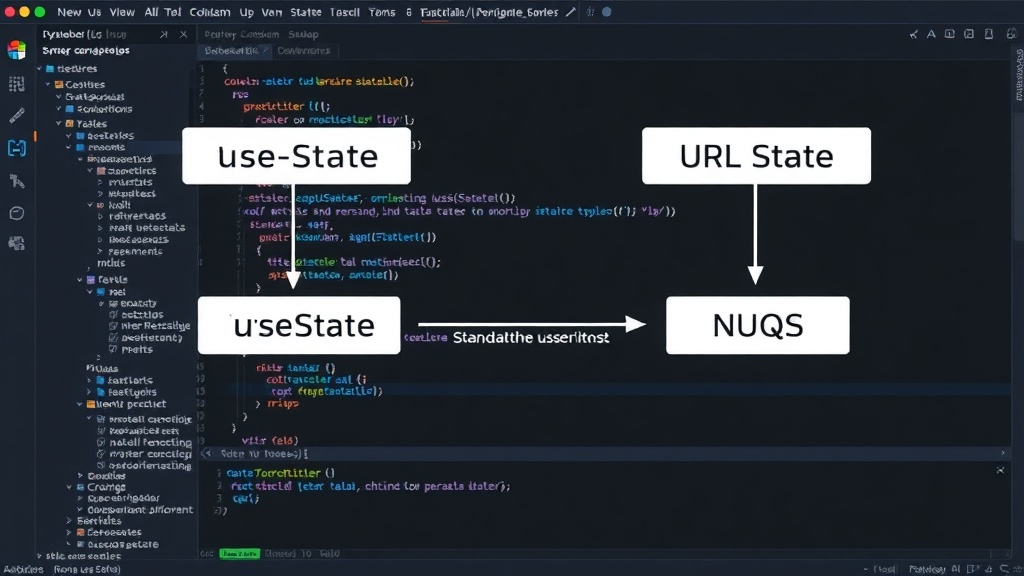
This is precisely the problem nuqs aims to solve. It provides a familiar API, designed to be compatible with useState, but with a crucial difference: the URL itself becomes the source of truth for the state. This means that any state managed by nuqs will persist across page reloads and can be shared directly via the URL, ensuring that users always land on the intended application state.
How nuqs Works: The useState-Compatible API
nuqs introduces a hook that mirrors the functionality of useState. Instead of storing the state in React's memory, it syncs with the browser's URL query parameters. This approach offers several key advantages:
- Persistence: State survives page reloads and browser tab closures.
- Shareability: URLs with state parameters can be shared, and recipients will see the same filtered or sorted view.
- Bookmarkability: Users can bookmark specific application states.
- SEO Benefits: Search engines can potentially index different states of a page if they are reflected in the URL.
The library's core is its ability to abstract away the complexities of URL manipulation. Developers can use nuqs with minimal changes to their existing codebase. For instance, a typical useState declaration like this:
const [search, setSearch] = useState('');can be transformed into a nuqs declaration:
import { useNuqs } from 'nuqs';

const [search, setSearch] = useNuqs('search', '');
Here, 'search' is the key that will be used in the URL's query string (e.g., ?search=example). The second argument, '', is the default value, similar to how useState works.
Beyond Basic State: Nuqs and Complex Data Types
nuqs doesn't stop at simple string values. It supports various data types, including numbers, booleans, arrays, and even objects, by serializing and deserializing them to and from the URL. This is particularly useful for managing complex filtering criteria or pagination states.
For example, managing an array of selected tags could be done with:
const [tags, setTags] = useNuqs('tags', [] as [string[]]);When setTags is called with a new array, nuqs automatically updates the URL. For instance, if the URL was /products and setTags(['electronics', 'sale']) is called, the URL becomes /products?tags=electronics,sale. The library handles the conversion of arrays to comma-separated strings and back.
Managing objects requires a bit more consideration regarding serialization. nuqs leverages built-in browser APIs or custom serializers to handle this. For complex objects, it might stringify them using JSON.stringify and parse them with JSON.parse on the other end. This ensures that intricate state structures can also be persisted and shared.
Integrating Nuqs with Next.js
nuqs is specifically designed for Next.js, taking advantage of its routing and rendering capabilities. The library works seamlessly with Next.js's App Router and Pages Router. For server-side rendering (SSR) or static site generation (SSG) scenarios, nuqs can hydrate the initial state from the URL on the server, ensuring that the rendered HTML already reflects the correct state. This avoids client-side re-renders and improves perceived performance.
The library's integration with Next.js's routing means that route changes initiated by nuqs are handled efficiently. When the state is updated, nuqs triggers a navigation event that Next.js processes. This ensures that the browser history is updated correctly, and the URL reflects the current application state.
The Counter-Intuitive Advantage: URL as the Single Source of Truth
The most surprising detail about nuqs is its radical embrace of the URL as the primary state container. In many modern SPAs, the URL is often treated as a secondary source of truth, updated only after the primary state (e.g., in useState or a global store) has changed. nuqs flips this paradigm. It makes the URL the authoritative source. This might seem counter-intuitive at first, as developers are conditioned to think of the URL as a passive reflection rather than an active state manager. However, this approach inherently solves the problems of state loss and shareability that plague traditional client-side state management for URL-bound data.
Consider a scenario where multiple components need to access and modify the same URL parameter. With useState, this would typically involve prop drilling or a global state management solution. nuqs simplifies this by allowing multiple components to simply call useNuqs with the same key. They all get the same state value, and any update from one component is immediately reflected for all others, directly via the URL synchronization.
What's Next for URL State Management?
Libraries like nuqs signal a broader trend towards leveraging the browser's URL for more than just navigation. As applications become more complex and state management more critical, developers are looking for robust, declarative ways to handle state that is inherently shareable and persistent. The success of nuqs will likely depend on its continued performance, ease of integration, and community adoption. It also raises the question of how other meta-frameworks and front-end architectures will adopt similar patterns for URL-driven state management.
For developers building data-heavy interfaces in Next.js, nuqs offers a compelling solution to a persistent problem. By treating the URL as a first-class citizen for state management, it simplifies development and enhances the user experience significantly.