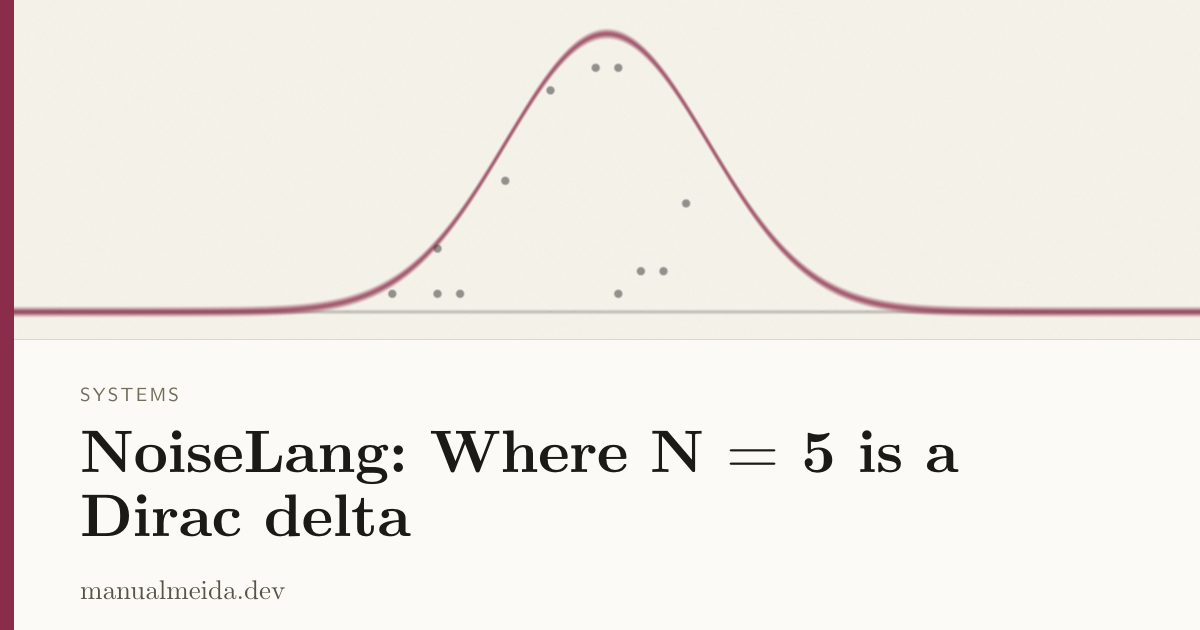
Introducing NoiseLang: A Novel Probabilistic Programming Language
Manual Almeida’s NoiseLang is a new domain-specific language (DSL) designed for probabilistic programming. Its core innovation lies in its treatment of discrete states, particularly in the context of probability distributions. Unlike traditional approaches that strictly separate discrete and continuous variables, NoiseLang blurs this line by representing discrete states as continuous distributions, a concept exemplified by the statement "N = 5 is a Dirac delta." This approach aims to simplify complex probabilistic models and enable new forms of analysis and computation within the field.
Probabilistic programming languages (PPLs) are powerful tools that allow developers to express probabilistic models and perform inference. They are used in a wide array of applications, from machine learning and Bayesian statistics to robotics and artificial intelligence. Existing PPLs often rely on underlying mathematical frameworks that can sometimes be cumbersome when dealing with mixed discrete and continuous variables, or when representing very specific, deterministic outcomes within a probabilistic context.
The Dirac Delta as a Continuous Representation
The statement "N = 5 is a Dirac delta" is central to understanding NoiseLang’s philosophy. In mathematics and physics, a Dirac delta function is a generalized function that is zero everywhere except at zero, where it is infinitely large, yet its integral over all space is 1. It is often used to represent a discrete point or an impulse. In the context of NoiseLang, representing a discrete value like '5' as a Dirac delta within a continuous framework means that this value has a probability of 1.0 at that specific point and 0 everywhere else.
This is not a novel concept in advanced mathematics, but its direct implementation and abstraction within a programming language for general probabilistic modeling is a significant departure. It allows for a unified representation of both deterministic outcomes and probabilistic uncertainty. For instance, a variable that must be '5' can be modeled as a continuous distribution with infinite density at 5 and zero elsewhere. This simplifies the syntax and semantics for users, abstracting away the complexities of mixed-variable inference.
Consider a scenario where you are modeling the outcome of a coin flip. Traditionally, you might use a Bernoulli distribution. With NoiseLang's approach, you could conceptually model this as a continuous distribution where the probability mass is concentrated at two points, representing heads and tails, each with a probability of 0.5. If, however, you wanted to model a situation where an event *must* occur, but you are still within a probabilistic framework, a Dirac delta representation for that specific outcome becomes incredibly useful. It ensures that the model doesn't assign probability to impossible states.
Implications for Model Simplicity and Expressiveness
The unified representation offered by NoiseLang has several potential benefits. Firstly, it can lead to more concise and readable model definitions. Developers don't need to switch between different types of distributions or inference algorithms for discrete versus continuous variables in many cases. This uniformity can reduce the cognitive load and potential for errors when building complex probabilistic systems.
Secondly, it opens up new avenues for inference algorithms. By treating all variables as continuous, even those representing discrete quantities, NoiseLang might leverage advanced continuous optimization and sampling techniques, such as Hamiltonian Monte Carlo (HMC) or Variational Inference, more directly. This could potentially lead to more efficient and accurate inference, especially in high-dimensional or complex models.
The language aims to provide a high-level abstraction that hides the underlying computational complexity. For a developer, defining a variable that can only take the value '5' might look as simple as `variable x = delta(5)`. This `delta(5)` function would internally represent a Dirac delta distribution centered at 5. If this variable were part of a larger probabilistic model, the inference engine would understand that this specific variable contributes no uncertainty and must evaluate to 5, simplifying the overall inference problem without explicit user intervention.
Potential Applications and Future Directions
The applications for a language like NoiseLang are broad. In machine learning, it could simplify the modeling of latent discrete variables in generative models or the representation of categorical features in Bayesian networks. In robotics, it could be used for state estimation where certain sensor readings or actuator states might be deterministically known at times, while others are uncertain.
For creators and data scientists, NoiseLang offers a new paradigm for building probabilistic simulations and analyses. The ability to seamlessly blend deterministic constraints with probabilistic uncertainty could lead to more realistic and flexible models for everything from financial forecasting to scientific simulations. The core challenge will be in the efficiency and scalability of the inference algorithms that can effectively handle these continuous representations of discrete phenomena.
What remains to be seen is how NoiseLang's inference engine will perform in practice on large-scale, real-world problems. While the theoretical elegance of representing discrete states as Dirac deltas is compelling, the computational cost of maintaining and sampling from such distributions, especially when they are part of a complex graphical model, could be a significant hurdle. The practical performance benchmarks against established PPLs will be crucial for its adoption.