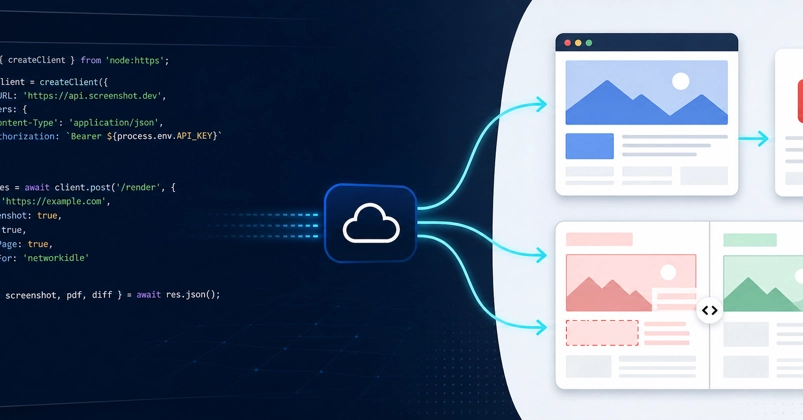
The Screenshot Trap in Node.js
Developers shipping features that require taking screenshots from Node.js often encounter unexpected complexities. The initial approach might seem straightforward, as demonstrated by a simple code snippet using a library like Puppeteer:
await page.goto(url);
await page.screenshot({ path: "page.png", fullPage: true });
However, this simplicity evaporates when moving to production environments. Critical dependencies like Chromium must be installed correctly, font differences between machines can lead to rendering variations, and pages might hang indefinitely, causing timeouts and failed jobs. These issues transform a seemingly trivial task into a significant engineering hurdle.
The core challenge lies in the discrepancy between a local development setup and the diverse, often resource-constrained, production environments. Managing these dependencies, ensuring consistent rendering across different operating systems and architectures, and implementing robust error handling for network issues or slow-loading pages are non-trivial problems. Traditional browser automation tools, while powerful, require careful configuration and maintenance to operate reliably at scale. This is where specialized Node.js screenshot APIs aim to provide a more streamlined and robust solution.
Beyond Basic Screenshots: PDFs and Visual Diffs
Modern web applications often require more than just static image captures. The ability to generate PDFs directly from web pages is crucial for reporting, archiving, and document generation. Similarly, visual diffing – comparing two versions of a webpage to highlight changes – is essential for automated visual regression testing, a critical practice in ensuring UI stability and preventing unintended visual bugs.
A comprehensive Node.js screenshot API should abstract away the complexities of browser automation and provide direct methods for these advanced use cases. For PDF generation, this typically involves leveraging the browser's built-in print-to-PDF functionality, but wrapped in an easy-to-use API that handles page breaks, headers, footers, and other print-specific configurations. This allows developers to convert complex web content into a structured, printable document format without deep knowledge of PDF specifications.
Visual diffing adds another layer of utility. The process involves capturing screenshots of two different states of a webpage (e.g., before and after a code change) and then using image processing algorithms to identify and highlight the differences. An effective API would automate this entire workflow, from capturing the baseline and comparison images to generating a diff image that clearly shows what has changed. This is invaluable for continuous integration pipelines, where automated visual tests can catch regressions before they reach users.
Addressing Production Challenges
The real value of a dedicated Node.js screenshot API lies in its ability to solve the production deployment issues. This typically involves several strategies:
- Managed Infrastructure: Instead of requiring developers to install and manage Chromium on their own servers, the API might offer a cloud-based service where the infrastructure is handled by the provider. This eliminates the dependency management headache.
- Optimized Rendering: The API can employ techniques to ensure consistent rendering across different environments. This might involve using standardized font sets, carefully managing browser configurations, or even employing headless rendering engines optimized for stability.
- Robust Error Handling and Timeouts: Production-ready APIs build in sophisticated error handling for network issues, timeouts, and unresponsive pages. They provide clear error messages and retry mechanisms to ensure that jobs complete successfully, even under adverse conditions.
- Scalability: Cloud-based solutions are inherently more scalable, allowing developers to handle fluctuating loads without provisioning and managing their own server fleets.
Consider the scenario of a continuous deployment pipeline. Developers push code, and automated tests must run. If these tests include visual validation, a flaky screenshot process can halt the entire deployment. A reliable API acts as a stable component in this pipeline, ensuring that visual checks are consistently performed. The API essentially acts as an abstraction layer, shielding the developer from the underlying complexities of browser automation and infrastructure management, much like a well-organized librarian who fetches the exact book you need without you having to navigate the entire library yourself.
Use Cases and Developer Benefits
The applications for a robust Node.js screenshot API are broad:
- Automated Visual Regression Testing: As mentioned, this is a primary use case for catching UI regressions.
- Web Scraping and Data Extraction: Capturing specific elements or entire pages for data analysis.
- Content Archiving: Creating static snapshots of web pages for historical records.
- Report Generation: Embedding visual representations of web content into reports or dashboards.
- E-commerce Price Monitoring: Tracking price changes on competitor websites.
- Website Auditing: Generating visual reports for SEO or accessibility audits.
For developers, adopting such an API means significantly reduced development time and fewer production headaches. It allows them to focus on building application features rather than wrestling with the intricacies of browser automation. The availability of features like PDF generation and visual diffing directly within the API simplifies complex workflows that would otherwise require integrating multiple libraries and custom logic. The time saved on debugging infrastructure and rendering issues can be reinvested into innovation and core product development.
The Future of Web Page Capture
As web applications become more dynamic and complex, the need for reliable tools to capture their visual state will only grow. Node.js, being a dominant backend JavaScript runtime, is a natural platform for developing such tools. The evolution from simple screenshotting to comprehensive solutions offering PDF generation and visual diffing indicates a maturing ecosystem that is increasingly addressing the practical challenges faced by developers in real-world production scenarios. The focus is shifting from mere capture to robust, scalable, and feature-rich solutions that integrate seamlessly into modern development workflows.