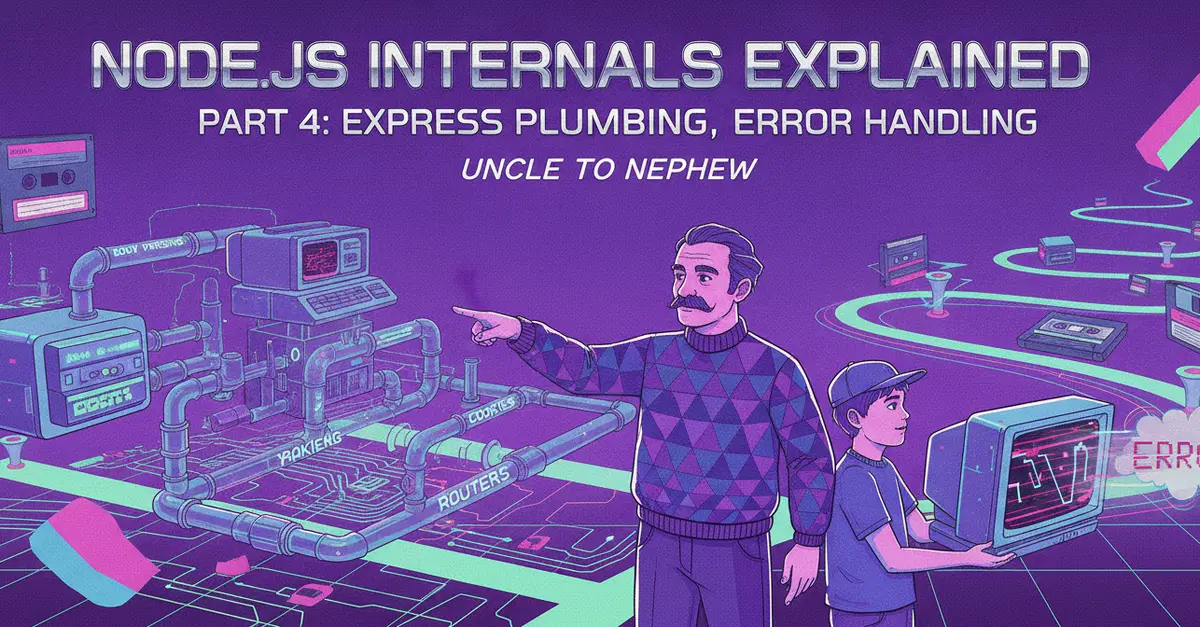
The Express Middleware Pipeline
This fourth installment in our Node.js internals series tackles the elements that often feel like black boxes: Express middleware. Specifically, we’re focusing on how modules like express.json(), cookie-parser, and express.Router() integrate into the request lifecycle. These are the components developers frequently copy-paste, yet rarely dissect. Understanding them is crucial for avoiding late-night debugging sessions.
At its core, Express is a sophisticated routing and middleware web framework. When a request hits your Node.js server, it doesn't immediately go to your final route handler. Instead, it passes through a series of middleware functions. Each middleware function has access to the request object (req), the response object (res), and the next middleware function in the application’s request-response cycle (next). The middleware can perform actions like executing code, making changes to the request and response objects, ending the request-response cycle, or calling the next middleware.
Consider express.json(). This isn't a core Node.js module; it's a piece of middleware provided by the Express framework itself. Its primary job is to parse incoming request bodies that have a Content-Type of application/json. Without it, req.body would be undefined for JSON payloads. It essentially takes the raw request stream, decodes it as JSON, and attaches the resulting JavaScript object to req.body. This allows your application to easily access and manipulate JSON data sent from clients.
Similarly, cookie-parser is middleware that parses incoming cookies. It reads the Cookie header from the request, parses it into an object, and attaches it to req.cookies. This simplifies cookie management significantly, abstracting away the manual parsing of the raw cookie string.
The express.Router() object is another key piece of Express plumbing. It acts as a mini-Express application. You can define routes and middleware on a router instance, and then mount it into your main Express application. This is instrumental for modularizing your application, allowing you to group related routes and their handlers together. For example, all routes related to user management (/users, /users/:id) could live within a dedicated user router, keeping your main app.js file cleaner.
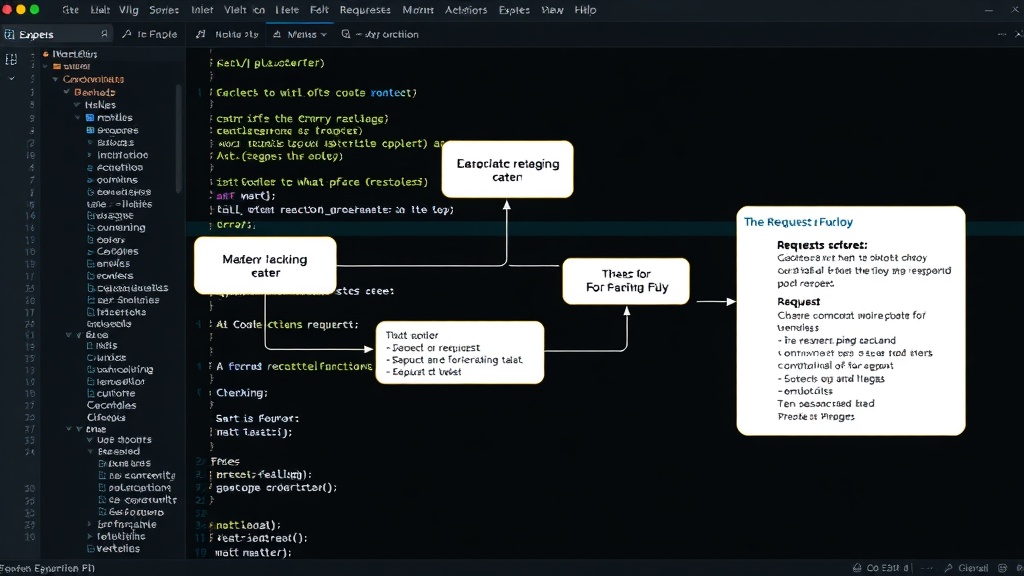
Error Handling in Express
Robust error handling is often an afterthought, but it's critical for stable applications. In Express, error handling is primarily managed through a special type of middleware. These error-handling middleware functions are defined with four arguments: err, req, res, and next. When an error occurs in any middleware or route handler, if you pass an error object to next(err), Express will skip all other middleware and route handlers and jump directly to the error-handling middleware.
This mechanism allows for centralized error management. You can define a single error-handling middleware function at the end of your middleware stack to catch and log errors, or to send a standardized error response to the client. For example, a basic error handler might look like this:
app.use((err, req, res, next) =>
  console.error(err.stack);
  res.status(500).send('Something broke!');
});
The surprising detail here is how seamlessly Express handles this. You don't need explicit `try...catch` blocks everywhere if you consistently use next(err). Express’s internal event loop and its handling of uncaught exceptions, combined with this middleware pattern, create a powerful, albeit sometimes complex, error management system. It’s less about individual error catches and more about guiding the error through a designated pipeline.
The Full Roadmap and Testing Yourself
To truly internalize Node.js and Express, a structured approach to learning and testing is essential. The journey typically starts with understanding Node.js's core concepts: the event loop, asynchronous I/O, and the V8 engine. This forms the foundation.
Next, dive into the request lifecycle. How does an HTTP request travel from the client to your server, get processed by Node.js, and return a response? This involves understanding TCP sockets, HTTP parsing, and the event-driven nature of Node.js.
Then, explore Express. Understand its middleware architecture, how request objects are augmented (like with req.body and req.cookies), and how routing works. Mastering express.Router() for modularity is key here. Crucially, solidify your understanding of error handling, ensuring you can gracefully manage unexpected issues.
A practical test involves building small, focused applications. Can you build a simple REST API? Can you implement authentication using middleware? Can you handle file uploads and streaming? Can you create a robust error reporting system? If you can explain how each piece of middleware works, why next() is called, and what happens when an error is passed to next(), you're on the right track.
The ultimate goal is not just to write code that works, but to understand *why* it works. This deep understanding allows for more efficient debugging, better performance optimization, and the ability to architect more resilient and scalable applications. It moves you from a copy-paste developer to an engineer who can design and build with confidence.
What nobody has fully addressed yet is the long-term maintenance cost of applications built on deeply understood but un-documented internal patterns. As Node.js and Express evolve, how do teams ensure their foundational knowledge remains relevant and doesn't become a brittle legacy?