The Illusion of Unified Status
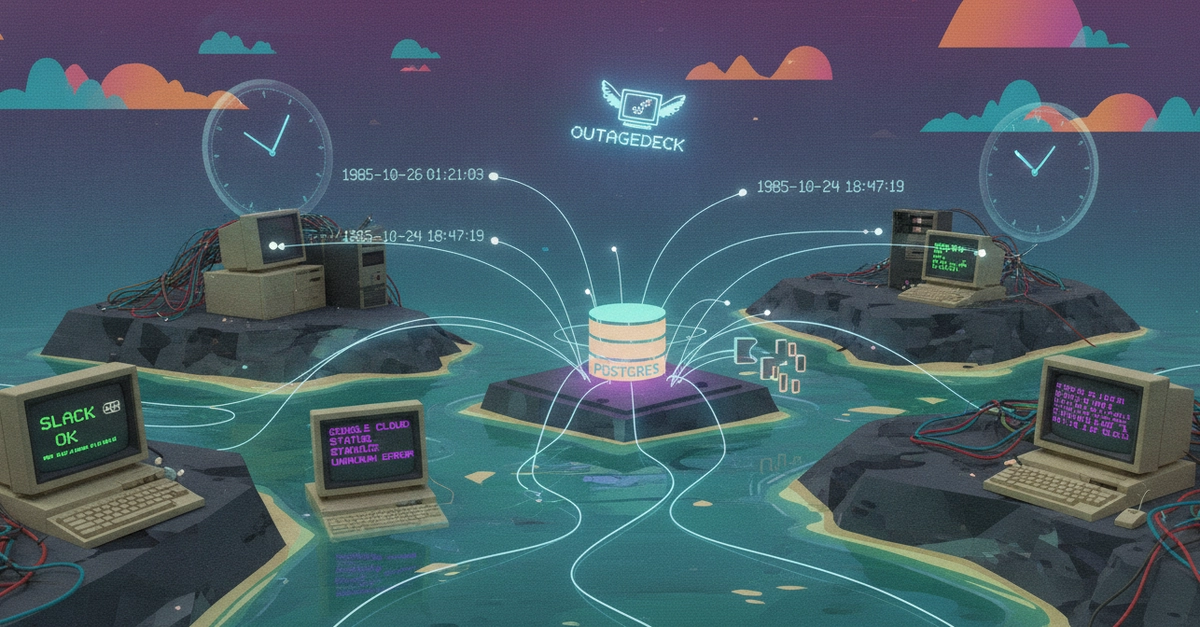
Your critical service is down. You reach for the provider's status page, expecting a clear, real-time report. Instead, you find a green light while your users are screaming. This common frustration stems from a fundamental problem: the lack of standardization in how cloud and SaaS providers report their operational status. Building OutageDeck, a tool designed to aggregate status information from 96 different providers into a single view, exposed this chaotic reality. The assumption that an "official status page" would be easily parsable and consistently updated proved naive. The true challenge wasn't building the frontend interface, but wrestling with the wildly inconsistent data sources themselves.
The core issue is that "official status" is not a standardized concept. While many providers use Statuspage.io, a significant portion employs unique, often bespoke methods. This includes Google's RSS feeds, Slack's custom formats, Heroku's specific API endpoints, Azure's own RSS implementations, and even AWS's UTF-16 encoded data. This fragmentation means a single monitoring tool cannot simply "plug in" to a common API; each provider requires custom integration and parsing logic. The sheer variety of formats necessitates a deep dive into each provider's unique way of communicating downtime, making aggregation a significant engineering feat.
Lagging Timestamps and Stale Feeds
Beyond format inconsistency, the timing of status updates is another critical flaw. Providers often update their status pages only after an incident is confirmed internally. This lag means the status page might show green while users are experiencing a complete outage. This delay renders direct uptime calculations from official status pages unreliable, as the reported timestamps frequently do not align with the actual user-perceived downtime. In some extreme cases, official feeds have been found to be "stale fossils," meaning they are not updated at all, or are updated so infrequently they provide no meaningful information about current service health.
This lack of real-time accuracy has profound implications for incident response and customer communication. When a service is down, users need immediate, accurate information. Relying on a status page that might be hours or even days behind the actual event creates frustration and erodes trust. Developers and operations teams attempting to troubleshoot issues are left guessing, unable to quickly determine if the problem lies with their own infrastructure or a third-party dependency. The data simply isn't there to make informed decisions in the critical early minutes of an incident.
The Bespoke Nature of Incident Reporting
The diversity extends to the very definition of an "incident." Some providers offer granular details about specific components affected, while others provide only a high-level overview. Some might detail the root cause and resolution steps, while others offer only a vague acknowledgment. This lack of uniformity makes it difficult to compare incident severity or impact across different providers. For organizations relying on multiple cloud services, piecing together a comprehensive understanding of an ongoing multi-provider outage becomes a manual, time-consuming detective task.
Consider the example of tracking AWS versus Google Cloud. AWS might provide detailed JSON responses from specific endpoints, but these can be encoded in UTF-16, requiring careful decoding. Google, on the other hand, might offer status updates via RSS feeds that are structured differently from those of other providers. Slack, a service many rely on for communication, has its own unique format for its status page. Each of these requires a distinct parsing strategy. This isn't just a minor inconvenience; it's a fundamental barrier to creating a reliable, automated system for monitoring the health of the digital infrastructure we all depend on.
Lessons Learned for a Fragmented Ecosystem
The experience of building OutageDeck highlighted several key takeaways for anyone depending on cloud services:
- Assume Inconsistency: Do not expect a uniform experience. Each provider's status reporting mechanism needs to be treated as a unique entity.
- Validate Timestamps: Official timestamps are often unreliable for precise uptime calculations. Independent monitoring is crucial.
- Look Beyond the Status Page: For critical services, consider supplementary monitoring methods, such as synthetic transaction testing or direct API health checks, to get a more accurate picture of service availability.
- Build for the Edge Cases: The majority of providers might use common tools, but the significant outliers with bespoke systems will break simple aggregators.
The current state of cloud service status reporting is a patchwork. While tools like OutageDeck attempt to bring order to this chaos, the onus remains on providers to adopt more standardized, accurate, and timely methods of communicating their operational status. Until then, users and developers must remain vigilant, understanding that the green light on a status page is not always a guarantee of uninterrupted service.