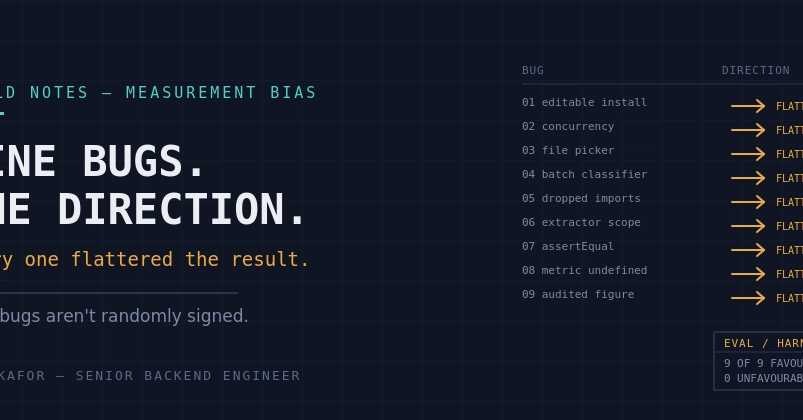
The Unseen Bias in Self-Built Evaluation Tools
Building your own evaluation harness for software or models seems like a direct path to objective results. You control the inputs, the metrics, and the process. However, a closer look reveals a systemic flaw: the very act of building and using a personal evaluation tool can introduce biases that consistently favor positive outcomes. Marvin Oka, in a candid self-examination, identified nine bugs within his own evaluation harness, each one designed, unintentionally, to make his results appear better than they were.
This isn't a story about incompetence; it's a cautionary tale about the psychology of development and the hidden pitfalls of self-assessment. The core issue, as Oka explains, is that debugging is overwhelmingly triggered by surprise. When results are disappointing, we investigate. When they are good, we accept them. This uneven application of scrutiny means that bugs that inflate performance often go unnoticed.
Consider it like a mechanic who only tunes up cars that are sputtering. A car running perfectly smooth might have an underlying issue, but without a noticeable symptom, the mechanic moves on. In software evaluation, the 'symptom' is a bad result. Good results, by definition, lack this critical diagnostic trigger.
The Mechanism of Positive Bias
Oka's analysis points to a structural problem inherent in self-built evaluation systems. The nine bugs he found were not isolated incidents; they were indicative of a pattern where the evaluation tool itself was subtly misinterpreting or misrepresenting data in a way that benefited the project's perceived performance. This bias isn't malicious; it's a natural consequence of how developers interact with their own creations.
The process typically unfolds like this: a developer builds a system, then builds an evaluation harness to test it. If the evaluation returns poor metrics, the developer is motivated to find the error. They might add more logging, step through the code, and eventually find and fix the bug. This fix, naturally, improves the metrics. If, however, the evaluation returns good metrics, there's no immediate imperative to dig deeper. The results are written up, and the project moves forward, leaving any hidden measurement errors unaddressed.
This creates a unidirectional filter for bugs. Errors that make the system look bad are likely to be caught and fixed. Errors that make the system look good are likely to be overlooked. Over time, this consistent, albeit unintentional, omission of negative-feedback-driven debugging leads to an inflated view of performance.
Examples of Unseen Flaws
While Oka doesn't detail every single bug, the implication is that these were not trivial issues. They could range from incorrect data parsing, flawed metric calculation, to improper handling of edge cases that, when mismanaged, coincidentally boost scores. For instance, an evaluation harness might incorrectly label a false negative as a true positive, or fail to account for a specific data distribution that, when ignored, makes a model appear more robust than it is.
The surprise trigger is key. If a model consistently scores 95% accuracy, the developer assumes it's performing well. If it scores 70%, the developer immediately questions the model, the data, and the evaluation process. This psychological asymmetry means that the 'good' results are rarely subjected to the same rigorous, skeptical examination as the 'bad' ones.
The Broader Implication for Evaluation
Oka's conclusion is stark: the problem is not unique to his project. Any evaluation harness built by the same team or individual developing the system under evaluation is susceptible to this phenomenon. The very tools designed for objectivity can become instruments of self-deception, not through intent, but through the inherent biases in the debugging process.
This suggests a critical need for independent verification or a more formalized internal audit process. Relying solely on self-generated evaluation metrics, especially when they align with desired outcomes, is a risky practice. The confidence developers place in their results might be misplaced if the measurement tools themselves are subtly flawed in a way that consistently favors positive outcomes.
The takeaway is that developers must be acutely aware of this potential bias. Actively seeking out potential flaws in evaluation harnesses, even when results are positive, is crucial. This might involve dedicating specific audit time, seeking peer review of the evaluation methodology, or employing independent evaluation frameworks. Without such measures, the pursuit of objective performance can inadvertently lead to a systematically optimistic, and thus inaccurate, assessment.