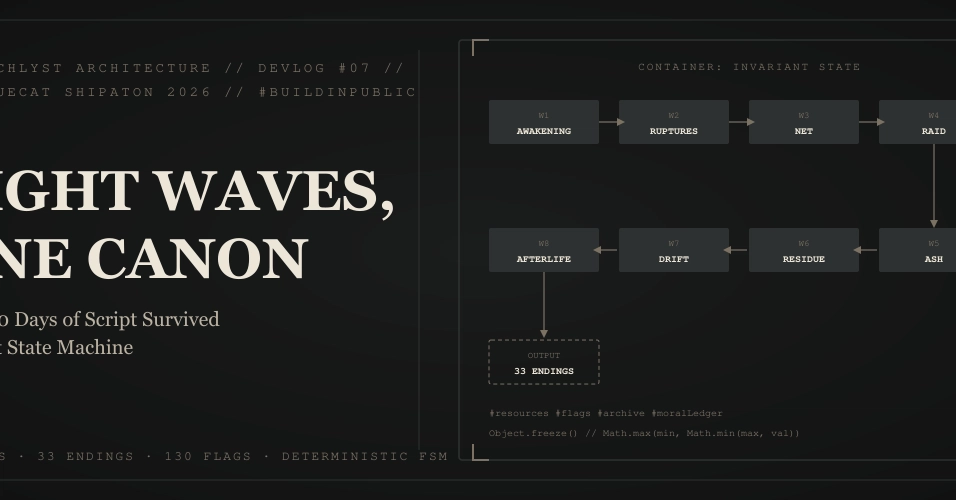
On September 21, 2026, amidst air raid sirens in Kyiv, developer Koztechie faced a critical juncture in the development of NICHLYST. The game, undergoing a 14-day closed testing phase on Google Play, was at risk of collapsing under the weight of its own complexity. The challenge: managing a narrative with an exponentially growing number of states stemming from player choices. The solution, detailed in a devlog, was an architecture built around a strict state machine that prevented the game from consuming itself.
The Branching Trap: Exponential State Growth
Narrative games with branching paths present a unique development hurdle. Each player choice, even a simple binary one, creates a new state. A game with one choice per day, branching into two paths, quickly spirals out of control. After ten days, the game can have 1,024 possible states. After twenty days, this number exceeds one million. NICHLYST, with 130 flags, six moral axes, and 33 distinct endings accumulated over 40 days of scripting, was on the verge of this state explosion. Without a robust system, the sheer volume of possible player journeys would become unmanageable, leading to bugs, performance issues, and a breakdown of the game's logic.
The core problem is that simple flag-setting mechanisms, common in branching narratives, create a combinatorial explosion. Each new decision point multiplies the existing state space. Developers often underestimate this growth, only realizing the problem when the codebase becomes a tangled mess of conditional logic. This is the "branching trap" that NICHLYST's architecture was designed to avoid. The system needed to handle not just the current state but the potential future states generated by every possible player interaction.
Eight Waves, One Canon: Structuring Narrative Progression
To combat the state explosion, NICHLYST employed a structure referred to as "Eight Waves, One Canon." This approach suggests a deliberate, structured progression through the narrative, likely with defined milestones or phases (the "waves") that contribute to a singular overarching story (the "canon"). This is not about free-form branching but about guided progression where choices, while present, are contained within predefined narrative arcs. Think of it less like a choose-your-own-adventure book where any page can lead anywhere, and more like a meticulously planned heist movie where player choices might alter the *how* of the plan, but not the fundamental *what* or *why* of the mission.
This structured approach allows developers to compartmentalize the state management. Instead of a single, monolithic state graph, the game can be broken down into smaller, more manageable segments. Each "wave" might represent a distinct chapter or act, with its own set of states and transitions. The "canon" ensures that despite these internal branches, the player's actions ultimately converge towards a predetermined narrative outcome or set of outcomes. This prevents the state space from growing indefinitely and allows for more predictable testing and debugging.
The State Machine as the Guardian
The critical component preventing NICHLYST from imploding was its strict state machine. Unlike a simple flag system, a state machine explicitly defines the valid transitions between states. In NICHLYST's context, this means that the game logic only allows movement to states that are explicitly defined as reachable from the current state. This prevents the creation of orphaned or impossible states that could arise from unexpected combinations of flags or choices.
The state machine acts as a gatekeeper. When a player makes a choice, the machine checks if that choice leads to a valid next state according to its defined rules. If it does, the transition occurs. If not, the choice is either ignored or handled gracefully, preventing the corruption of the game's internal logic. This strictness is the key to managing complexity. For 40 days of scripting, with a significant number of variables and potential endings, this strict adherence to defined transitions was the only mechanism robust enough to maintain system integrity.
The devlog highlights a moment of quiet triumph: "The bundle compiled. The state machine holds. There is nothing to add today, and that restraint is the only reason the system still works." This implies a disciplined development process where new features or branching options were only introduced if they could be seamlessly integrated into the existing state machine without violating its rules. This restraint, born out of necessity, became the architecture's strongest feature.
The Human Element: Restraint and Resilience
The story of NICHLYST is not just about technical architecture; it is also about the human element under pressure. The developer, working on an aging laptop in Kyiv during wartime, faced significant external stressors. The decision to stop adding content ("that restraint is the only reason the system still works") is a testament to disciplined development practices overriding the temptation to add just one more feature or branch.
This restraint is crucial. In any complex system, especially one involving user-generated complexity like branching narratives, there's a constant push to expand possibilities. However, without a strong architectural foundation, this expansion leads to fragility. The NICHLYST team recognized this, prioritizing stability and manageability over unchecked growth. This discipline, combined with the strict state machine, created a robust system capable of handling 40 days of intricate scripting without collapsing.
The success of NICHLYST's architecture, particularly its ability to manage a vast number of states, offers a blueprint for other narrative game developers. It demonstrates that meticulous planning and a commitment to architectural integrity, even under duress, are paramount for building complex, stable interactive experiences.