
The Problem with Traditional State Changes
Current systems often handle state changes in a linear fashion: decide, act, report. An agent decides to modify something, executes the action, and then reports the outcome. Verification, if it exists, checks what has already happened. This structure is acceptable for simple logs, but it’s a control vacuum. By the time a check fails, the detrimental effect is already written to disk. The subsequent steps involve describing the damage, attempting repairs that lack verification, or resorting to restoring from backups whose age and integrity are often unknown.
This reactive model means that when an error occurs, the system is already in a compromised state. The primary focus shifts from preventing errors to detecting and recovering from them after the fact. This is akin to a firefighter arriving at a burning building to document the blaze, rather than having a sprinkler system that activates before the flames spread.
Introducing the Inverse Operation First Architecture
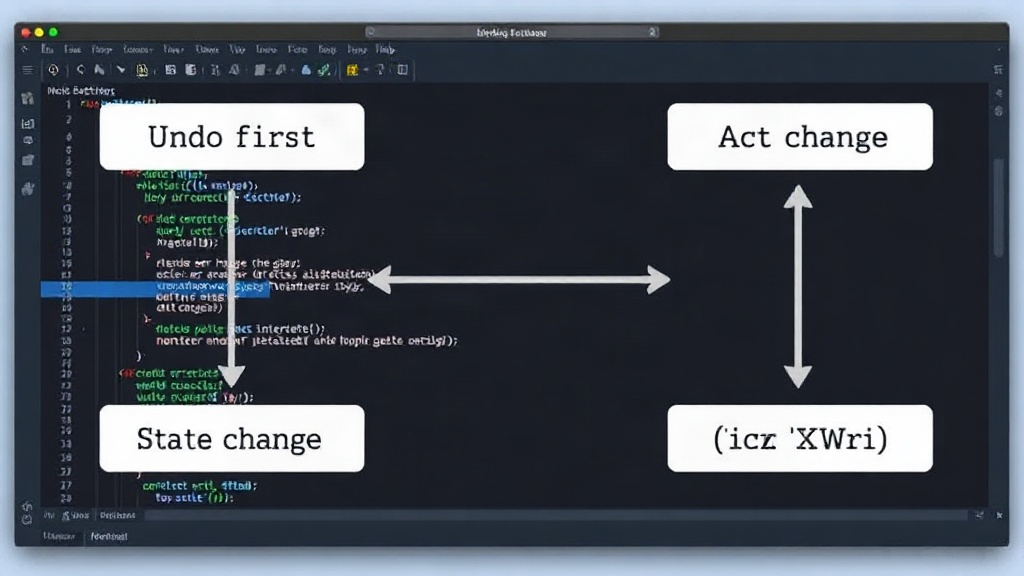
A new architectural pattern challenges this status quo by fundamentally reordering how changes are managed. The core principle is that the inverse operation—the 'undo' for any proposed change—must be constructed, validated, and stored before the actual 'write' operation is executed. This ensures that every potential modification is inherently reversible from its inception.
This isn't about a single tool but an entire workflow for change. When a proposed change is initiated, it receives a canonical identity. Crucially, its inverse operation is then automatically generated. This inverse is not just a placeholder; it is checked for correctness and stored. Only after this reversible 'undo' is secured does the system proceed to apply the original change. A gatekeeper mechanism then evaluates the proposed change and its pre-defined undo, returning one of three verdicts: accept, reject, or require further review. The outcome, including any refusals, is logged as a signed record. This record is designed to be re-checked offline by a third party, removing the need for trust in the original agent or system.
This approach transforms state management from a process of sequential, potentially irreversible actions into a system of atomically defined, reversible operations. Think of it less like writing a letter and then trying to erase it; it’s more like drafting both the letter and its complete retraction, ensuring the retraction is perfectly crafted and filed before the original letter is ever sent.
The Technical Implementation and Benefits
The technical implementation involves several key components. First, every proposed change must be represented in a way that allows for automatic inverse generation. This often requires changes to how data structures and operations are defined, leaning towards functional programming principles where operations are pure functions with well-defined inputs and outputs. Second, a robust mechanism for generating, validating, and storing these inverse operations is necessary. This could involve a dedicated service or a framework integrated into the application's core logic.
The validation of the inverse operation is critical. It ensures that the proposed 'undo' can indeed reverse the intended 'write'. This validation step acts as a pre-flight check, catching potential issues before they manifest as data corruption or system instability. The signed record of the outcome provides an immutable audit trail, enhancing transparency and accountability.
The benefits are substantial. For developers, it drastically simplifies error handling and debugging. Instead of complex rollback procedures, systems can often simply execute the pre-defined inverse operation. For operations and reliability engineers, it means a more stable and predictable system. Downtime due to data corruption can be significantly reduced, and recovery processes become more straightforward and less risky. The system's overall resilience is enhanced because every operation carries its own guaranteed escape hatch.
Broader Implications for System Design
This paradigm shift has profound implications for how we design critical systems, particularly those dealing with financial transactions, distributed databases, or any application where data integrity is paramount. In financial systems, an incorrect transaction could be immediately and verifiably reversed before it impacts account balances or triggers downstream processes. In distributed databases, where consensus and consistency are challenging, defining reversible operations upfront can simplify conflict resolution and ensure stronger guarantees.
The concept also has parallels with software transactional memory (STM) and the principles of immutability, but it extends them by making the reversibility a first-class citizen and a prerequisite for any change. It addresses the inherent fragility of mutable state by ensuring that mutability, when it occurs, is always within a controlled and reversible context.
While the full paper is still in draft, its deposit at Zenodo signifies a move towards formalizing this approach. The challenge now lies in its widespread adoption and the development of robust tooling and frameworks to support this 'undo-first' methodology across various programming languages and system architectures. The question remains: what happens to the vast existing codebase that operates on the 'write-first' model, and how can this new paradigm be integrated incrementally without requiring complete system overhauls?