Automating the Tedious Task of Skeleton UI Creation
Frontend developers working with React and Next.js often find themselves bogged down by a repetitive and time-consuming task: manually creating skeleton UI states for their applications. The process typically involves crafting individual `div` elements for each card, list item, or component, meticulously matching widths, heights, and border-radius values to mimic the final UI. This manual approach not only consumes valuable development hours but also necessitates re-work whenever the actual UI changes, forcing developers to update both the real components and their skeletal counterparts.
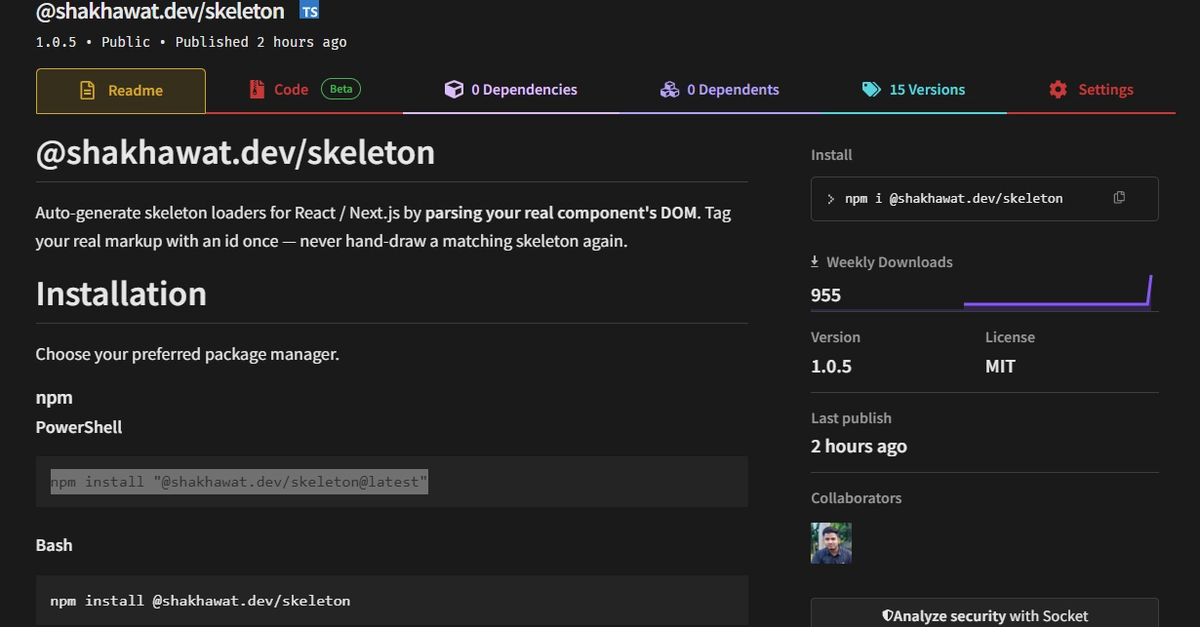
To address this common pain point, a new npm package, @shakhawat.dev/skeleton, has been released. This package aims to automate the generation of skeleton loaders, significantly streamlining the development workflow.
The core innovation behind @shakhawat.dev/skeleton is its ability to parse the DOM structure of your existing React components and automatically generate a skeleton loader with the identical structure. This means developers can focus on building their primary components, and the skeleton UI will be created for them without manual intervention.
How @shakhawat.dev/skeleton Works
The package operates by analyzing the rendered output of your React components. When integrated, it inspects the component's DOM tree, identifying elements, their styles, and their hierarchical relationships. Based on this analysis, it constructs a corresponding skeleton structure. This structure typically uses placeholder elements that represent the visual layout of the original component, often employing shimmering effects or simple colored blocks to indicate loading states.
The primary benefit is a dramatic reduction in boilerplate code and development time. Instead of writing separate JSX for loading states, developers can simply wrap their components or use the package's configuration to generate the skeleton. This approach ensures that the skeleton UI remains in sync with the actual UI; as the real component evolves, the generated skeleton will naturally reflect those changes upon recompilation or re-rendering, provided the underlying structure remains similar.
This auto-generation capability is particularly powerful for applications with complex UIs, numerous data-driven components, or frequent updates. It frees developers from the granular task of pixel-perfect skeleton design and allows them to concentrate on core feature development and application logic.
Key Features and Benefits
The introduction of @shakhawat.dev/skeleton brings several key advantages to the React and Next.js development ecosystem:
- Automatic Structure Parsing: The package intelligently parses your component's DOM to replicate its structure, eliminating the need for manual mapping.
- Time Savings: By automating the creation of skeleton UIs, developers can reclaim significant development hours previously spent on repetitive styling and markup.
- Improved Maintainability: Skeleton loaders generated by the package stay synchronized with the actual components, reducing the effort required to update them when the UI changes.
- Consistency: Ensures a consistent loading experience across the application by adhering to the actual component layout.
- Ease of Integration: Designed to be straightforward to implement within existing React and Next.js projects.
The underlying mechanism relies on inspecting the component's rendered output. For instance, if a component renders a card with an image, title, and description, the skeleton loader will generate placeholders for these elements, maintaining their relative positions and sizes. This is achieved by analyzing element types, dimensions, and potentially CSS properties, then rendering equivalent, simplified elements that convey the layout.
The simplicity of the package is a significant draw. Developers do not need to learn a complex new API or undertake a major refactor. The intention is to provide a drop-in solution that addresses a ubiquitous development challenge. This focus on developer experience is crucial in a landscape where productivity tools are highly valued.
Considerations for Implementation
While the package offers a compelling solution, developers should consider a few points during implementation. The accuracy of the auto-generated skeleton is dependent on the consistency of the component's structure. Dynamic or highly variable component structures might require some manual adjustments or configurations to ensure the skeleton accurately represents the intended loading state. Furthermore, while the package handles structural replication, developers may still need to apply custom styling to the generated skeleton elements if specific branding or visual themes need to be strictly adhered to beyond basic layout.
The package's ability to parse DOM structure is a powerful abstraction. It means that developers don't need to explicitly define the skeleton's layout separately; the package infers it. This is akin to having a smart assistant that watches you build a piece of furniture and then automatically builds a simplified, wireframe version of it based on observation. The complexity lies in the parsing and interpretation engine, which must be robust enough to handle common React patterns.
For those working with server-side rendering (SSR) in Next.js, the package's compatibility with the rendering lifecycle is an important factor. Ensuring that the skeleton generation occurs appropriately on both the server and client, or is managed effectively during hydration, will be key to a seamless user experience. The documentation for @shakhawat.dev/skeleton likely provides guidance on such integration scenarios.
The Future of Skeleton Loaders
The advent of tools like @shakhawat.dev/skeleton signals a shift towards more intelligent and automated UI development practices. As frontend applications grow in complexity, the demand for solutions that reduce manual effort and improve code maintainability will only increase. This package directly addresses a significant friction point, allowing developers to build faster and more efficiently. The potential for further refinement, such as more sophisticated style replication or integration with state management libraries, remains an exciting prospect for future iterations.
What remains to be seen is how this approach scales with highly dynamic UIs where elements might appear or disappear based on complex state logic. Developers will be keen to understand the package's resilience in such edge cases, and whether it offers mechanisms for fine-tuning the generated skeleton beyond its initial parsing.