Embarking on the Cybersecurity Journey
For many, the start of a new academic year signals a fresh beginning. For one college student, this transition marks the deliberate commencement of a cybersecurity learning journey. Today, on the first day of their second year, the student initiated a structured approach to mastering the field, aiming to rectify perceived inactivity during their freshman year. The chosen path is cybersecurity, a domain increasingly critical in our interconnected world. This endeavor is notable for its proactive stance and the utilization of advanced AI tools to facilitate learning.
The initial day's curriculum focused on foundational concepts, essential building blocks for understanding more complex cybersecurity principles. The student systematically tackled several key areas, demonstrating a commitment to building a robust theoretical base. These topics are not unique to cybersecurity but are fundamental to many technical disciplines, including computer science and digital forensics. Mastering them early is crucial for anyone serious about a career in the field.

Core Concepts for Day One
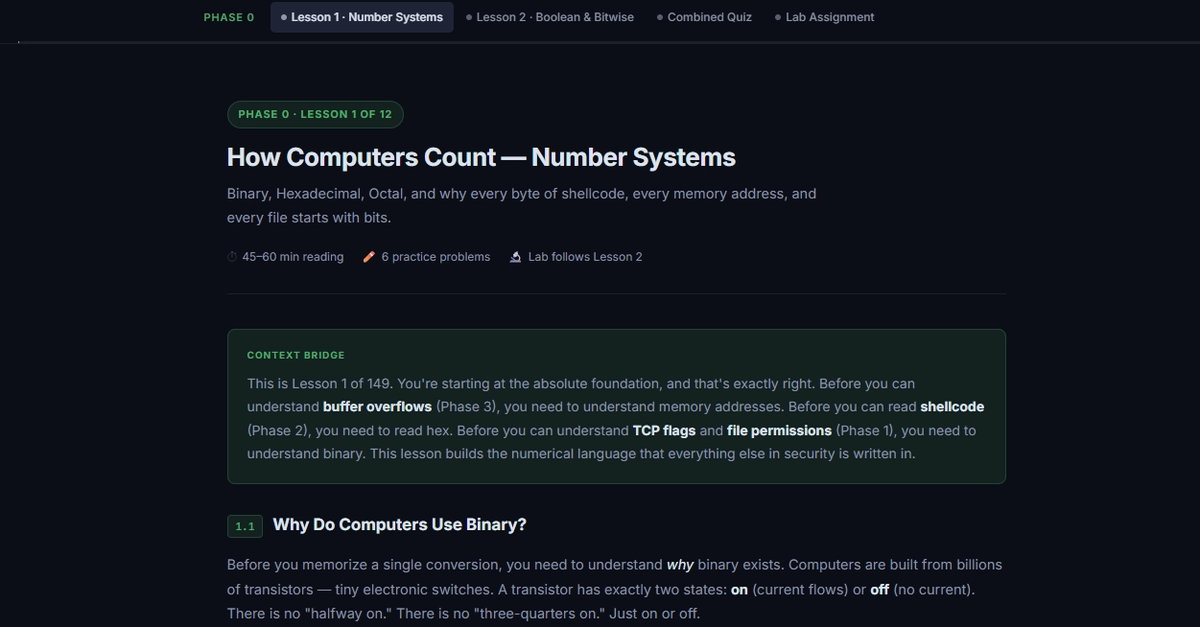
The first day's study was meticulously organized around a set of essential topics. The student began with the Number System & Conversion. This involves understanding different bases, such as binary (base-2), octal (base-8), decimal (base-10), and hexadecimal (base-16), and the methods to convert values between them. This skill is paramount for interpreting raw data, understanding memory addresses, and analyzing network protocols, all of which are common in cybersecurity analysis.
Following this, the focus shifted to Octal & Permission System Basics. The octal number system is particularly relevant in computing due to its direct relationship with binary (three binary digits map to one octal digit). In Unix-like operating systems, file permissions are often represented using an octal notation (e.g., 755, 644), where each digit corresponds to read, write, and execute permissions for the owner, group, and others. Understanding this system is vital for managing access control and identifying potential misconfigurations that could lead to security vulnerabilities.
The curriculum then moved to File Signature Basics. File signatures, also known as magic numbers, are sequences of bytes at the beginning of a file that indicate its file type. Identifying these signatures helps in classifying files, especially when file extensions are missing or have been maliciously altered. This is a key technique in malware analysis and digital forensics.
Boolean Logic formed another core component. This area of mathematics deals with truth values, typically true and false, and the logical operators AND, OR, NOT, XOR. Boolean logic is the bedrock of digital circuits, programming, and, critically, cybersecurity. It underpins how conditions are evaluated in access control, firewall rules, and secure coding practices.
Applying Logic to Security: XOR and Bitwise Operations
The student then delved into practical applications of logic, specifically focusing on XOR in the context of security. The XOR (exclusive OR) operation is an essential cryptographic primitive. Its property of being its own inverse (A XOR B XOR B = A) makes it suitable for simple encryption and decryption algorithms. It's also used for data integrity checks and efficiently swapping values without a temporary variable. Understanding XOR is a gateway to comprehending more advanced cryptographic techniques.
Closely related are Bitwise Operations in the context of security. These operations manipulate individual bits within a number. This includes AND, OR, NOT, left shift (<<), and right shift (>>). In security, bitwise operations are used extensively for tasks like masking (isolating specific bits), setting or clearing flags (individual bits representing a state or option), and managing permissions, as previously touched upon with the octal system. For instance, a single byte can store multiple boolean states using individual bits.
The ability to Extract Specific Bits from a Value is a direct application of bitwise operations, particularly AND with a carefully crafted mask. This allows for precise data extraction and manipulation, essential when dealing with packed data structures or configuration bytes.
Finally, the day concluded with Two's Complement. This is the standard method for representing signed integers in computers. Understanding two's complement is crucial for interpreting numerical data correctly, especially in low-level programming, memory analysis, and understanding how arithmetic operations behave with negative numbers, which can sometimes be exploited in buffer overflow or integer overflow vulnerabilities.
Leveraging AI for Learning
A notable aspect of this learning initiative is the explicit mention of using Claude, an AI language model, to generate topics, study materials, labs, and practice exercises. This demonstrates a modern approach to self-directed learning, where AI acts as a personalized tutor and content creator. This strategy can accelerate the learning process by providing tailored resources and immediate feedback, allowing the student to explore concepts and practice skills without relying solely on traditional educational materials.
The student's approach highlights a common trend: the integration of AI into educational pathways. For individuals starting in complex fields like cybersecurity, AI can demystify challenging subjects, offer diverse learning formats, and provide practice scenarios that mimic real-world challenges. This method suggests a future where AI plays an increasingly significant role in skill acquisition and professional development, particularly in rapidly evolving technical domains.
This first day sets a strong precedent for the student's cybersecurity journey. By covering fundamental numerical, logical, and bitwise operations, they are building a solid foundation. The strategic use of AI to curate and generate learning content further enhances the efficiency and personalization of their education. As they progress, applying these foundational concepts to practical cybersecurity scenarios will be the next critical step.