The Race for Faster JIT Compilation
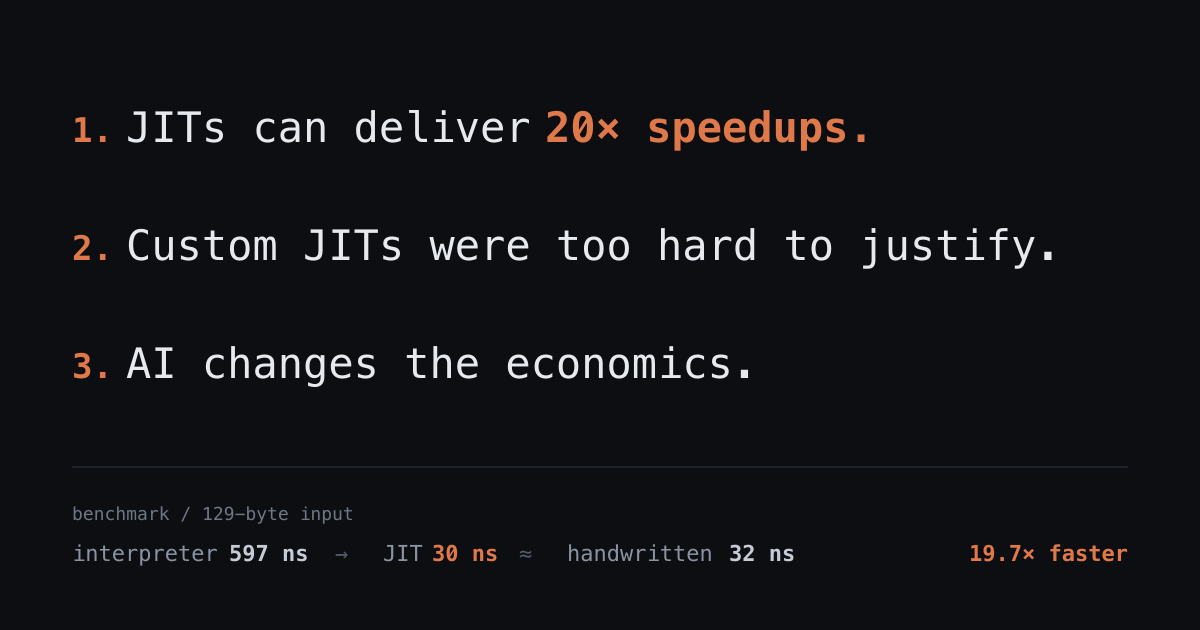
Just-In-Time (JIT) compilation is a cornerstone of modern high-performance computing, offering a balance between the flexibility of interpretation and the speed of ahead-of-time compilation. However, the overhead associated with the compilation process itself can become a bottleneck, particularly in dynamic environments or latency-sensitive applications. A new development reported on Hacker News demonstrates a significant leap forward, achieving JIT compilation times as low as 5 microseconds (μs). This is not an incremental improvement; it represents a fundamental shift in how quickly code can be compiled and executed.
The core challenge in JIT compilation lies in the trade-off between compile-time complexity and runtime performance. Traditional JIT compilers often perform extensive analysis and optimization to generate highly efficient machine code. While this yields excellent runtime speeds, the compilation phase can take milliseconds, or even seconds, for complex functions or large codebases. This latency is unacceptable for applications demanding millisecond or microsecond responsiveness. The reported breakthrough suggests a radical simplification or a highly specialized optimization strategy that bypasses these traditional hurdles.
Unpacking the 5μs Compilation
Achieving a 5μs JIT compilation time implies a highly constrained environment or a significantly de-optimized compilation process, focused solely on minimizing latency. This could involve several strategies:
- Minimal Optimization: Instead of performing deep, multi-pass optimizations, the compiler might apply only the most critical, low-overhead transformations. This would prioritize getting code running quickly over achieving peak runtime performance. The assumption here is that the runtime environment or subsequent JIT passes could handle further optimizations if needed.
- Specialized Code Generation: The compiler might be tailored for a specific subset of code or a particular hardware architecture. This specialization allows for highly efficient, hardcoded generation paths that avoid general-purpose analysis.
- Incremental Compilation: Rather than compiling an entire function or module at once, the compiler might compile only the currently executing hot path or a small block of code. This breaks down the compilation task into much smaller, faster units.
- Pre-compiled Stubs/Templates: The compiler could leverage a library of pre-compiled code snippets or templates that are quickly assembled and tailored to the specific runtime needs, rather than generating code from scratch.
- Reduced Analysis: The compiler might perform very shallow or no static analysis, relying more on runtime profiling to guide code generation. This shifts the burden of optimization from compile time to runtime, but with a very fast initial compilation step.
Think of traditional JIT compilation like a chef meticulously preparing a multi-course meal, ensuring every dish is perfect before serving. This new 5μs JIT is more like a barista who can instantly assemble a pre-made espresso shot and hot water into a passable Americano – it’s fast, functional, and ready for immediate consumption, even if it’s not gourmet.
Implications for Latency-Sensitive Systems
The ability to compile code in mere microseconds opens up new possibilities for applications where even millisecond delays are detrimental. This includes:
- High-Frequency Trading (HFT): In finance, microsecond advantages can translate into millions of dollars. Faster code execution and adaptation to market conditions are paramount.
- Real-Time Systems: Industrial control systems, robotics, and embedded systems often operate under strict timing constraints. Rapid code adaptation can improve responsiveness and safety.
- Game Development: Dynamic loading of game assets, procedural content generation, or runtime modifications could become more seamless.
- Serverless and Edge Computing: Reducing cold start times and improving function execution speed in distributed environments is critical.
- Interactive Development Tools: Live coding environments, debuggers, and performance profilers could offer a much more fluid and responsive experience.
The surprising detail here is not just the speed, but the potential for this approach to coexist with or even complement existing, slower JIT compilers. A hybrid model could use the 5μs compiler for initial execution and then have a more powerful, slower JIT optimize hot paths in the background.
The Unanswered Question: Runtime Performance Trade-offs
While the 5μs compilation time is a remarkable achievement, the critical question remains: what is the trade-off in terms of the generated code's runtime performance? A compiler that is too simplistic might produce code that is significantly slower than that generated by mature, multi-pass optimizers. If the generated code is orders of magnitude slower at runtime, the initial compilation speed advantage could be negated. The success of this approach hinges on finding the sweet spot where compilation is near-instantaneous, and runtime performance remains competitive for the target use case. Without detailed benchmarks comparing the generated code's performance against established JITs, its ultimate applicability remains to be seen.
Further details on the specific compiler architecture, the target language or VM, and the nature of the optimizations applied are crucial for understanding the full scope of this advancement. However, the mere possibility of microsecond JIT compilation signals a significant evolution in dynamic code execution technology.