Automating the Quantum Machine Learning Workflow
Building effective quantum machine learning (QML) models remains a significant hurdle for researchers and developers. The process is fraught with complexity, demanding manual circuit design, speculative hyperparameter tuning, and a lack of robust evaluation metrics. Edwin Jose Chittilappilly’s new open-source project, quoptuna, directly addresses these pain points by introducing an automated machine learning (AutoML) framework specifically for QML.
quoptuna aims to demystify QML development by automating several critical stages. It offers a streamlined web application that requires no installation, simplifying access for users. At its core, the framework performs a comprehensive hyperparameter search across 21 quantum and classical classifiers. This systematic approach replaces the often-intuitive and time-consuming guesswork involved in selecting optimal model configurations. Furthermore, quoptuna incorporates early pruning of underperforming configurations, accelerating the search process. Beyond performance, the system audits every model for fairness and utilizes SHAP (SHapley Additive exPlanations) to explain the winning model's behavior, even drafting a report to summarize findings.
The Core Challenges in Quantum ML Development
Chittilappilly identifies three primary obstacles hindering the widespread adoption and efficient development of quantum machine learning models:
- Manual Circuit Design: Unlike classical machine learning, where model architectures are well-defined and libraries abound, quantum classifiers often require developers to manually code intricate quantum circuits, known as ansatzes. This process is highly specialized, time-consuming, and prone to error, demanding deep expertise in both quantum computing and machine learning.
- Hyperparameter Guesswork: Classical machine learning benefits from established tools like
GridSearchCVorRandomizedSearchCVfor hyperparameter optimization. For quantum models, such systematic approaches are largely absent, forcing practitioners to rely on intuition or extensive, unfocused experimentation to find optimal learning rates, optimizer settings, and other crucial parameters. - Limited Interpretability and Fairness Audits: Understanding why a quantum model makes certain predictions and ensuring its fairness across different demographic groups are critical for real-world deployment. Current QML development often lacks integrated tools for explaining model decisions or rigorously auditing for bias, leaving a significant gap in trustworthiness and accountability.
The Architecture of Quoptuna
Quoptuna is built upon a modular architecture designed to integrate seamlessly with existing quantum computing frameworks and classical machine learning libraries. The system leverages a combination of classical optimization techniques and quantum circuit execution to achieve its automated capabilities.
Frontend and User Interface
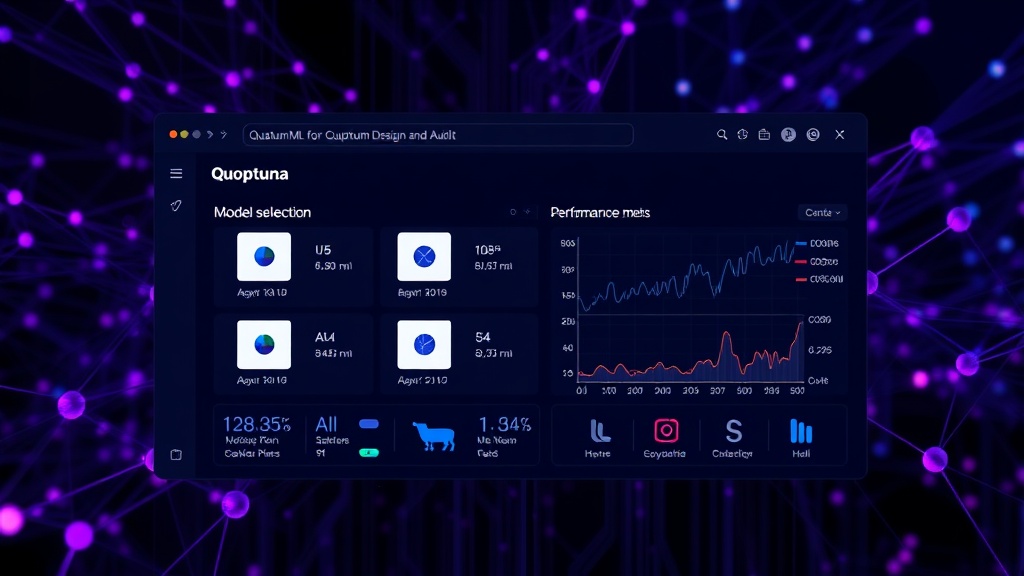
The user-facing component is a web application built with a modern JavaScript framework. This interface provides an intuitive way for users to initiate QML experiments without needing to set up complex local environments. Users can select from a predefined library of quantum and classical classifiers, specify datasets, and configure high-level search parameters. The application communicates with the backend services to manage experiment queues, display progress, and present results.
Backend Orchestration and Search
The backend is responsible for orchestrating the entire AutoML process. It includes a hyperparameter optimization engine that draws inspiration from classical AutoML tools but is adapted for the unique challenges of QML. This engine manages the execution of multiple trials, each involving the construction and training of a quantum or classical model. A key feature is the early pruning mechanism. This component monitors the performance of ongoing trials and terminates those that show little promise, thereby saving computational resources and accelerating the overall search for the best model. The selection of 21 classifiers ensures a broad exploration of potential model types, ranging from variational quantum circuits to established classical algorithms for comparison.
Quantum Circuit Generation
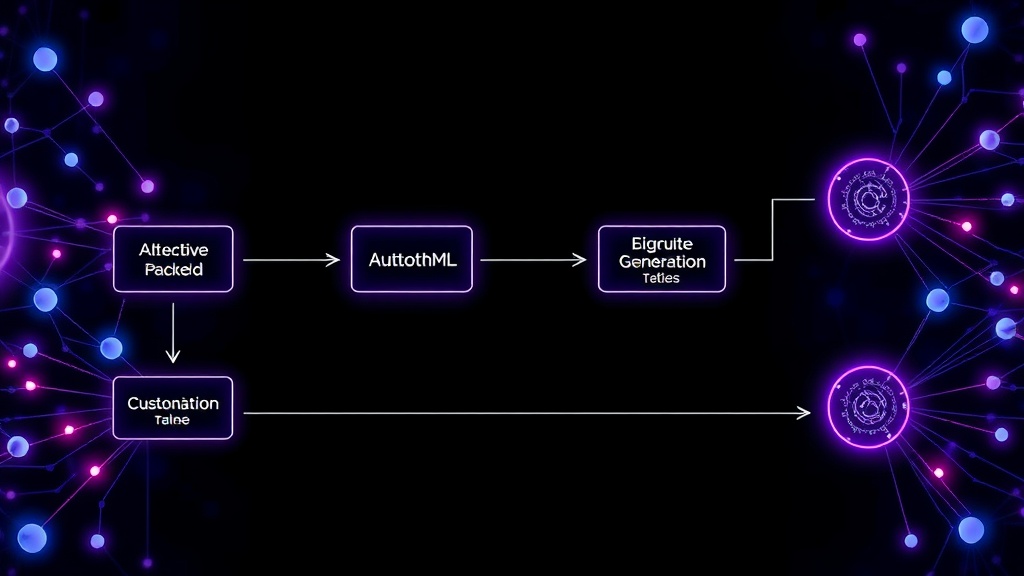
A critical part of quoptuna is its ability to automate the generation of quantum circuits. Instead of requiring users to hand-code ansatzes, the framework employs parameterized circuit generation techniques. This might involve predefined templates or more advanced methods that search for optimal circuit structures based on the problem's characteristics. This abstraction layer significantly lowers the barrier to entry for QML development.
Model Evaluation and Explanation
Once an optimal model configuration is identified, quoptuna moves to the evaluation phase. This includes standard performance metrics (accuracy, precision, recall, F1-score) but also extends to fairness audits. The integration of SHAP values is a significant advancement, providing interpretable insights into which features are most influential for the model's predictions. This transparency is crucial for building trust in QML systems, especially in sensitive applications. The system can then draft a comprehensive report detailing the experimental setup, the winning model, its performance, fairness metrics, and the SHAP explanations, further streamlining the research and development process.
Future Directions and Community Involvement
The quoptuna project is released under the Apache-2.0 license, encouraging community contributions and adoption. Chittilappilly welcomes feedback and contributions, inviting developers and researchers to star the GitHub repository and engage with the project. Future work could involve expanding the library of supported quantum and classical models, integrating with a wider range of quantum hardware backends, and developing more sophisticated techniques for automated circuit discovery and hyperparameter optimization. The goal is to make QML as accessible and efficient as classical machine learning.