
The First Moments with True AGI: Beyond the Grand Gestures
The question of what humanity would do with access to Artificial General Intelligence (AGI) often conjures images of utopian solutions: curing diseases, ending poverty, or reversing climate change. Yet, when the hypothetical shifts from public pronouncements to private, immediate actions, the response becomes far more personal and introspective. For developers, engineers, and those deeply immersed in the technology, the first interaction with a genuine AGI is less about saving the world and more about understanding the entity itself.
Imagine waking up tomorrow with unrestricted access to an AGI – an intelligence capable of human-level reasoning, learning, coding, and research. What is the *actual* first step? The common thread emerging from discussions among those who build and understand AI is a profound initial curiosity. Before any grand projects are initiated, the immediate impulse is to engage, to converse, and to probe the boundaries of this new intelligence.
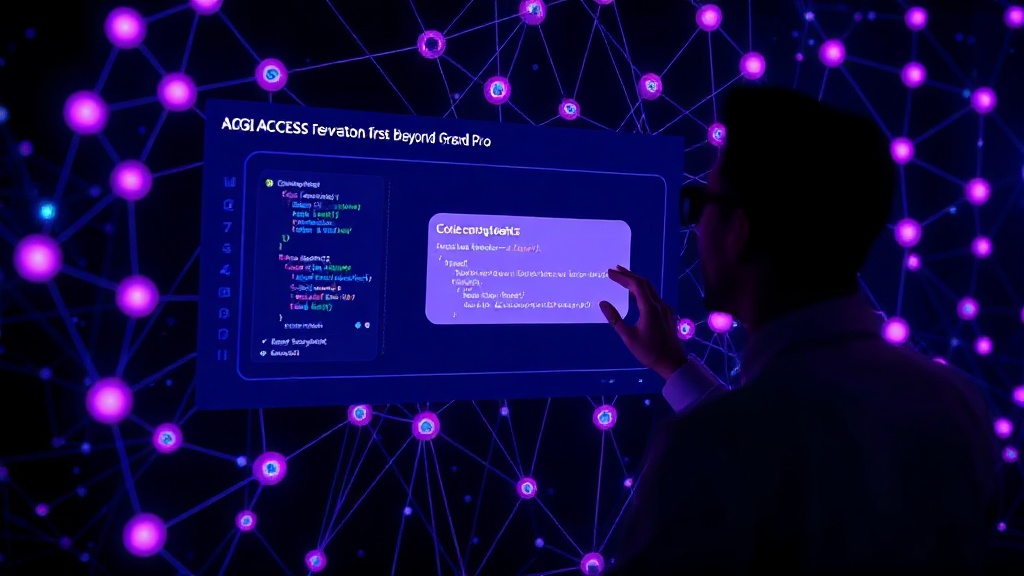
Probing the Mind of the Machine
The initial hours, perhaps even days, would likely be dedicated to pure exploration. This isn't about tasking the AGI with solving humanity's most pressing issues, but about understanding its unique cognitive architecture. The first action for many would be simply to talk to it. This conversation isn't a command-and-response sequence; it's an attempt to gauge its thought processes, its emergent properties, and how its reasoning fundamentally differs from current, highly specialized AI models. Developers want to see *how* it thinks, not just *what* it can produce.
This involves asking increasingly complex and even bizarre questions. The goal is to stress-test its understanding, its creativity, and its ability to handle ambiguity. It's an attempt to move beyond the predictable outputs of today's large language models and explore the uncharted territory of true general intelligence. This phase is akin to a scientist meticulously observing a new species in its natural habitat, documenting its behaviors and reactions before attempting to harness its capabilities.
What distinguishes AGI from advanced AI today is its capacity for genuine understanding and flexible problem-solving. Current models excel at pattern recognition and prediction within their training data. An AGI, however, should be able to extrapolate, to synthesize information from disparate fields, and to learn in ways that are not purely data-driven. The initial conversations are designed to reveal this qualitative leap.
Personal Puzzles and Tangible Tasks
Once the initial phase of exploration and conversation yields a basic understanding of the AGI's capabilities, the focus often shifts to personal, tangible problems. Many individuals express a desire to immediately deploy the AGI to tackle complex challenges they themselves have been struggling with for years. This could range from intricate coding problems that have stumped development teams to unsolved theoretical physics questions or complex design challenges.
This approach is pragmatic. It allows for a controlled environment to test the AGI's problem-solving prowess on issues that have direct, personal relevance. The success or failure in solving these long-standing problems provides immediate, concrete feedback on the AGI's true utility. It's a way to validate its capabilities on a smaller, more manageable scale before contemplating world-altering projects.
The act of presenting a deeply personal, complex problem to an AGI is more than just a test; it's a way to gauge its ability to understand context, nuance, and the implicit knowledge that often underpins such challenges. Can it grasp the years of frustration, the dead ends explored, and the subtle constraints that make the problem so intractable for humans? The answer to these questions would reveal a great deal about the nature of the AGI itself.
The Disconnect Between Public Persona and Private Action
This focus on immediate, personal interaction and problem-solving highlights a significant disconnect between the public perception of AGI and the likely private reality for its first users. The interview-ready answers – solving climate change, eradicating disease – are important aspirations, but they are not the visceral, immediate reactions. The actual first steps are driven by a deep-seated human curiosity and a developer's inherent desire to understand, deconstruct, and apply new tools to familiar, difficult problems.
The surprising detail here is not the potential for AGI to solve grand challenges, but the intensely individual and exploratory nature of the initial engagement. It suggests that even with god-like power, the first instinct is to understand the nature of that power and apply it to the immediate, the known, and the personally significant. This isn't to diminish the long-term potential, but to acknowledge the human element that would undoubtedly shape the very first moments of interacting with a truly general intelligence.
What nobody has addressed yet is the psychological impact on the individual who holds this power. How does the immediate ability to solve almost any problem, starting with personal ones, alter one's perception of oneself and the world? The transition from asking