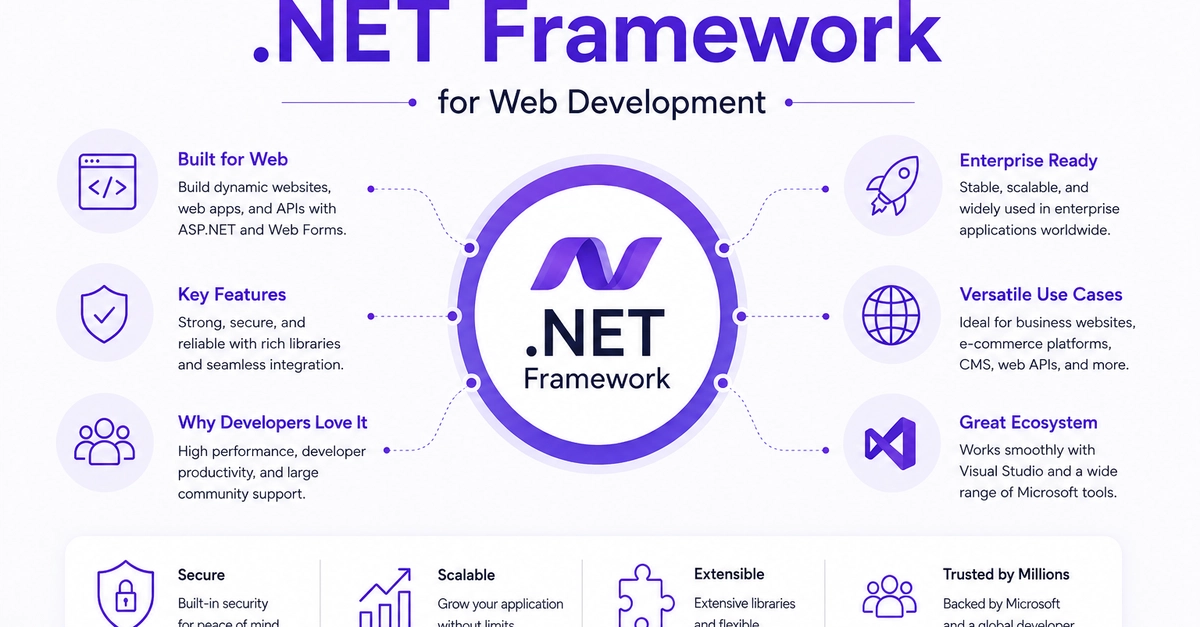
The Unseen Backbone: .NET's Enduring Production Presence
Twenty-three years. That's how long .NET has been a workhorse in production environments. In the fast-moving world of web development, where frameworks rise and fall with alarming speed, .NET has remained a consistent, reliable platform. Major technology players like Netflix, GitHub, and Stack Overflow — services that handle immense traffic and complex functionalities — continue to rely on .NET. This isn't a testament to inertia; it's a clear signal of a framework built for resilience and scale, capable of withstanding the pressures that expose every weakness in less robust systems.
The key to .NET's sustained relevance lies in its architecture and ecosystem. It offers a unified approach to development across multiple platforms, a significant advantage for teams managing diverse projects. This cross-platform capability means a single codebase can serve applications on Windows, Linux, macOS, iOS, and Android, streamlining development and maintenance efforts. For businesses, this translates to faster time-to-market and reduced development costs.
Beyond Inertia: Why .NET Excels Under Load
The decision to stick with a framework for over two decades is never arbitrary. Companies like Stack Overflow, which has arguably saved more developer careers than any other single resource, run on ASP.NET. This choice is driven by performance and stability under extreme conditions. .NET's runtime environment, the Common Language Runtime (CLR), provides robust memory management, type safety, and exception handling, all critical for preventing crashes and ensuring application uptime.
Furthermore, the .NET ecosystem is rich with tools and libraries that accelerate development. ASP.NET Core, the modern, cross-platform evolution of ASP.NET, offers high performance, built-in dependency injection, and a modular architecture. This allows developers to build efficient, scalable web applications, APIs, and microservices. The framework's built-in support for asynchronous programming, for example, is crucial for handling a large number of concurrent requests without blocking threads, a common bottleneck in traditional web servers.
Strategic Technology Choices: Aligning with Business Needs
Choosing a web development approach is often mistakenly framed as purely a technical decision. However, the technology stack profoundly impacts development timelines, content management flexibility, performance optimization, security posture, SEO effectiveness, long-term maintenance costs, and the agility to adapt to future product changes. A technology that's perfect for a simple five-page corporate brochure site might be entirely unsuitable for a complex customer portal or a Software-as-a-Service (SaaS) application with thousands of active users.
The most effective way to navigate this decision is to work backward from the business requirements. Instead of asking, "Should we use WordPress or React for our new project?" a more productive question is, "What specific problems does this website need to solve for our business and our users?" This shift in perspective prevents unnecessary development effort and ensures the chosen technology aligns with strategic goals.
For instance, a business website might have several core objectives:
- Lead Generation: Effectively capture visitor information through forms and clear calls to action.
- Brand Showcase: Present company information, products, and services in a compelling and professional manner.
- Customer Support: Provide resources, FAQs, or contact channels to assist existing clients.
- E-commerce: Facilitate online transactions, product browsing, and order management.
Each of these objectives has different technical implications. A platform excelling at content delivery might struggle with real-time data processing or complex user authentication required for a customer portal. .NET, with its versatile nature, can address a broad spectrum of these needs. Whether building a public-facing marketing site, a secure internal application, or a high-throughput API, .NET provides a stable foundation.
The .NET Advantage for Teams and Future Growth
The longevity of .NET means that developers joining a project can often step into an existing codebase and understand its structure relatively quickly. Unlike frameworks that undergo radical, breaking changes or become obscure, .NET's evolution has been largely additive and backward-compatible where possible. Microsoft's commitment to the platform, coupled with its widespread adoption by industry leaders, ensures a steady stream of documentation, community support, and talent availability.
For founders and team leads, this translates into reduced onboarding friction, a larger pool of experienced developers, and lower long-term maintenance overhead. The ability to build applications that are performant, secure, and scalable from the outset, while also being maintainable by future teams, is a significant competitive advantage. This strategic foresight in technology selection is what separates fleeting projects from enduring digital products.