Local Execution of Advanced Coding Models
Running sophisticated AI coding models locally offers significant advantages in terms of privacy, cost, and customization. The Qwythos-9B-Claude-Mythos-5-1M model, an enhanced version of Mythos, is now accessible for local deployment using the efficient llama.cpp framework. This allows developers to leverage powerful code generation and assistance capabilities without relying on cloud-based APIs, which can incur costs and introduce latency.
The integration with the Pi coding agent further streamlines this local setup. Pi, known for its conversational AI capabilities, can act as an interface to the Mythos model. This means users can interact with the coding model in a more natural, chat-like manner, asking for code snippets, explanations, or debugging assistance. The synergy between a specialized coding model and a conversational agent creates a potent local development environment.
Leveraging llama.cpp for Efficiency
llama.cpp is a C/C++ implementation that enables running large language models (LLMs) on consumer hardware. Its primary advantage lies in its optimization for CPU inference, making it accessible to a broader range of users who may not have high-end GPUs. By quantizing models, llama.cpp reduces their memory footprint and computational requirements, allowing them to run smoothly on standard laptops and desktops.
The Mythos Enhanced Coding Model, specifically the Qwythos-9B-Claude-Mythos-5-1M variant, benefits greatly from this optimization. The '9B' in its name signifies a 9-billion parameter model, which is manageable for llama.cpp to run efficiently. This enables developers to experiment with and integrate advanced coding AI into their daily workflows without the prohibitive costs or infrastructure needs of larger, cloud-hosted models.
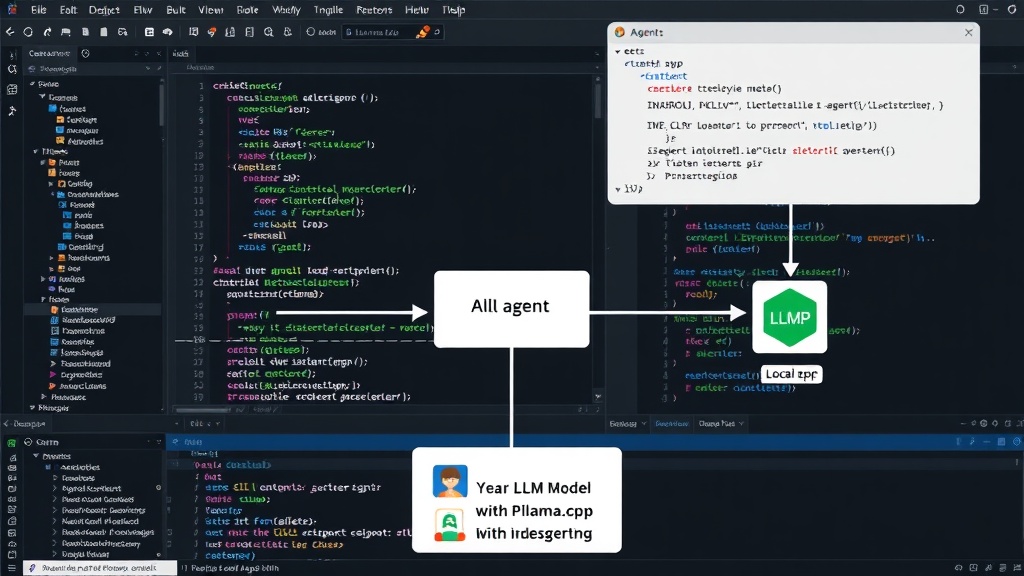
MTP Speculative Decoding and OpenAI-Compatible API
A key innovation enabling faster local inference for models like Mythos is MTP speculative decoding. This technique involves using a smaller, faster model to predict the output of a larger, more complex model. The larger model then verifies these predictions. If the predictions are correct, the output is generated much faster than if the larger model had to compute every token sequentially. This significantly speeds up response times, making the local coding experience feel more fluid and responsive.
Furthermore, the setup includes an OpenAI-compatible API. This is a crucial feature for developers. It means that existing tools and applications built to interact with OpenAI's APIs (like GPT-3.5 or GPT-4) can be easily reconfigured to point to the local Mythos model. This lowers the barrier to entry for integrating the local model into existing projects and development pipelines, allowing teams to switch to a private, local solution with minimal code changes.
Building Fast Local Coding Workflows
The combination of a locally runnable, powerful coding model, an efficient inference engine like llama.cpp, and a conversational interface via Pi creates an environment for rapid local development. Developers can iterate quickly on code, get instant feedback, and maintain full control over their data and models. This is particularly valuable for tasks involving sensitive codebases or for developers who prefer an offline development environment.
The ability to speculatively decode and serve requests via an OpenAI-compatible API means that the performance of this local setup can approach, and in some cases exceed, the perceived performance of cloud-based services for certain tasks, especially when network latency is a factor. This empowers developers to build sophisticated AI-assisted coding tools that are both private and performant.
The Future of Local AI Development
The successful local deployment of models like Qwythos-9B-Claude-Mythos-5-1M using llama.cpp and integrated agents like Pi signals a significant shift in how AI tools will be used. As models become more efficient and frameworks for local execution mature, the trend towards decentralized, private AI will likely accelerate. This approach democratizes access to advanced AI capabilities, enabling individuals and smaller organizations to build powerful AI-driven applications without massive infrastructure investments. The focus on privacy, speed, and customization ensures that local AI solutions will play an increasingly vital role in the future of software development and beyond.