
The Illusion of Feature Scope
When building a Minimum Viable Product (MVP), teams often focus on feature sets: what can be cut, what must be included, and what can wait for version two. This perspective, however, frequently overlooks critical architectural decisions that masquerade as simple scope questions. These aren't merely UI tweaks; they are foundational choices about system design that, if deferred, can incur significant technical debt and costly migrations down the line.
Misclassifying architectural requirements as optional features leads to a false sense of agility. A decision to defer a feature might be straightforward, but deferring an architectural pattern like multi-tenancy, or its underlying data modeling, is akin to deciding to build a house without deciding if it will be a single-family dwelling or an apartment complex, only to realize the error after framing has begun.
User-Tenant Relationships: More Than a Toggle
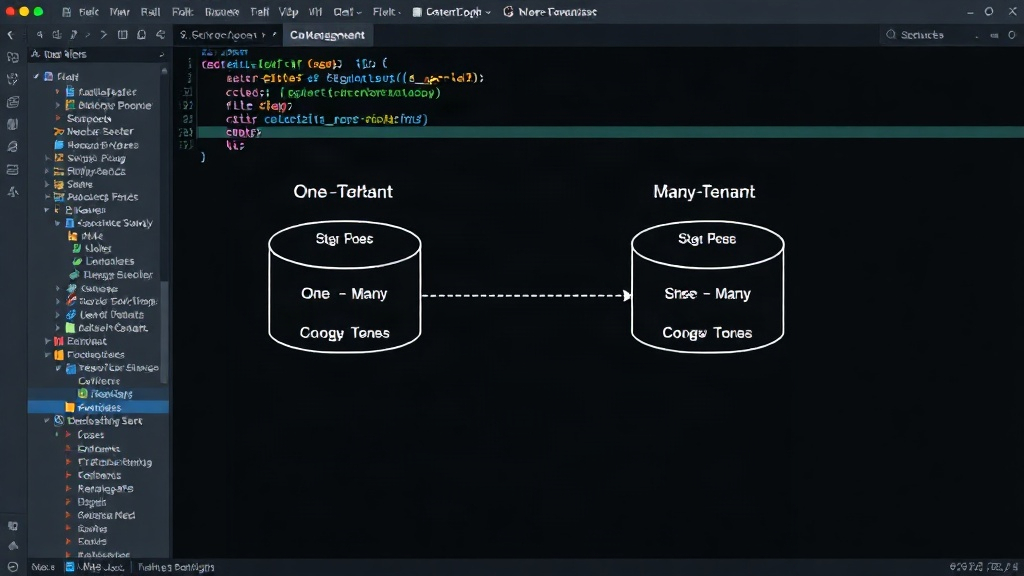
Consider the seemingly innocuous question: "Can users belong to more than one workspace?" On the surface, this appears to be a simple boolean flag or a join table addition. In reality, it strikes at the heart of how users and tenants (or organizations, accounts, etc.) are modeled within your system. If your initial MVP assumes a one-to-one user-tenant relationship, and later you discover users need access to multiple tenants, this isn't a feature enhancement. It's a fundamental schema change.
Implementing this post-launch often requires migrating virtually every table that references a user ID. Instead of adding a simple join table, you might need to refactor foreign key constraints, update indexing strategies, and potentially rewrite significant portions of your data access layer. If there's even a remote possibility of multi-tenant user access within the first year of operation, it is far more economical to address the data model upfront, even if the user interface supporting this capability is slated for a later release.
Custom Roles Per Customer: A Tenant-Specific Access Control Problem
Another common MVP scope question is: "Do we need custom roles per customer?" Initially, this might be simplified to just an "admin" and a "user" role, often applied globally. However, the need for customer-specific roles signals a requirement for tenant-aware access control. This means that the definition and assignment of roles must be scoped to a particular tenant, not just the user.
If your MVP launches with a global role system, introducing per-customer roles later means you can't simply add a `tenant_id` to your existing `roles` table. You might need to rethink your entire authorization model. This could involve creating tenant-specific role definitions, managing role assignments per tenant for each user, and ensuring that all API endpoints and UI elements correctly enforce these tenant-scoped permissions. This is not a minor adjustment; it's a complex security and access management overhaul.
Data Isolation: Beyond Simple Filtering
A related architectural consideration often disguised as a feature is data isolation. The question might arise as, "Will customers be able to see each other's data?" The obvious answer for most SaaS MVPs is no. However, the implementation of this isolation is where the architectural complexity lies.
The simplest approach is often a `tenant_id` column on every table that contains tenant-specific data. This requires diligent application of filters across all queries. But what if certain data is highly sensitive, or compliance regulations demand stronger separation? You might then consider separate databases per tenant, separate schemas within a single database, or even separate physical infrastructure. These are not feature choices; they are fundamental architectural decisions impacting deployment, maintenance, scalability, and cost. Deciding on a `tenant_id` column for simplicity in the MVP might be viable, but understanding the path to stronger isolation methods if needed is crucial. Treating data isolation solely as a filtering problem in the MVP can lead to a brittle foundation if more robust separation becomes necessary.
The Cost of Deferral
Deferring these architectural decisions is often driven by a desire to launch quickly and validate a core product idea. While understandable, it’s essential to recognize when a feature request is actually an architectural dependency. The cost of retrofitting multi-tenancy, tenant-aware access control, or robust data isolation into a system not designed for it can be orders of magnitude higher than building it correctly from the start.
This isn't to say every MVP must be a fully-fledged multi-tenant system from day one. The key is to identify the *potential* for these architectural needs early. If a feature like "multiple workspaces per user" or "customizable user permissions" is on the roadmap for year one, the underlying data model and access control mechanisms should be designed with that future in mind, even if the user-facing implementation is delayed. This upfront architectural thinking, even if it feels like premature optimization, saves immense pain, time, and resources in the long run. It's about building a scalable foundation, not just a quick facade.