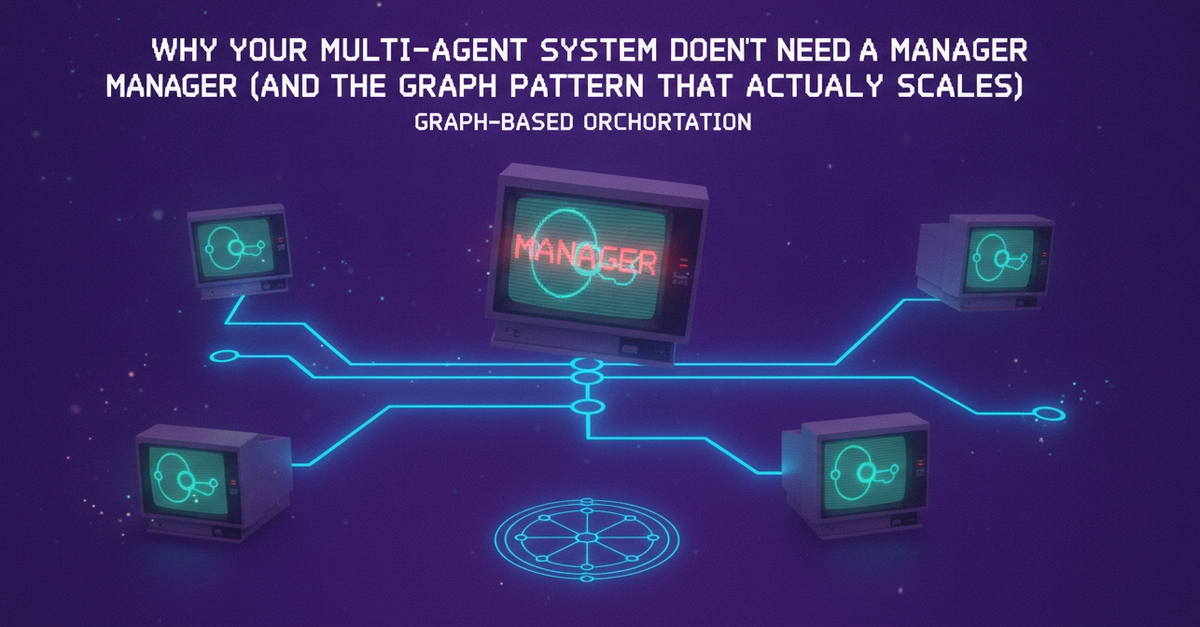
The Manager Pattern's Inherent Bottleneck
For three years, teams have grappled with scaling multi-agent systems, often abandoning projects due to a common architectural flaw: the manager pattern. This centralized approach, where a single 'orchestrator agent' routes every task, holds all decision-making, and manages the full state of each sub-agent, is an intuitive but ultimately brittle design. It mirrors the pitfalls of early 2010s microservice monoliths, destined to fail under production pressure.
The manager pattern appears elegant in simple notebooks. However, in real-world applications, it buckles under three primary pressures:
- Context Window Saturation: The manager agent must retain the complete state of every task it dispatches. As workflows become more complex and involve more agents, the manager's context window fills up. This doesn't reflect a limitation of the underlying LLM's reasoning ability; rather, it becomes a structural bottleneck imposed by the architecture itself.
- Single Point of Failure: If the manager agent crashes or encounters an error, the entire system grinds to a halt. There is no inherent redundancy or failover mechanism within this centralized model.
- Limited Parallelism: All task routing and decision-making funnel through the manager. This prevents true parallel execution of independent sub-tasks, severely limiting throughput and responsiveness.
This centralized design forces AI systems into an outdated, inefficient paradigm. The reliance on a single point of control stifles the potential for emergent behavior and efficient task distribution that multi-agent systems promise.
Introducing Graph-Based Orchestration
A more robust and scalable approach eschews the manager entirely, adopting a graph-based orchestration pattern. Instead of a central controller, agents communicate directly with each other based on predefined relationships and conditions represented in a directed acyclic graph (DAG) or a more general graph structure. Each agent is responsible for its own task execution and for determining the next agent(s) to interact with, based on the output of its own work.
Think of it less like a hierarchical command structure and more like a decentralized network of specialists. Each specialist knows who to pass their work to next, and when. They don't need a central dispatcher to tell them; they just need to know the rules of the network and the capabilities of their immediate peers. This distributed intelligence allows for:
- Enhanced Scalability: By removing the central bottleneck, the system can handle a vastly larger number of agents and more complex workflows. The load is distributed across the network.
- Increased Resilience: The failure of a single agent does not bring down the entire system. Other agents can continue processing their tasks, and fault tolerance can be built into the graph's structure.
- True Parallelism: Independent branches of the graph can execute concurrently, dramatically improving processing speed and efficiency.
- Simplified Agent Logic: Each agent only needs to understand its immediate neighbors and the conditions for passing work, rather than needing a global view of the entire system state.
This pattern transforms multi-agent systems from rigid, centralized structures into flexible, distributed networks. It mirrors more modern distributed systems design principles, allowing for greater autonomy and specialized intelligence within each agent.
Implementing Graph-Based Orchestration
Implementing graph-based orchestration involves defining the agents, their capabilities, and the connections between them. This is typically done using a declarative approach, where the graph structure is defined separately from the agent logic. Libraries and frameworks exist to help manage these graph definitions and the execution flow.
Key components include:
- Agent Definitions: Each agent needs a clear definition of its function, its inputs, and its outputs.
- Node Representation: Agents are represented as nodes in the graph.
- Edge Representation: The connections between agents (edges) represent the flow of data or control. These edges can be conditional, meaning data only flows if certain criteria are met.
- Execution Engine: A component that interprets the graph and triggers agent execution based on data availability and conditions. This engine is not a central manager but rather a distributed scheduler or event bus.
For instance, an agent designed to summarize text might output its result, which then triggers a 'sentiment analysis' agent. If the sentiment is negative, it might then trigger a 'draft response' agent. This chain of events is defined by the graph, not dictated by a central manager. The 'sentiment analysis' agent doesn't need to know about the 'draft response' agent until it receives input from the 'summarize text' agent. This is the essence of decentralized, scalable orchestration.
Referenced Sources
- verified