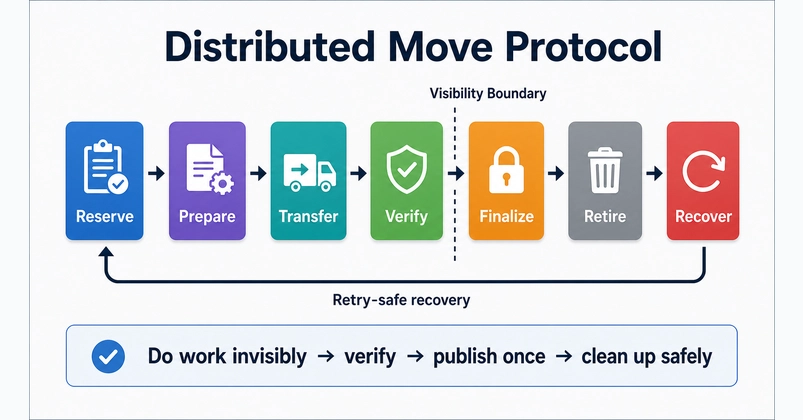
The Illusion of Simple State Migration
Moving data sounds trivial. For systems confined to a single machine, a straightforward copy-and-delete operation suffices. You duplicate the state to a new location and then purge it from the original. This model works because there's a single, authoritative source of truth, and operations are atomic and immediately visible to all processes. However, this simplicity shatters the moment state must traverse boundaries within a distributed system. These boundaries—partitions, shards, distinct services, databases, or even separate geographic regions—transform a basic data movement into a complex distributed protocol.
The core challenge isn't the mechanics of data copying. Modern storage systems handle data transfer efficiently. The real difficulty lies in controlling visibility. When state moves across these distributed boundaries, ensuring consistency and preventing data anomalies becomes paramount. A system must guarantee that at no point is the state ambiguously represented, leading to incorrect operations or data corruption.
Consider a distributed database where a user record resides on shard A but needs to be moved to shard B. If the move is simply a copy from A to B followed by a delete on A, several problematic scenarios can arise. What happens if a read request for that user arrives at shard A *after* the copy but *before* the delete? The system might return stale data or, worse, indicate the record no longer exists. Conversely, what if a write request arrives at shard B *before* the copy is complete? The new data would be written to an incomplete or nonexistent record. The system must manage the transition so that operations are correctly routed and applied, regardless of when they arrive relative to the migration process.
Risks of Naive Copy-and-Delete
A naive approach to moving state in a distributed environment, typically involving a direct copy followed by deletion, introduces significant risks. These risks stem from the asynchronous and partitioned nature of distributed systems, where operations are not instantly globally consistent.
- Duplicate Visibility: The most immediate danger is that both the source and destination appear to be the live, authoritative location for the state simultaneously. During the transition, a read operation might hit the old location and succeed, while another read hits the new location and also succeeds, potentially returning different versions of the data or indicating the data exists in two places. This ambiguity can lead to conflicting updates or incorrect application logic that assumes a single source of truth.
- Data Loss: If a write operation is directed to the source location after the data has been copied but before it's confirmed as deleted, and if the destination is not yet fully updated or acknowledged, the write could be lost. Alternatively, if a write targets the destination *before* the copy is finalized, it might be applied to an incomplete dataset, or the system might reject it if it expects a specific pre-migration state.
- Inconsistent State: The period where both locations are partially active creates a window for inconsistency. Applications interacting with the system might receive data from the old location while new data is being written to the new location. This leads to a state where different parts of the system observe different realities, violating the fundamental principle of consistency required for reliable distributed operations.
These issues are not theoretical. They manifest in real-world scenarios when systems need to rebalance data across nodes, migrate to new infrastructure, or implement sharding strategies. The complexity arises because a simple two-step process requires a more sophisticated distributed coordination mechanism to ensure atomicity, consistency, and isolation.
The Distributed Protocol for State Movement
Addressing the complexity of moving state across distributed boundaries necessitates a robust distributed protocol. This protocol must manage the transition in a way that maintains system integrity. Typically, such protocols involve multiple phases and coordination points.
Phase 1: Prepare and Copy
The process begins with preparing both the source and destination. The destination is made ready to receive the state. Then, a snapshot of the state is taken from the source. This snapshot is copied to the destination. Crucially, during this phase, the source remains active and continues to accept read and write operations. The system must ensure that any writes occurring on the source during the copy process are also captured or reconciled later. This might involve logging changes made to the source during the copy operation.
The "So What?" Perspective
Developers must understand that migrating state across partitions, services, or regions isn't a simple copy-delete. It requires implementing or leveraging distributed protocols that manage visibility and consistency to prevent duplicate writes or data loss. Expect to implement complex state machines or use libraries that abstract these coordination challenges.
While not a direct security vulnerability, improper state migration can lead to data inconsistencies that attackers might exploit. Ensuring that state is moved atomically and that visibility controls are strictly enforced prevents scenarios where stale or duplicated data could be accessed or manipulated. Thorough testing of migration rollback and commit logic is critical.
The hidden complexity of state migration directly impacts operational costs and system reliability. Rebalancing data, scaling partitions, or moving to new infrastructure requires significant engineering investment. This can slow down feature velocity and increase the risk of outages. Prioritizing robust, automated migration strategies is key to long-term scalability and stability.
For creators relying on distributed storage or databases, understanding the underlying state management is crucial. If a platform undergoes infrastructure changes that involve state migration, creators might experience temporary availability issues or unexpected data behavior. Awareness of these potential disruptions can help manage expectations and workflows.
Moving state in distributed systems necessitates careful consideration of data consistency models. Eventual consistency might be acceptable for some operations, but for critical state transitions, stronger guarantees are needed. This requires implementing mechanisms like two-phase commit or Paxos/Raft-like consensus protocols for state updates during migration, impacting model training and data integrity.
Sources synthesised
- 13% Match