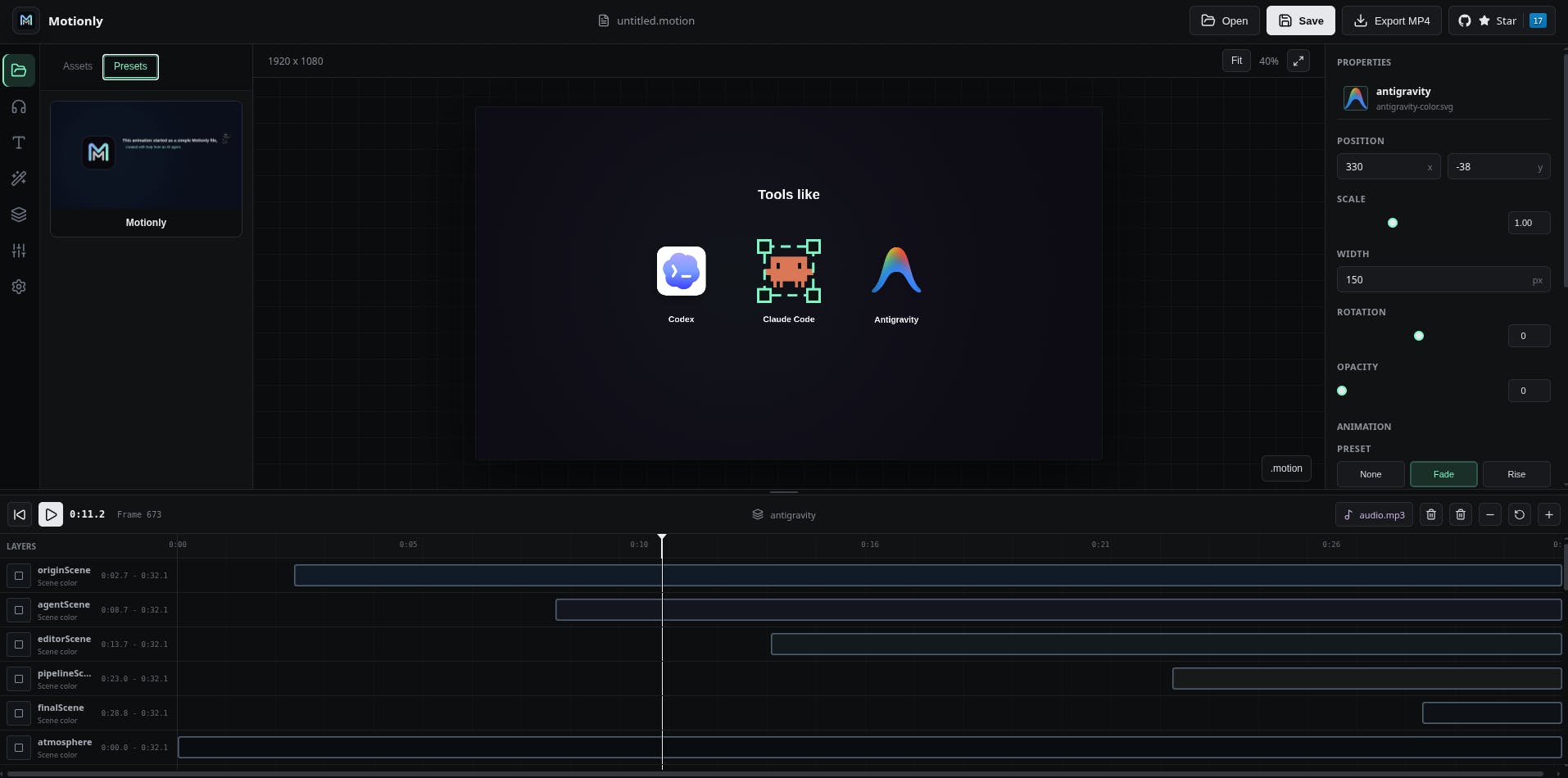
Motionly: AI-Native Motion Graphics Editor
Motionly enters the creative software landscape with a bold claim: to redefine motion graphics creation through an AI-native approach. The platform positions itself as a solution for designers and creators struggling with the steep learning curve and time-intensive nature of traditional motion design tools. By leveraging artificial intelligence, Motionly aims to automate repetitive tasks, generate complex animations, and streamline the entire production pipeline, making sophisticated motion graphics accessible to a broader audience.
The core proposition of Motionly is its AI-first architecture. Unlike existing software that might incorporate AI features as add-ons, Motionly is built from the ground up with AI at its center. This foundational difference suggests a deeper integration and a more intuitive user experience, where AI doesn't just assist but actively participates in the creative process. The goal is to reduce the friction typically associated with motion design, such as manual keyframing, complex rigging, and intricate animation layering.
For creators, this translates into significant potential time savings and enhanced creative output. Imagine needing to create animated text sequences for a video. In a traditional workflow, this might involve setting individual keyframes for position, scale, rotation, and opacity for each character or word, meticulously adjusting timing and easing curves. Motionly's AI, however, could potentially take a text input and a desired style, then generate a dynamic, well-timed animation automatically. This allows designers to focus on the conceptualization and storytelling aspects rather than the granular execution.
The platform's AI capabilities are designed to tackle various aspects of motion graphics production. This includes intelligent animation generation, where the AI can suggest or create animations based on user prompts or existing assets. It also extends to asset manipulation, potentially enabling AI-driven background removal, object tracking, or style transfer for video elements. Furthermore, Motionly aims to simplify scene composition and layout, using AI to optimize the placement and movement of elements within a frame for aesthetic appeal and narrative clarity.
Simplifying Complex Workflows
The complexity of motion graphics software like Adobe After Effects or Cinema 4D is a well-known barrier to entry. These tools offer immense power but demand significant expertise and time investment. Motionly seeks to democratize this field by abstracting away much of that complexity. Its AI-native design means that users can interact with the software using more natural language prompts or by providing high-level creative direction, rather than needing to master intricate technical controls.
Consider the process of creating a character animation. Traditionally, this involves rigging a character model with a skeletal structure, then painstakingly animating each joint and limb. Motionly's approach might involve uploading a character design and then using AI to infer movement patterns or apply pre-defined animation styles, such as a walk cycle or a gesture, with minimal manual input. This is akin to giving a director's notes to an AI animator rather than manually posing a puppet.
The platform also promises to accelerate the iteration process. In design, rapid prototyping and feedback loops are crucial. Motionly's automation capabilities mean that designers can quickly generate multiple variations of an animation or design concept, test them, and refine them without the overhead of redoing hours of manual work. This speed advantage is critical in fast-paced content creation environments.
Target Audience and Market Implications
Motionly appears to be targeting a broad spectrum of users, from individual content creators and social media managers to small design agencies and even marketing teams within larger organizations. Anyone who needs engaging visual content but lacks the specialized skills or resources for traditional motion design could benefit. This includes YouTubers, podcasters, app developers, and educators looking to enhance their presentations and online content.
The AI-native approach to motion graphics is an emerging trend, and Motionly is positioning itself at the forefront. While established players like Adobe are integrating AI features, a platform built entirely around AI could offer a fundamentally different user experience and workflow. This raises an interesting question: as AI becomes more adept at creative tasks, what is the future role of the human motion designer? Will it shift towards prompt engineering, creative direction, and AI model curation, or will AI become a tool that augments, rather than replaces, human creativity?
The success of Motionly will likely depend on the sophistication of its AI, the intuitiveness of its user interface, and its ability to produce high-quality, professional-looking results that can compete with traditionally crafted motion graphics. If it can deliver on its promise, Motionly could significantly lower the barrier to entry for creating dynamic visual content, opening up new avenues for creativity and communication in the digital space.