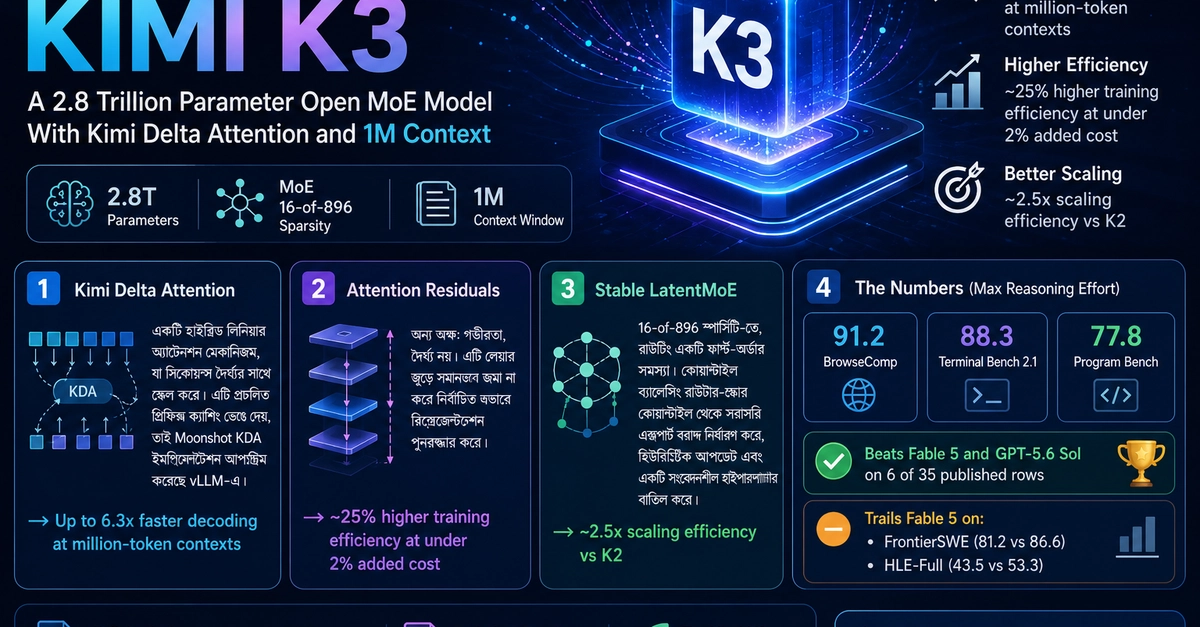
Kimi K3: A Leap in Open LLM Capabilities
The AI race continues its relentless pace, with Moonshot AI introducing Kimi K3, a significant milestone in large language model development. This new model isn't just about scale; it represents a focused effort to overcome practical bottlenecks in training efficiency, inference speed, and the crucial ability of models to understand and process extremely long contexts. At its core, Kimi K3 is a 2.8 trillion parameter open Mixture-of-Experts (MoE) model, designed to push the boundaries of what's possible with long-context AI.
Innovations in Kimi Delta Attention (KDA)
A key innovation driving Kimi K3's long-context capabilities is Kimi Delta Attention (KDA). Traditional attention mechanisms, fundamental to how LLMs process information, become computationally prohibitive as the length of the input text (context window) increases. KDA addresses this by implementing a hybrid linear attention approach. This design is specifically engineered to handle extremely long contexts more efficiently, making it feasible to process documents, codebases, or entire books in a single pass without the exponential cost increase seen in standard attention models.

Addressing Training and Inference Bottlenecks
Beyond attention, Moonshot AI tackled other critical areas. The development paper highlights improvements in training efficiency, suggesting that Kimi K3 can be trained with significantly fewer computational resources than comparable models. This is achieved through a combination of architectural optimizations and advanced training techniques. For inference, the model is optimized for speed, ensuring that despite its massive size, it can deliver responses quickly. This focus on practical engineering challenges means Kimi K3 is not just a theoretical marvel but a model designed for real-world deployment and use.
The Significance of Open MoE Models
Kimi K3's status as an open Mixture-of-Experts (MoE) model is also noteworthy. MoE architectures are known for their efficiency, using specialized 'expert' networks that are activated only when needed, rather than a single monolithic network processing all inputs. Making this architecture open-source democratizes access to advanced AI capabilities. This move by Moonshot AI, particularly with a model of this scale and long-context capability, can have ripple effects across the AI landscape. It challenges existing economic models for AI infrastructure and development, potentially reigniting discussions about the cost-effectiveness of training and deploying massive models, especially in regions like China where it represents the largest open-weight model.
Market and Economic Implications
The introduction of Kimi K3 has already sent ripples through the AI and semiconductor stock markets. By demonstrating that advanced capabilities, like massive parameter counts and long context windows, can be achieved with potentially greater efficiency and in an open format, it raises questions about the economic assumptions underlying current AI infrastructure spending. Companies heavily invested in proprietary, closed-source models or in the hardware required for less efficient training paradigms may face increased pressure. The success of open models like Kimi K3 could shift investment towards more efficient architectures and potentially reduce the perceived need for the most expensive, cutting-edge hardware for certain applications, impacting semiconductor stock valuations. This could revive 'DeepSeek-era' fears about the long-term economics of US infrastructure spending on AI if open, efficient alternatives gain significant traction.
What's Next for Long-Context AI?
Kimi K3's 1 million token context window represents a substantial increase in the amount of information an AI can process at once. This capability unlocks new use cases, from comprehensive legal document analysis and intricate code review to in-depth scientific research summarization and sophisticated narrative generation. The engineering breakthroughs that enable this scale and efficiency are as important as the parameter count itself. As researchers and developers continue to build upon and experiment with Kimi K3, we can expect further innovations in how AI models understand and interact with vast amounts of data, potentially leading to more powerful and versatile AI applications across numerous industries.
The focus on solving practical bottlenecks rather than just scaling parameters underscores a maturing phase in LLM development. It suggests a trend towards more pragmatic, efficient, and accessible AI, driven by open innovation and a deep understanding of the underlying engineering challenges. Moonshot AI's Kimi K3 is a testament to this evolution.