The Frustration of Naive Array Traversal
The interview question “Next Greater Element” is a classic. You’re given an array, and for each element, you need to find the first element to its right that is greater than it. If no such element exists, you typically mark it with a placeholder like -1. The most straightforward approach involves nested loops: for each element, scan the rest of the array to its right. This brute-force method has a time complexity of O(n²). While it works, it’s inefficient and often feels like overkill, especially when you know there must be a more elegant solution.
This O(n²) approach is akin to meticulously checking every single item on a grocery list against every item in your cart, one by one, to see if you’ve picked up a specific brand. It’s slow, repetitive, and prone to errors if you’re not careful. Many developers hit this wall, realizing that the linear, left-to-right scan, while intuitive, isn’t always the most effective for problems requiring look-ahead capabilities or maintaining a specific order of seen elements.
Introducing the Monotonic Stack
The monotonic stack offers a sophisticated yet surprisingly simple solution. It’s a stack data structure where the elements are always in a specific order—either strictly increasing or strictly decreasing. This property is key to its efficiency. Instead of re-scanning, we leverage the stack to maintain a history of elements that are candidates for future comparisons.
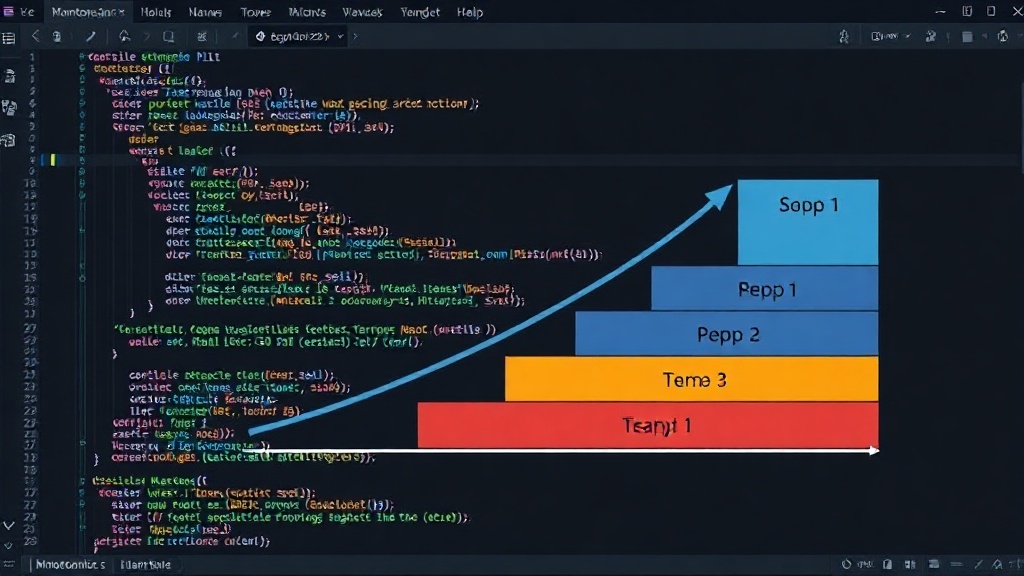
Imagine you’re building a tower of blocks, but you can only add a block if it’s taller than the one immediately below it (an increasing stack), or shorter (a decreasing stack). If you pick up a block that violates this rule, you must first remove any blocks from the top of the tower that are shorter (or taller, depending on the rule) than the new one before you can place your new block. This removal process is analogous to how a monotonic stack handles elements that don't fit the required order.
How it Works: The Mechanics
Let’s consider the “Next Greater Element” problem with an increasing monotonic stack. We iterate through the input array from left to right. For each element `current_element`:
- Check the Stack: While the stack is not empty AND `current_element` is greater than the element at the top of the stack (`stack.peek()`):
- This means `current_element` is the “Next Greater Element” for the element at the top of the stack.
- Pop the element from the stack. Record that `current_element` is its next greater element.
- Push onto Stack: After the while loop finishes (either the stack is empty or `current_element` is not greater than the top element), push `current_element` onto the stack. This maintains the increasing order of the stack.
After iterating through the entire array, any elements remaining in the stack do not have a “Next Greater Element” to their right. They are assigned the placeholder value (-1).
Variations and Applications
The monotonic stack isn’t limited to just finding the next greater element. Its core principle of maintaining an ordered sequence of potential candidates makes it incredibly versatile:
- Previous Greater Element: Traverse from right to left, using a similar logic but looking for the first greater element to the left.
- Next Smaller Element: Use a decreasing monotonic stack. When `current_element` is *smaller* than `stack.peek()`, pop and record.
- Previous Smaller Element: Traverse right to left with a decreasing monotonic stack.
- Largest Rectangle in Histogram: This is a classic application. For each bar, we need to find the nearest bar to its left and right that is shorter. A monotonic (increasing) stack helps find these boundaries efficiently. For each bar `h`, we find the nearest smaller bar to its left and right. The width of the rectangle with height `h` is `right_index - left_index - 1`. The area is `h * width`. We can compute this for all bars and find the maximum.
- Trapping Rain Water: While often solved with two pointers or dynamic programming, monotonic stacks can also be applied here by finding for each bar, the nearest taller bars to its left and right.
The Efficiency Gain
The power of the monotonic stack lies in its time complexity. Although there’s a `while` loop inside the main `for` loop, each element is pushed onto the stack exactly once and popped from the stack at most once. This means the total number of stack operations (push and pop) is proportional to the number of elements in the array. Therefore, the overall time complexity for most monotonic stack problems is O(n), a significant improvement over the O(n²) brute-force approach.
The space complexity is O(n) in the worst case, as the stack might need to store all elements if the array is strictly increasing or decreasing.
Beyond the Interview Room
While the monotonic stack is a staple in coding interviews, its utility extends to real-world scenarios. Developers working with time-series data, financial analyses, or any problem involving sequential data where relationships between elements are crucial can benefit from this pattern. For instance, in analyzing stock market data, you might use a monotonic stack to find periods where a stock price consistently rose or fell before a significant change, helping to identify potential turning points.
Understanding the monotonic stack transforms how you approach a class of array problems. It moves you from brute-force iteration to an elegant, efficient, and insightful solution, much like understanding perspective changes how you draw a scene. It’s not just an algorithm; it’s a way of thinking about relationships within sequential data.