
Refactoring Core Assertion Logic
In the second installment of this series, we continue the deep dive into modernizing a quarter-century-old minimal C++ unit testing framework. The previous part laid the groundwork, introducing the project's goals: enhancing maintainability, improving developer experience, and ensuring compatibility with modern C++ standards without sacrificing the framework's core simplicity. This section focuses on the intricate refactoring of the assertion logic, the very heart of any unit testing suite. The original framework, built in an era where C++ was significantly different, relied on a rather verbose and less type-safe approach to assertions. Think of it less like a modern, expressive assertion library and more like a series of C-style `assert()` calls peppered throughout the test code, albeit with some custom macros for basic reporting.
The primary challenge here is to evolve this system into something that leverages C++'s type system more effectively. This means moving away from macro-heavy implementations that often obscure the actual test logic and make debugging harder. The goal is to introduce a more fluent, readable, and robust assertion API. We're not just talking about syntax; we're talking about the underlying mechanisms that handle comparisons, report failures, and integrate with the test runner. The original framework's failure reporting was rudimentary: a simple line number and a generic failure message. Modernizing this involves capturing more context, such as the actual values being compared, and providing more actionable diagnostic information.
Introducing Modern C++ Idioms
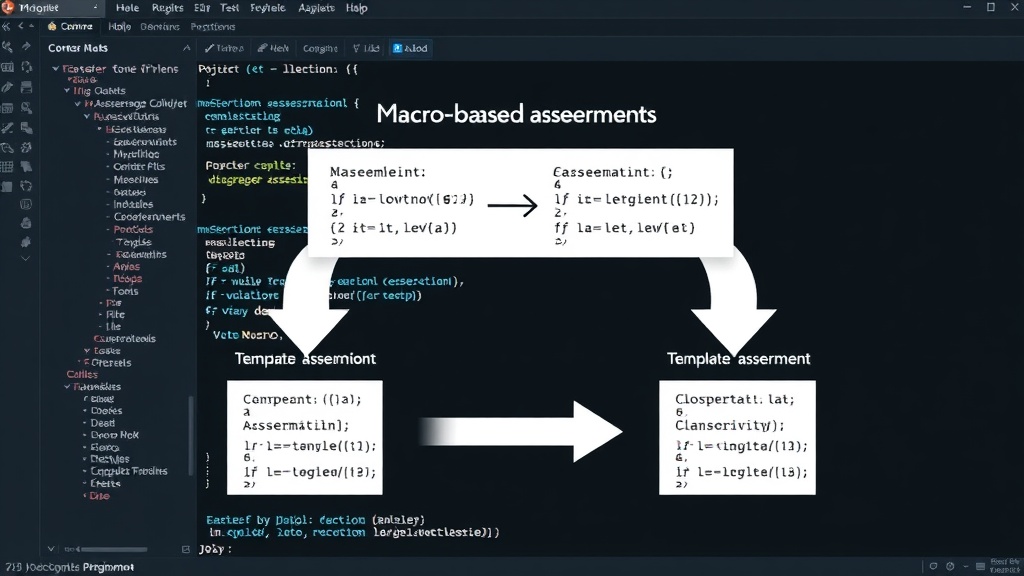
The refactoring process involves several key steps. First, we're systematically replacing custom macros with C++ templates and function overloads. This allows for better type checking at compile time, reducing the likelihood of runtime errors due to type mismatches. For instance, instead of a macro like ASSERT_EQUALS(a, b), which might perform a simple `if (a != b)` check and then print string representations, we aim for a template function like ASSERT_EQ(a, b) that can handle various types gracefully and provide detailed output if `a` and `b` differ. This also opens the door to more advanced features like custom matchers, inspired by libraries like Google Test or Catch2, but kept within the minimalist ethos of this framework.
A significant undertaking is the handling of complex types and custom comparison logic. The old framework was brittle when dealing with user-defined types that didn't have straightforward equality operators. The new approach involves allowing users to provide custom comparators or to specialize existing ones for their types. This is achieved through template metaprogramming and SFINAE (Substitution Failure Is Not An Error) techniques, ensuring that the compiler can select the most appropriate comparison mechanism without crashing. The aim is to make the framework feel intuitive, so developers don't have to fight the compiler or the testing tools.
Improving Test Runner Integration and Reporting
Beyond assertions, the test runner itself requires modernization. The original runner was a simple command-line executable that iterated through test files, executed tests, and printed a summary. This is functional but lacks the features expected today: detailed reporting formats (like JUnit XML for CI/CD integration), better error handling, and more granular control over test execution. We are implementing support for different output formats, starting with a basic XML reporter that can be easily parsed by continuous integration systems.
Furthermore, the way tests are discovered and organized is being revisited. While the framework prioritizes minimal boilerplate, the old method of manually registering tests could be error-prone. We are exploring options for more automatic test discovery, perhaps through conventions or a slightly more sophisticated registration mechanism, without adding significant overhead. The goal is to strike a balance: maintain the framework's lightweight nature while making it more practical for larger projects. This involves careful consideration of performance implications, ensuring that any new features do not bog down test execution times, which are critical for rapid feedback loops in development.
The surprising detail here is not the complexity of the refactoring itself, but the sheer number of subtle edge cases that emerge from a system that has been in use, likely in some form, for 25 years. Each 'simple' assertion or runner command turns out to have had implicit assumptions baked into it over years of use, assumptions that are now being challenged by modern C++ features and evolving developer expectations. What nobody has addressed yet is how to gracefully migrate existing test suites built on the old framework to the new API without requiring extensive rewrites. This is a significant hurdle for adoption, and a future iteration may need to focus on backward compatibility layers or migration tools.
Future Considerations and Minimalist Philosophy
Looking ahead, the focus remains on the minimalist philosophy. The goal is not to become a feature-rich behemoth like some existing frameworks. Instead, it's about making the core testing experience as smooth, efficient, and understandable as possible for C++ developers. This means carefully evaluating every new feature for its necessity and its impact on the framework's size and complexity. We are considering features like parameterized tests and fixture management, but only if they can be implemented in a way that aligns with the core principles.
The continued success of this modernization effort hinges on the active participation of its users. Feedback from developers who rely on this framework is invaluable for prioritizing features and identifying areas for improvement. The next steps will involve more rigorous performance testing and broader compatibility checks across different C++ compilers and platforms. The ultimate aim is to provide a testing foundation that is both robust and a pleasure to use, proving that even legacy systems can be revitalized with careful engineering and a clear vision.