A Homegrown Parallel Processing Powerhouse
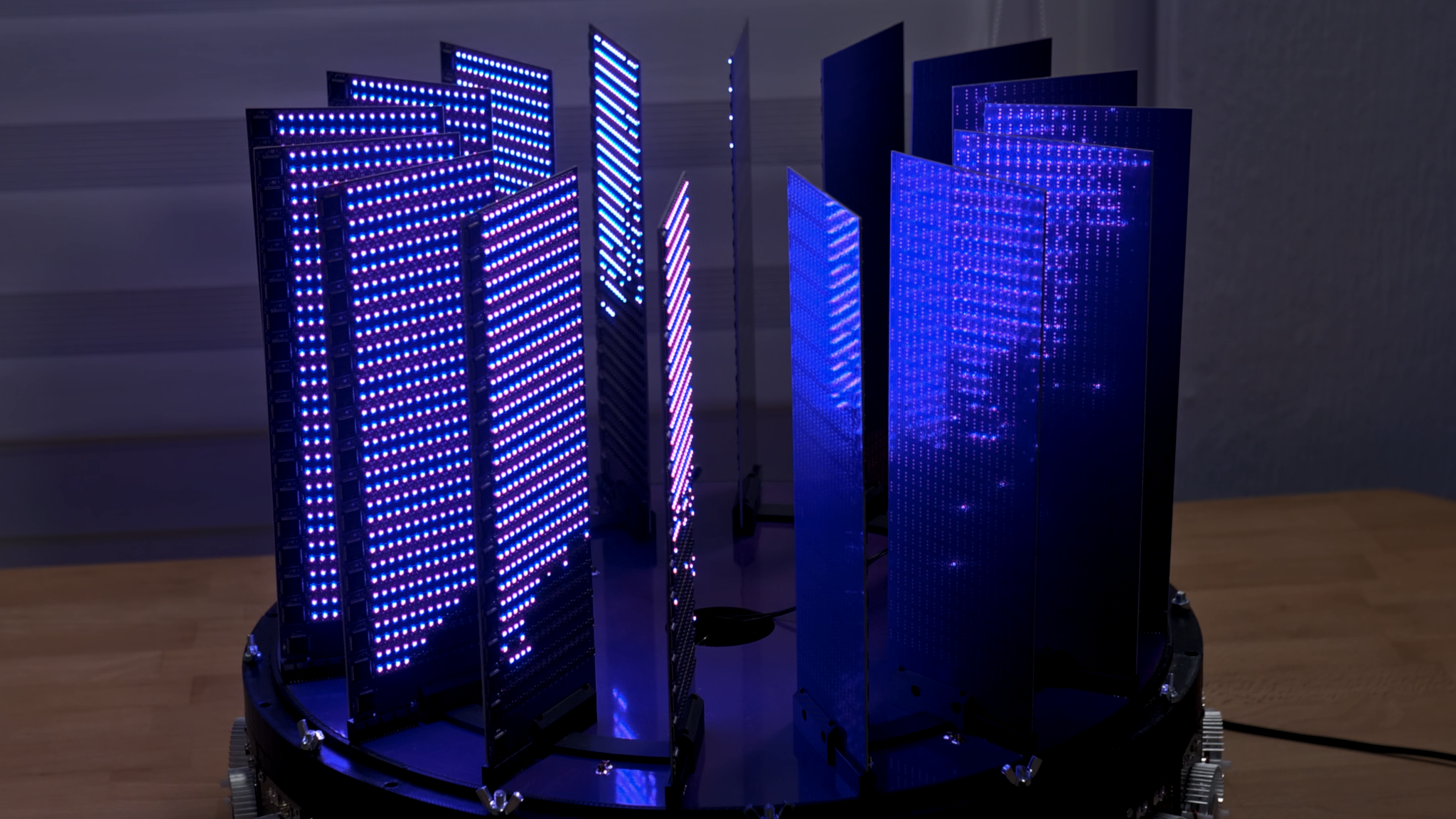
Matthias Balwierz, known online as Bitluni, has achieved what many would consider a feat of engineering bordering on the impossible: building an 8,192-core Graphics Processing Unit (GPU) entirely from scratch at home. This isn't a typical consumer graphics card; it's a massive, custom-built parallel processing system constructed from individual RISC-V microcontrollers. The sheer scale of this undertaking is staggering, requiring not only significant technical expertise but also a considerable investment in time, resources, and a substantial amount of power.
The core of Balwierz's creation is its immense parallelism. By connecting 8,192 individual processing cores, he aims to achieve computational throughput that rivals or even surpasses some commercial solutions for specific tasks. This approach bypasses the monolithic design of traditional GPUs, opting instead for a distributed, modular architecture. Each of the 8,192 cores is a complete RISC-V microcontroller, meaning each has its own instruction set, memory access, and execution capabilities. This fundamentally differs from how commercial GPUs operate, where thousands of simpler, specialized shader cores are managed by a more complex control unit.
Power Demands and Programming Challenges
The ambition of such a project comes with significant practical challenges. The most immediate is power consumption. Balwierz's 8,192-core GPU draws over 2,000 watts of power. To put that into perspective, a high-end commercial gaming GPU typically consumes between 200-400 watts. This massive power draw necessitates a robust power supply and advanced cooling solutions to prevent the system from overheating and failing. The sheer heat generated by thousands of active microcontrollers working in parallel is a critical engineering hurdle that Balwierz had to overcome.
Programming such a massively parallel, custom-built system presents another unique challenge. Unlike commercially available GPUs with well-defined driver stacks and programming interfaces like CUDA or OpenCL, Balwierz’s creation requires a bespoke approach. The source indicates that a 3D printer is essential for programming this GPU. This likely means that the physical configuration and interconnection of the microcontrollers, perhaps through custom-designed boards or interfaces printed by the 3D printer, are integral to the programming process itself. This could involve physically reconfiguring the hardware to load new instructions or data, a stark contrast to the software-defined programming of conventional hardware.
The RISC-V Advantage and DIY Hardware Culture
The choice of RISC-V architecture is significant. RISC-V is an open-standard Instruction Set Architecture (ISA) based on established Reduced Instruction Set Computer principles. Its open nature means that anyone can design, manufacture, and sell RISC-V chips and software without paying royalties. This open philosophy makes it an ideal choice for hobbyists, researchers, and companies looking to innovate outside the traditional proprietary ecosystems dominated by x86 and ARM. For Balwierz, RISC-V provides the flexibility to experiment with custom hardware designs at a fundamental level.
This project is a testament to the growing culture of DIY hardware and open-source innovation. Engineers and enthusiasts are increasingly leveraging accessible technologies, like microcontrollers and 3D printing, to create complex systems that were once the exclusive domain of large corporations. Balwierz's work highlights the potential for distributed computing and custom hardware design, pushing the boundaries of what can be achieved outside of traditional R&D labs. It serves as an inspiration for makers and engineers looking to explore novel architectures and build powerful computational tools with their own hands.
Broader Implications and Future Directions
While this 8,192-core RISC-V GPU is unlikely to find its way into consumer products, its existence poses interesting questions about the future of custom hardware development. It demonstrates that with enough ingenuity and resources, individuals can construct highly parallel computing systems. This could inspire new approaches to specialized computing tasks, where bespoke hardware tailored to specific algorithms might offer significant advantages over general-purpose processors or GPUs. The project also underscores the growing maturity and applicability of the RISC-V ecosystem, showing its potential beyond embedded systems and into more complex computational domains.
The integration of a 3D printer into the programming workflow is particularly novel. It suggests a future where hardware design and software development become more intertwined, with physical fabrication playing a more dynamic role in the development cycle. This could lead to entirely new paradigms for prototyping and deploying custom hardware. As Balwierz continues to refine his creation, the focus will likely be on optimizing its performance, exploring its capabilities for specific workloads, and perhaps developing more streamlined methods for programming its vast array of cores.