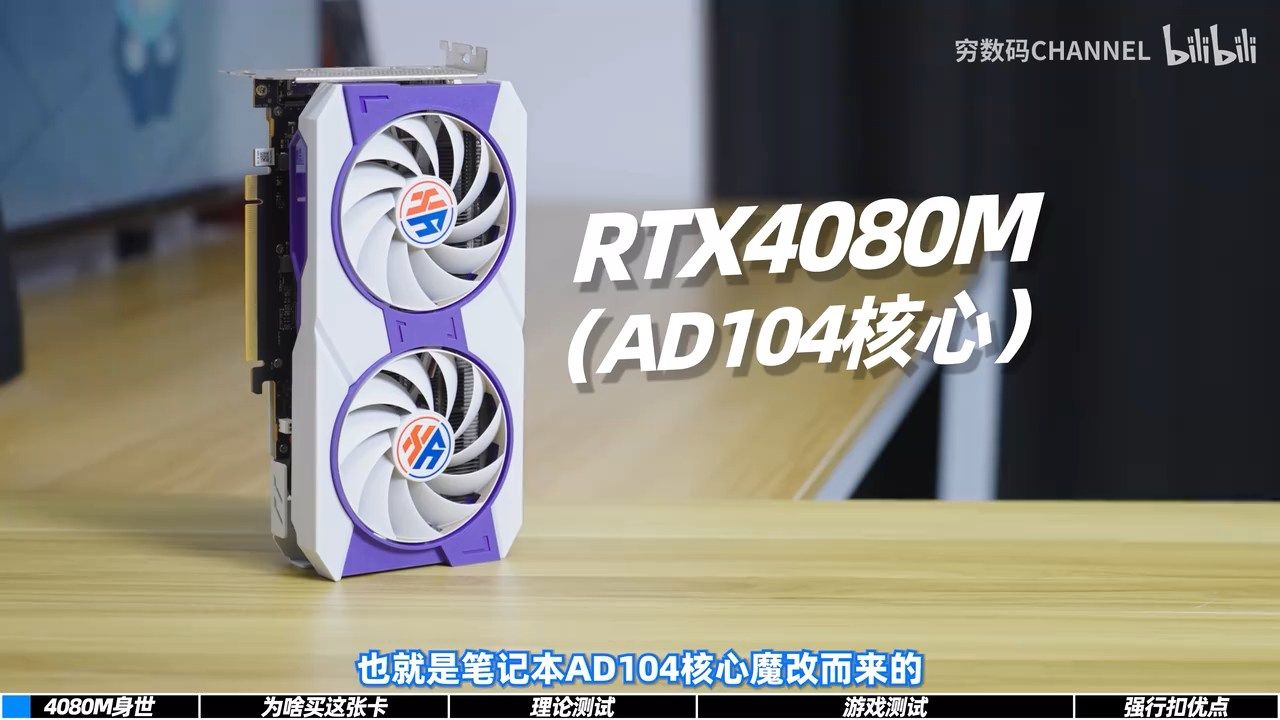
The Enthusiast's Frankenstein GPU: RTX 4080M Desktop Edition
In the relentless pursuit of PC performance, enthusiasts often push hardware to its limits, sometimes beyond. The latest example comes from a Chinese reviewer who has managed to construct a functional desktop graphics card using silicon salvaged from a mobile RTX 4080 laptop GPU. This custom-built card, dubbed the 'RTX 4080M Desktop Edition,' presents a fascinating case study in repurposing high-end mobile components for a desktop form factor. However, performance benchmarks reveal that this Frankenstein GPU, while impressive in its engineering, falls short of its similarly priced desktop counterparts.
The core of this project lies in adapting the smaller, power-constrained mobile GPU to a standard desktop PCIe interface. This typically involves significant modification, including the addition of a robust power delivery system, a custom cooler, and potentially BIOS modifications to unlock higher clock speeds or power limits than the original laptop design allowed. The goal is often to achieve performance closer to a native desktop card, but with the inherent efficiency advantages of mobile silicon.
The reviewer's findings, however, paint a different picture. While the card successfully boots and runs games, its performance is consistently lower than expected, even when compared to GPUs in a similar price bracket. Specifically, when pitted against the AMD Radeon RX 7070 GRE, a card that is only slightly more expensive, the custom RTX 4080M desktop card loses in nearly every gaming benchmark. The sole exception noted was PlayerUnknown's Battlegrounds (PUBG), where it managed to eke out a win, but this was not enough to redeem its overall performance deficit.
Performance Deficit and Efficiency Trade-offs
The comparison to the RX 7070 GRE is particularly telling. The RX 7070 GRE, a mainstream desktop GPU, offers a superior gaming experience across a range of titles despite its slightly higher cost. The custom RTX 4080M, built from what was once a flagship mobile chip, struggles to keep pace. This suggests that even with desktop-level cooling and power, the fundamental architectural limitations and binning of mobile silicon, designed for lower power envelopes, cannot be entirely overcome to match native desktop performance at this tier.
The primary selling point for this custom card appears to be its power efficiency. The reviewer reports that the card draws only 100W during gaming sessions. This is a remarkably low figure for a card aiming to compete in the performance tier of an RTX 4080. For context, a standard desktop RTX 4080 can consume upwards of 320W, and even the RX 7070 GRE typically operates in the 200-220W range. This exceptional efficiency is a direct benefit of using mobile silicon, which is engineered from the ground up for thermal and power constraints.
However, this efficiency comes at a steep performance cost. The 100W draw, while impressive from an engineering standpoint, translates directly into lower frame rates. The fact that a card derived from RTX 4080 mobile silicon, potentially pushed with custom cooling and power, cannot outperform a more affordable, mainstream desktop card like the RX 7070 GRE highlights the significant performance gap between mobile and desktop architectures, even at the high end. It’s akin to taking a finely tuned sports car engine designed for a lightweight track car and trying to shoehorn it into a heavy sedan; while it might run, it won't outpace a purpose-built V8 sedan.
Market Context and Cost Analysis
Currently, this custom RTX 4080M desktop card is priced at approximately $400 in China. This price point places it directly in competition with cards like the RX 7070 GRE and potentially lower-tier RTX 40 series desktop cards. While $400 is a compelling price for a card bearing the RTX 4080 designation, the performance benchmarks do not justify the premium over other options in that price range, especially when the RX 7070 GRE offers a better gaming experience.
The enthusiast market has a long history of pushing hardware boundaries. Projects like this demonstrate incredible technical skill and dedication. However, for the average consumer or even a performance-conscious gamer, the value proposition is questionable. The performance deficit against the RX 7070 GRE, despite the latter being a mainstream desktop part, suggests that the engineering effort and the cost of salvaged mobile silicon do not translate into a competitive product in terms of raw gaming power. The appeal remains niche: for users who prioritize extreme power efficiency above all else, and who possess the technical acumen to source and assemble such a custom solution.
This experiment also raises questions about the future of repurposed mobile silicon in the desktop space. While this particular build falls short, it demonstrates that with sufficient engineering, mobile GPUs can be adapted for desktop use. The key challenge remains bridging the performance gap without compromising the efficiency advantage that makes mobile silicon attractive in the first place. For now, builders seeking the best performance per dollar or per watt in the $400 range will likely find more conventional desktop GPUs to be a more sensible choice.